Bankroll for Live Tournaments
How big a bankroll live tournaments really need: why field size drives variance, buy-in counts by player type, and a worked ROI-and-cushion example.
On this page · 6 sections
Live tournaments are the highest-variance format most players will ever touch. You can play a technically perfect week and cash zero times, because the payout structure rewards a tiny slice of the field and buries the rest. That reality — not your skill — is what sets your bankroll requirement. A live tournament roll has to be deep enough that a completely normal cold stretch does not end your career.
Why tournaments need so many buy-ins
In a cash game, every good decision converts to expected value on the spot, and a losing session rarely costs more than a buy-in or two. Tournaments are different. Only the top 10-15% of a field cashes, and the payouts are steeply top-heavy: the winner might take 20% of the prize pool while a min-cash barely returns your entry. That means most of your lifetime profit comes from a handful of deep runs, and everything in between is a slow bleed of buy-ins.
The statistical consequence is brutal downswings. Even a strong tournament player with a healthy ROI can go 30, 50, or 100 buy-ins without a meaningful score. That is not running bad — that is the format working as designed. Your bankroll’s only job is to keep you seated through those dry spells so your edge has time to pay off. This is the same logic behind tournament bankroll requirements, amplified by the larger fields and slower schedules of live poker.
Buy-in counts by player type
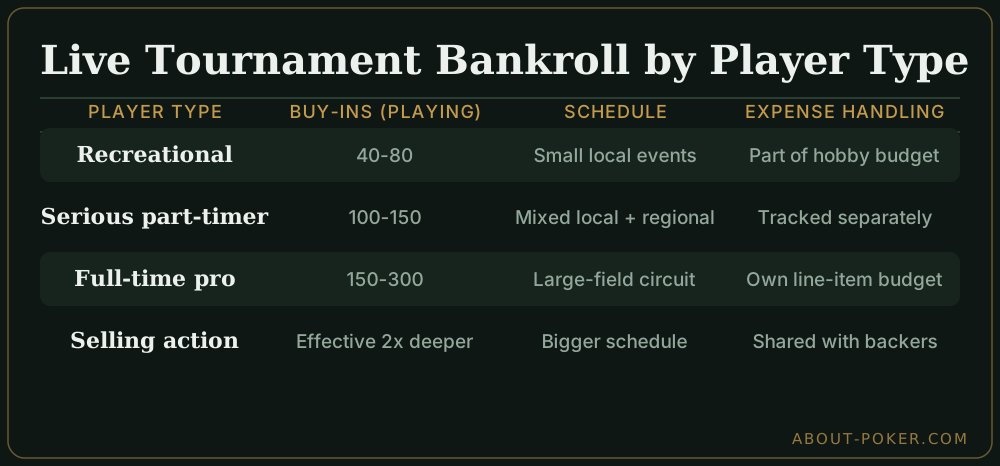
There is no single right number, but the ranges below reflect how much dry-spell risk each type of player can stomach. Whatever you choose, remember these are buy-ins of playing money, entirely separate from travel and living costs.
The heavier your schedule of large-field events, the deeper you need to be. A player who only fires small local $100 tournaments can run leaner than someone chasing $1,000+ events with 1,000-runner fields, simply because the big fields cash less often and swing harder.
Worked example: ROI meets cushion
Suppose you play $200 live tournaments and have a genuine 25% ROI — strong for live MTTs. That means over a long sample you expect to profit $50 per $200 entry. Sounds comfortable, until you look at the distribution. Your ROI is a long-run average, not a monthly paycheck.
Model a realistic year: 200 tournaments at $200 each is $40,000 in entries. At 25% ROI your expected profit is $10,000. But the variance around that number is enormous — a plausible bad year lands you down several thousand dollars, and a plausible good year triples the target, all with the same skill. To survive the down year without going broke, you need a roll that absorbs a 40-to-60-buy-in trough. On $200 events that is $8,000 to $12,000 in playing bankroll alone. Now add travel: even $3,000 in flights and hotels across the year is 15 extra buy-ins you must earn back before you are even. Suddenly the “comfortable” 25% ROI needs a $15,000+ war chest to play safely.
How to shrink the variance without shrinking the schedule
You do not have to accept the full swing. The most common tool is selling tournament action: you sell a percentage of yourself, often at a markup, so investors share both the risk and the reward. If you sell half your action, your swings roughly halve, and you can play a bigger schedule on the same personal roll. Percentage swaps with trusted players do the same thing informally. The trade-off is real — you keep less of your big scores — but for many grinders, steadier variance is worth more than raw upside.
Common mistakes live tournament players make
- Rolling for tournaments like they are cash games. A 30-buy-in cash roll is fine; a 30-buy-in tournament roll is a coin flip on going broke.
- Blending expenses into the playing bankroll. Travel, hotel, and food are not buy-ins. Track them separately or a losing trip drains two budgets at once.
- Moving up after one score. A single final table does not prove your ROI. Let volume, not a heater, decide your stakes.
- Ignoring reentry costs. Multi-flight and reentry events can quietly cost three or four buy-ins in a single tournament. Count the total you are willing to fire, not the single entry.
A quick live tournament bankroll checklist
- Do I hold at least 100 buy-ins of playing money for my target stake?
- Is my travel and expense budget tracked completely separately?
- Have I honestly measured my ROI over a large sample, not a lucky month?
- Would selling action let me play a fuller schedule with safer swings?
- Can I stay calm through a 50-buy-in dry spell without moving up to force a score?
Live tournaments pay the patient. Build the roll to survive the droughts, and the scores will come.
Frequently asked
How many buy-ins do I need for live tournaments?
Far more than for cash. A conservative live MTT bankroll is 100+ buy-ins because field sizes are large and cashes are infrequent. Recreational players who accept dry spells can get by on less, but full-time tournament pros commonly hold 100 to 300 buy-ins.
Why do tournaments need more buy-ins than cash games?
In a tournament you can play flawlessly and still finish out of the money most of the time, since only the top 10-15% cash and the real money sits at the final table. That top-heavy payout structure creates enormous variance that a cash game never sees.
Does buying a smaller share of many tournaments help?
Yes. Selling action or swapping percentages spreads your results across more events, which smooths variance and lets you play a bigger schedule on the same roll. It lowers your swings at the cost of some upside.
How does travel and expense factor into a live tournament bankroll?
Heavily. Live events add travel, hotel, and food costs that online play does not. Budget those separately from your playing bankroll so a road trip of buy-ins plus expenses does not quietly eat two rolls at once.