Bankroll Rules by Risk Tolerance
Bankroll rules by risk tolerance: conservative, moderate and aggressive buy-in counts explained, how to pick yours, and a worked risk-of-ruin example.
On this page · 6 sections
There is no single “correct” number of buy-ins — there’s a range, and where you sit in it is a function of your risk tolerance. Risk tolerance isn’t a personality quiz; it’s the honest answer to one question: what happens to your life if this bankroll busts? A student reloading from a part-time job can play thin. A parent paying a mortgage from poker cannot. Bankroll rules by risk tolerance simply put a number on that answer.
The three tiers
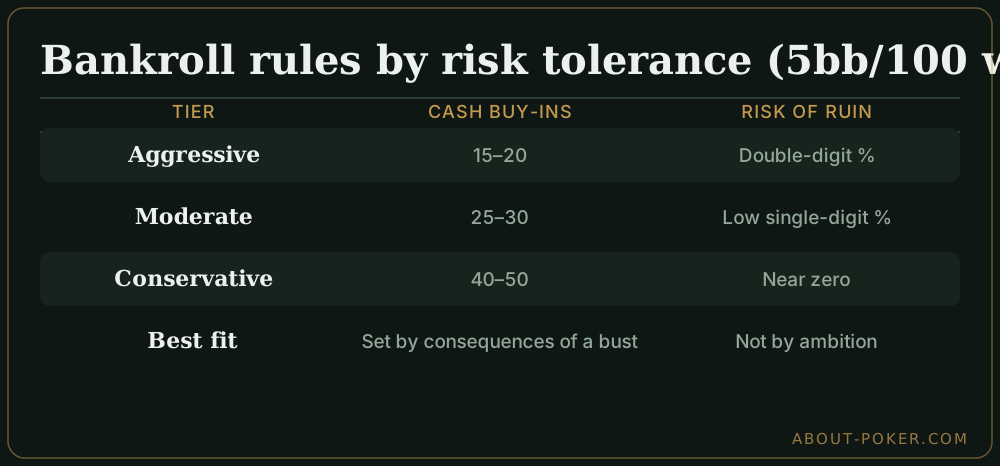
Think of bankroll rules as three columns — conservative, moderate, and aggressive — each expressed in buy-ins.
Conservative keeps 40–50 buy-ins for cash games (and roughly 250+ for tournaments). This all but eliminates risk of ruin for a winning player and is the right choice for anyone whose living depends on the roll.
Moderate keeps 25–30 buy-ins for cash (100–150 for tournaments). This is the standard recommendation for most serious players — deep enough to survive normal variance, shallow enough to progress at a reasonable pace.
Aggressive keeps 15–20 buy-ins for cash (roughly 75–100 for tournaments). This is only defensible for recreational players who can reload easily and move down instantly, treating poker as a hobby with an external safety net.
Our overview on how much bankroll for poker covers the baseline; this page is about choosing your column.
What actually determines your tolerance
Three factors decide it. Reload ability: can you top up the roll from outside income without pain? Dependence: is poker your income, or extra money? Move-down discipline: will you actually drop stakes when the rules say to? A player who can reload freely, doesn’t need the money, and moves down without ego can survive aggressive rules. Remove any one of those and you belong a column to the left.
A worked risk-of-ruin example
Risk of ruin depends on win rate, variance, and buy-in count. Take a player with a solid 5bb/100 win rate and typical cash-game standard deviation around 90bb/100.
At 15 buy-ins (aggressive), that player’s risk of ruin is meaningful — comfortably in the double digits as a percentage. Real chance of busting even while being a genuine winner.
At 30 buy-ins (moderate), the same player’s risk of ruin drops dramatically, into the low single digits.
At 50 buy-ins (conservative), it approaches zero — you’d essentially have to run below your true win rate for an implausibly long time to bust.
Notice the win rate and skill are identical in all three cases. The only thing that changed is how many buy-ins stand between you and zero. That’s the entire point: risk tolerance is you choosing an acceptable bust probability, and the buy-in count is the dial.
Matching the tier to real people
- Recreational player, full-time job: aggressive is fine. Losing the roll is annoying, not life-changing, and you can rebuild from salary.
- Semi-pro building toward full-time: moderate. You’re relying on poker partly, so you need real cushion but still want to grow.
- Full-time pro, dependents: conservative, plus a separate living-expense fund as covered in our professional bankroll guide. Here a bust is a genuine crisis.
Common mistakes
- Picking a column based on ambition, not consequences. “I’m aggressive” is a feeling; the correct column is set by what a bust would cost you.
- Choosing aggressive rules with no reload ability. Thin rules only work if you have a safety net. Without one, aggressive is just underrolled.
- Never re-evaluating. Your life changes — new job, new dependents, lost income — and your column should move with it.
- Confusing tolerance with discipline. You can only run aggressive rules if you actually move down; most people overestimate their discipline here.
Choosing your column: a checklist
- If poker busting would hurt my ability to pay bills, start conservative.
- If I can reload freely and it’s hobby money, aggressive is available.
- If I’m somewhere in between, moderate (25–30 cash buy-ins) is the safe default.
- Re-check the column whenever my income or responsibilities change.
Pick the column you can hold under a real downswing, not the one that sounds fearless. The bravest-looking rule is worthless if you abandon it the first time you’re down ten buy-ins.
Frequently asked
What's the right number of buy-ins for my risk tolerance?
For cash games, conservative players keep 40–50 buy-ins, moderate players 25–30, and aggressive players 15–20. Tournament players multiply roughly by four. Pick the column you can actually stick to under pressure, not the one that sounds brave.
Is an aggressive bankroll ever correct?
Yes, if you can reload freely, have income outside poker, and move down instantly. Aggressive rules let recreational players take shots cheaply. They're wrong for anyone relying on poker income, where a bust has real consequences.
How does risk tolerance connect to risk of ruin?
Fewer buy-ins means a higher mathematical risk of ruin for the same win rate and variance. Choosing a risk-tolerance level is really choosing an acceptable probability of busting — conservative rules push that probability toward zero.
Should my risk tolerance change over time?
Yes. Turning pro, adding dependents, or losing outside income should all push you toward the conservative column. A student with a side income can play aggressively; the same person supporting a family cannot.