Poker Expenses and Overhead
Poker expenses and overhead explained: rake, travel, tips, taxes and coaching, why your true win rate is net of costs, plus a worked monthly budget.
On this page · 6 sections
Most players track their winnings and ignore their costs, which is why so many “winning” players are quietly break-even. Your real result is gross winnings minus overhead, and overhead in poker is larger and more varied than beginners expect. Rake alone can eat an entire small edge; add travel, tips, taxes, and tools and the picture changes completely. If you want an honest win rate and ROI, you have to account for every dollar the game costs you.
The main categories of poker overhead
Rake and fees are the house’s cut — a percentage of each cash pot (often capped) or a fee on each tournament buy-in (the “+X” in a $100+$20 event). This is the cost that never sleeps: you pay it whether you win or lose the hand.
Tips are real money, especially live. Tipping the dealer on pots you win and the floor on jackpots adds up over thousands of hands.
Travel and accommodation apply to live players — flights, hotels, meals, and gas to reach games or a tournament series. A single week-long trip to a series can run into the thousands before you play a hand.
Tools and coaching — tracking software, solvers, training-site subscriptions, and coaching — are optional but common for serious players, and they’re a legitimate business cost.
Taxes apply wherever poker income is taxable. Ignoring tax during winning months is how pros end the year underrolled.
Why overhead quietly lowers your win rate
Your posted win rate at the table is a gross number. Overhead is subtracted from it. Suppose you win at 6bb/100 before costs, but rake and tips effectively cost you 2bb/100 — your true net win rate is 4bb/100. That’s a third of your edge gone, and it directly raises the bankroll you need, because a smaller net edge means variance dominates for longer. Every serious professional bankroll plan starts from net numbers, never gross.
A worked monthly budget
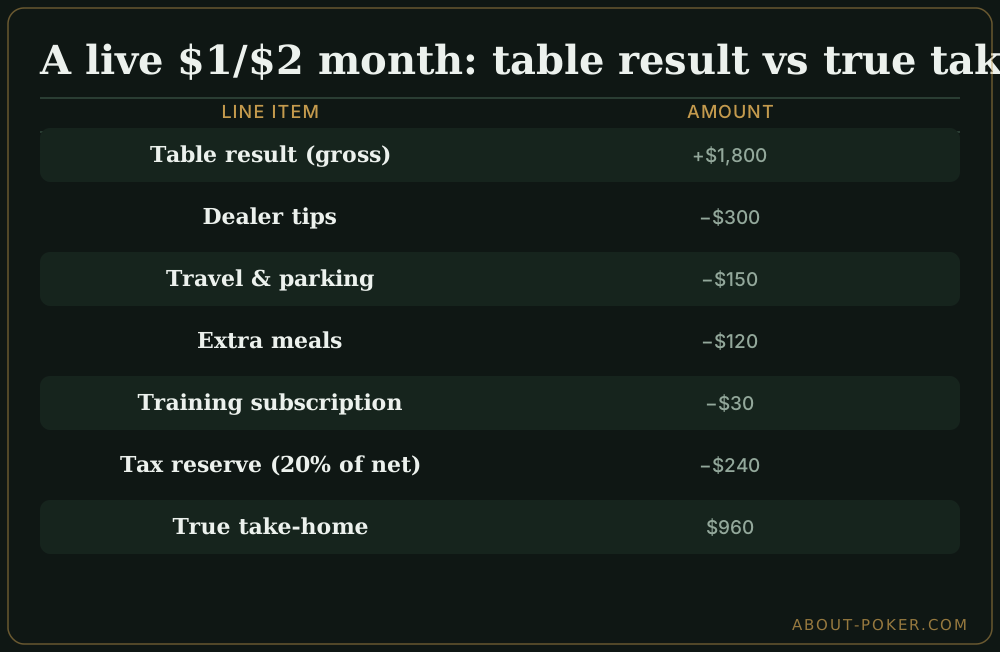
Take a live $1/$2 grinder playing 100 hours a month, winning $12/hour gross before considering costs is easy to overstate, so let’s build it properly. Say the raw table result is +$1,800 for the month. Now the overhead:
- Dealer tips: roughly $2 per winning pot; call it $300.
- Travel and parking to the room: $150.
- Meals bought at the casino above what you’d spend at home: $120.
- Training-site subscription: $30.
- Tax reserve (set aside 20% of net): applied after the above.
Costs before tax = $600, so pre-tax net = $1,800 − $600 = $1,200. Reserve 20% for tax = $240, leaving a true take-home of $960. The table said $1,800; the reality is $960 — nearly half. A player who budgets and withdraws from the $1,800 figure is drawing down their roll every single month without realizing it. Our guide on withdrawing poker profit covers how to pull money out without quietly decapitalizing yourself.
How overhead differs by format
- Online cash: low fixed overhead — mostly rake plus software. No travel or tips. This is why online win rates in bb/100 can look lower yet net out fine.
- Live cash: rake, tips, and travel dominate; the per-hour cost of showing up is real even before variance.
- Live tournaments: the highest overhead of all. Series travel, hotels, and food across many days, combined with brutal variance, mean the effective cost per event is far above the entry fee.
Common mistakes with poker expenses
- Tracking only buy-ins in and cashouts out. That hides rake and tips completely.
- Forgetting tax until April. Reserve it monthly or you’ll be underrolled exactly when you can least afford it.
- Treating a series trip as “just the buy-ins.” Travel and accommodation often exceed the entries.
- Ignoring rake when choosing a game. A softer game with brutal rake can be worse than a tougher game with a lower cut.
Overhead checklist
- Track rake and fees as a line item, not an invisible cost.
- Log tips separately — they’re real and they’re large live.
- Budget travel and accommodation per trip, in full.
- Reserve for tax every winning month.
- Report and plan from net win rate, never gross.
Do this and your bankroll numbers finally tell the truth — which is the only way to know if you’re actually winning.
Frequently asked
What counts as poker overhead?
Every recurring cost of playing: rake and tournament fees, dealer and staff tips, travel and accommodation, coaching and training sites, tracking software, and taxes. These come out of gross winnings before you have real profit.
Is rake really that big an expense?
Yes, especially at lower stakes. A capped $5–$6 per hand in live cash or 5% online can easily be your largest single expense, and at micro stakes it can exceed a marginal player's entire edge, turning a small winner into a loser.
Should I include taxes in my poker budget?
If poker is meaningful income, absolutely. Set aside a portion of net winnings for tax in every winning month so you're never caught short — treating tax as an afterthought is a classic way pros end up underrolled at year end.
How do expenses change my required bankroll?
Overhead lowers your effective win rate, which raises variance relative to your edge and therefore raises the buy-ins you need. High-overhead formats like live tournament travel demand a deeper roll than the raw buy-in count suggests.