Poker Staking Explained
Poker staking lets a backer fund a player in exchange for a cut of profits. Here's how deals, splits, and makeup work — and how to avoid a bad one.
On this page · 6 sections
Poker staking is a deal where one person (the backer or “horse owner”) funds another person (the player, or “horse”) to play, and the two split the results according to an agreed percentage. It exists because poker has a hard truth built into it: you can be a long-term winner and still go broke in the short run if your bankroll is too small for the variance of your game. Staking lets skill and money find each other.
At its simplest, staking separates the two things a poker session needs — money and edge — and lets each party supply what they have more of.
How a basic stake works
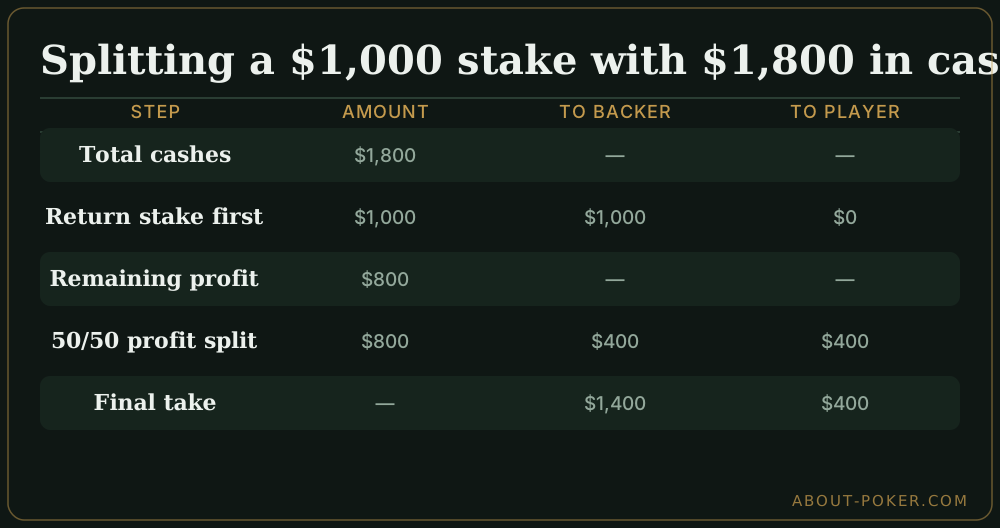
In a standard stake, the backer covers 100% of your buy-ins for an agreed set of games or a fixed time window. You play, and at the end of the deal you tally the net result. If you’re up, you first return the backer’s staked money, then split the remaining profit by the agreed percentage. If you’re down, that loss carries forward as makeup — a debt you clear out of future profit before you’re paid again.
You do not hand the backer cash when you lose. That’s the key protection staking gives the player: your personal downside is capped at zero, while your upside is a share of the wins. In exchange, the backer takes on all the financial variance — which is exactly why they demand a slice of your edge.
A quick worked example. Say a backer stakes you for ten $100 tournaments — $1,000 total — at a 50/50 split. You cash for $1,800 across the ten. First the $1,000 stake goes back to the backer. That leaves $800 profit, split evenly: $400 to you, $400 to the backer. If instead you’d busted all ten with no cashes, you’d owe nothing, but you’d carry $1,000 of makeup into your next batch with that backer.
The common splits and why they vary
The headline number in any deal is the profit split. The classic starting point is 50/50 after stake and makeup, but the real number tracks how much value each side brings:
- A proven winner with a big sample and a clear ROI can push for 60/40, 70/30, or better. The backer is buying a near-guaranteed edge, so they accept a thinner cut.
- An unproven or higher-variance player gets closer to 50/50 or worse, because the backer is pricing in uncertainty and makeup risk.
- Markup appears in tournament packages: you sell action at, say, 1.2 to 1, meaning a buyer pays $1.20 for every $1 of your equity. Markup rewards you for your edge up front instead of through the split.
Your negotiating power comes almost entirely from your documented results. This is why serious backed players obsess over tracking — see poker win rate and ROI for how those numbers are actually measured.
Staking vs. playing on your own roll
The trade in staking is always the same: you give up part of your win rate to shed variance and unlock bigger games. Whether that’s a good deal comes down to math you can estimate.
Suppose you’re a $1/$2 winner earning $8/hour on your own roll, but you can’t afford $2/$5 where you’d have a $16/hour edge. If a backer funds you at $2/$5 for 50% of profit, your take is roughly $8/hour — the same dollars, but now with none of your own money at risk and a shot at proving yourself at the higher stake. If the backing also lets you play more hours or move up faster, your total earnings can rise even after the split.
The opposite case matters too. If you’re already properly rolled for your best game, giving away half your profit to a backer is usually a bad trade. Staking is a tool for the under-rolled and the ambitious, not a default. Understanding your own risk of ruin tells you whether you actually need it.
Common mistakes that sink staking deals
Most staking blowups come from fuzzy terms, not bad luck. Watch for these:
- No written agreement. Verbal deals fall apart the moment a big swing hits. Put the split, the game selection, the makeup rules, and the exit terms in writing.
- Ignoring how makeup carries. If you’re deep in makeup and want to quit, some deals let you walk; others expect you to grind it off. Know this before you sign, not after.
- Game selection creep. A stake for $1/$2 cash is not a license to punt the $1,000 satellite. Staying inside the agreed games is a trust issue, and trust is the whole business.
- Overselling markup. Charge more than your true edge justifies and you’ll burn buyers who track their ROI. Repeat action is where the real money is.
Makeup: the part everyone underestimates
Makeup is where staking gets emotionally hard, because it’s the mechanism that makes a losing stretch feel like working for free. Every dollar you win goes to erasing debt, not to your pocket, until the slate is clean. In a deep downswing that can mean weeks of profitable play with zero take-home.
This is normal and mathematically fair — the backer ate those losses in real cash, so you earn nothing back until they’re whole. But it’s the number one reason staking relationships end badly, so it deserves its own deep read. We cover the mechanics in full in poker staking and backing.
A checklist before you accept a stake
Run through this before shaking hands on any backing deal:
- Is the split clearly defined, and does it reflect your proven edge?
- Are the exact games and stakes written down?
- How is makeup tracked, and does it reset if you leave?
- Who covers fees, rakeback, and staking-site charges?
- Is there a minimum volume or time commitment either way?
- Can either party exit, and on what terms mid-makeup?
- Do you actually need a stake, or are you giving away edge you could keep by managing your own roll?
Get those seven answered in writing and staking becomes what it should be: a clean way to trade variance for opportunity, not a source of resentment down the line.
Frequently asked
What is poker staking?
Poker staking is an arrangement where a backer puts up all or part of a player's buy-ins in exchange for a share of the profits. The player supplies the skill and time; the backer supplies the money and absorbs the downside if the player loses.
What is a typical staking split?
The most common split is 50/50 of profits after the stake is repaid, though strong, proven players often negotiate 60/40 or 70/30 in their favor. Splits vary by the player's edge, sample size, and how much makeup risk the backer is taking.
Do I have to pay back losses in a stake?
Not out of pocket in a standard stake. Losses become makeup — a running debt that must be cleared from future winnings before you split profits again. You never owe the backer cash directly, but you earn nothing until makeup is paid off.
Is poker staking worth it?
It can be if you have a real edge but not enough bankroll to play your best games with proper risk of ruin. You trade away part of your upside for lower variance and access to higher stakes, which often raises your total expected earnings.