Poker Variance and Standard Deviation
Variance is the swing around your true win rate; standard deviation measures its size. Here's how both work, typical bb/100 figures, and what they mean for.
On this page · 7 sections
Variance is the reason a winning poker player can lose for a month straight and a losing player can win for a week. It’s the swing of your actual results around your true, long-run win rate — driven entirely by the luck of which cards fall and how opponents play. Standard deviation is the number that measures how big those swings tend to be. Understand both and you stop mistaking bad luck for bad play, and you size your bankroll for reality instead of hope.
These two concepts sit under almost every bankroll decision you’ll ever make, so it’s worth getting them precisely right.
Variance vs. win rate: two different things
Your win rate is your expected profit per unit of play — in cash games, big blinds per 100 hands (bb/100). Your variance is how much any given stretch deviates from that expectation. They’re independent: a 5 bb/100 winner and a 5 bb/100 loser can have identical variance, and two players with the same win rate can have very different swings depending on their style.
The key mental shift is this: your win rate is what you earn on average over the long run, while variance is what you actually experience session to session. In the short term, variance dominates. Over a big enough sample, win rate wins out. Confusing the two is the root of most tilt and most bad bankroll decisions.
What standard deviation looks like in numbers
Standard deviation (SD) is quoted in bb/100, the same units as win rate, which makes the two easy to compare. Rough typical figures for no-limit hold’em cash:
- Full-ring (9-handed): about 60–80 bb/100 — tighter, fewer big multiway pots.
- 6-max: about 80–110 bb/100 — more aggression, more variance.
- PLO and loose games: 120 bb/100 or higher — huge multiway pots swing results violently.
Here’s what that means concretely. Suppose you’re a 6-max player with a true win rate of 5 bb/100 and an SD of 100 bb/100. Over any single 100-hand block, your result will typically land within one SD of your average — that is, roughly between −95 and +105 bb. Read that again: a genuine winner routinely loses close to a full buy-in over 100 hands, purely by chance. That’s not a leak; that’s variance doing exactly what it does.
How swings shrink over larger samples
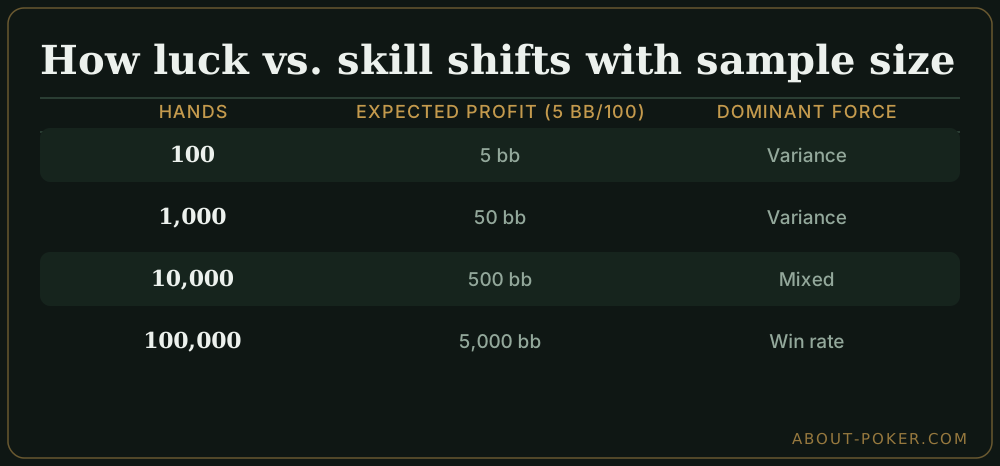
The comforting math is that variance averages out — but slowly, and not the way most people expect. Your total swing grows with the square root of the number of hands, while your expected profit grows linearly. So the ratio of luck to skill shrinks over time.
Practically: over 100 hands, variance utterly swamps your 5 bb/100 edge. Over 100,000 hands, your expected profit (5,000 bb) has grown far faster than the swing around it, and your results will sit much closer to your true win rate. This is why serious players judge themselves over tens of thousands of hands, never a session — and why a computed risk of ruin depends directly on the ratio of your win rate to your SD.
Why variance drives your bankroll
Everything about bankroll sizing flows from variance. A player with a thin edge and high SD needs far more buy-ins than a crusher in a low-variance game, even at the same stake. The relationship is baked into the risk-of-ruin formula, where a higher win rate lowers risk and a higher variance raises it.
A worked comparison: two players both win 3 bb/100, but Player A has an SD of 70 (full-ring) and Player B has an SD of 130 (loose PLO). Player B will endure downswings roughly twice as deep and long as Player A, and needs a substantially bigger roll to run the same risk of busting. Same edge, wildly different bankroll needs — because of variance alone. You can model your own figures with a poker variance calculator.
Variance and the mental game
The hardest part of variance isn’t the math — it’s the psychology of living through a downswing that the numbers say is completely normal. A 5 bb/100 winner can absolutely have a 20-buy-in losing stretch over 30,000 hands without playing a single hand badly. Believing that in the moment is what separates players who last from those who tilt off their rolls. We go deep on surviving those stretches in understanding poker downswings.
Common variance mistakes
- Judging your win rate over a session or a week — samples far too small to mean anything.
- Assuming a downswing means you’re playing badly when it’s within normal variance.
- Ignoring that your game choice sets your variance, then under-rolling for it.
- Chasing losses to “beat” variance, which only adds risk.
- Thinking a high win rate cancels variance — it eases the pain, but the swings are still there.
A variance checklist
Use this to keep variance in its place:
- Do I know my game’s typical standard deviation in bb/100?
- Am I judging results over a large enough sample (tens of thousands of hands)?
- Is my bankroll sized for my SD, not just my win rate?
- When I’m losing, am I checking for leaks versus assuming variance — and vice versa?
- Have I modeled my downswing risk so today’s swing doesn’t surprise me?
Master these and variance stops being a mysterious enemy. It becomes what it truly is: a predictable, measurable feature of the game — one you plan around with bankroll and patience rather than fighting hand by hand.
Frequently asked
What is variance in poker?
Variance is the natural swing of your results around your true win rate caused by luck. Even a strong long-term winner will have losing days, weeks, and sometimes months purely because of variance — it does not mean you are playing badly.
What is standard deviation in poker?
Standard deviation measures the size of your swings, expressed in big blinds per 100 hands (bb/100). A typical no-limit hold'em cash player has a standard deviation around 80–100 bb/100, meaning results in any 100-hand stretch commonly land within that range of the average.
What is a typical poker standard deviation?
For 6-max no-limit hold'em, standard deviation usually runs 80–110 bb/100. Full-ring is lower, around 60–80 bb/100, and looser or higher-variance games like PLO or heavy 3-bet pots run higher, often 120 bb/100 or more.
Does a higher win rate reduce variance?
No. Win rate and variance are separate. A higher win rate does not shrink your swings, but it does make downswings shallower and shorter relative to your winnings, which lowers your risk of ruin for a given bankroll.