Recovering a Busted Bankroll
Recovering a busted bankroll: the disciplined way to rebuild from zero, why you must drop stakes, and a step-by-step plan with real numbers and pitfalls.
On this page · 7 sections
Busting your bankroll feels like the end, but mechanically it’s just a starting line moved backward. Recovery is not about a heroic comeback session — it’s about rebuilding with tighter discipline than you had before, because the bust proved your old process had a hole in it. The players who recover treat it as a systems problem. The players who re-bust treat it as bad luck to be avenged.
Step 1: Stop, and diagnose the cause
Before you redeposit a cent, work out why you busted. There are only two real answers, and they need different fixes.
If you were properly rolled — 20+ buy-ins for cash, 100+ for tournaments — and moving down when required, then you ran into a genuine downswing and the process was fine. If, on the other hand, you were playing stakes your roll never justified, chasing losses, or refusing to move down, the bust was a discipline leak. Redepositing without fixing that leak just funds the same mistake a second time.
Step 2: Deposit only true risk capital
Rebuild with money you can genuinely afford to lose again. Do not borrow, do not use rent, do not use the emergency fund. The recovery deposit should be small enough that losing it again changes nothing about your life. This matters emotionally as much as financially: a right-sized deposit lets you play your best poker, and playing scared money is how good players turn a rebuild into a second bust.
Step 3: Drop to the correct rebuild stake
Take your deposit and find the lowest stake where it is at least 20 buy-ins (cash) or 100 buy-ins (tournaments). This is non-negotiable and it will feel painfully small. That’s the point — the stake has to be low enough that variance can’t bust you again while you regrind. Our bankroll building guide covers the grind-from-the-bottom mindset in more depth.
A worked example
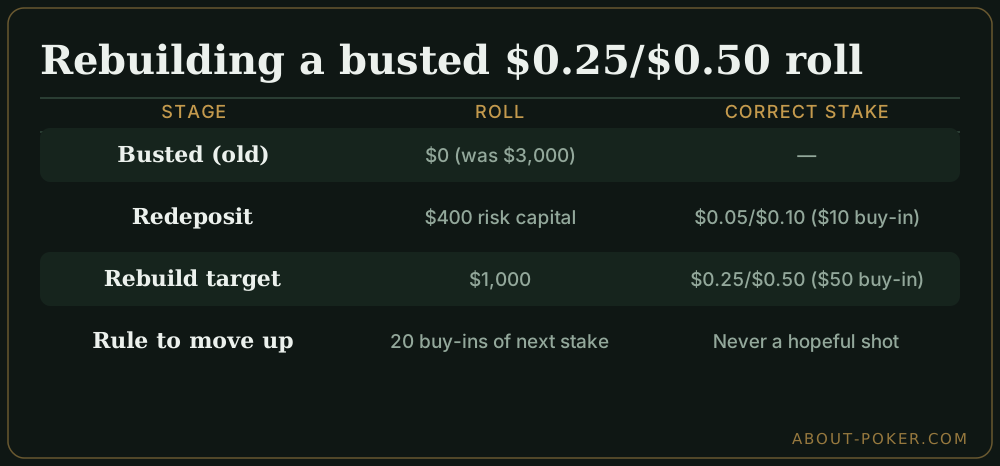
You had a $3,000 roll at $0.25/$0.50 online ($50 buy-ins, 60 buy-ins deep) and busted it over a bad two months. Diagnosis: you were actually fine on buy-ins but tilted into $1/$2 to “win it back,” which is a discipline leak.
Recovery plan: redeposit $400 — money you can lose again. At 20 buy-ins that qualifies you for $0.05/$0.10 ($10 buy-in), not the $0.25/$0.50 you used to play. It stings. But at $0.05/$0.10 a solid win rate of, say, 5bb/100 over decent volume steadily rebuilds the roll, and the rule is simple: you don’t touch $0.25/$0.50 again until your roll independently hits $1,000 (20 buy-ins of the $50 game). No shortcuts, no shots taken out of impatience.
Step 4: Only move up when the roll qualifies
The temptation during recovery is to jump stakes the moment you’re up, to “recover faster.” This is the exact behavior that caused most busts in the first place. Move up strictly by the numbers described in when to move up in stakes: the next stake requires its own full buy-in count before you play it, not a hopeful shot with a half-roll.
Common recovery mistakes
- Redepositing immediately, still on tilt. The bust hurts; wait until you’re calm. Emotional deposits are almost always oversized and mis-staked.
- Skipping the diagnosis. If you don’t name the leak, you fund it again.
- Playing the old stake with the new small roll. A $400 deposit at your former $50 game is 8 buy-ins — that’s not a bankroll, it’s a coin flip.
- Chasing volume without study. Rebuilding is a chance to plug the strategy leaks that the bust exposed; grinding blindly just recreates the loss.
Recovery checklist
- Stopped playing and identified whether the bust was variance or a leak.
- Fixed the named leak (staking rules, tilt control, or a strategy gap).
- Redeposited only money I can afford to lose again.
- Dropped to a stake where the deposit is 20+ buy-ins (cash) or 100+ (MTT).
- Committed to moving up only when the roll independently qualifies.
Rebuilds are slow by design. The slowness is the safety. A recovery that takes four disciplined months beats a “fast” one that ends in a third deposit — and by the end you’ll be a more disciplined player than the one who busted.
Frequently asked
What is the first thing to do after busting my bankroll?
Stop playing and separate the emotional loss from the strategic problem. Deposit only what you can afford to lose again, then drop to the lowest stake where that deposit is 20+ buy-ins. Rebuilding starts with proper bankroll rules, not a lucky session.
Should I move up fast to recover my losses quicker?
No. Chasing losses by jumping stakes is exactly what busts most rebuilds. Move up only when your new roll independently qualifies for the next level — recovery speed comes from a solid win rate at safe stakes, not from gambling bigger.
How long does it take to rebuild a poker bankroll?
It depends on your win rate, volume, and starting stake, but expect months, not days. A winning micro-stakes player putting in real volume can rebuild a modest roll steadily; the key is that the timeline is driven by discipline, not by one big score.
Was busting my bankroll a strategy leak or just variance?
Usually both. Review whether you were properly rolled and moving down when required — a bust despite good rules is variance, but a bust from playing over-rolled stakes or chasing is a discipline leak you must fix before redepositing.