Understanding Downswing Length
Understanding downswing length: how long and how deep normal poker downswings run, why win rate and variance drive it, and a worked example in buy-ins.
On this page · 6 sections
Downswing length is the single most misunderstood thing in poker bankroll management. Players imagine a bad run lasts a weekend; in reality, a genuine winner can run break-even or worse for tens of thousands of hands. Understanding how long and how deep normal downswings actually go is what stops you from quitting a winning game, moving up to “get unstuck,” or busting a roll that was never big enough for the swings you’d realistically face. This is the practical companion to our broader piece on poker downswings.
Downswings are longer than they feel
The reason downswings feel unbearable is that variance is invisible while it’s happening. You only see results, not your true win rate. Over a short sample, results are dominated by variance, not skill — so a winning player and a break-even player look identical over a few thousand hands. It takes a large sample for skill to separate from noise, and until then, a run of losses tells you almost nothing about whether you’re actually good.
What drives downswing length
Two numbers control it: your win rate and your standard deviation (variance). A big edge against low variance means short, shallow downswings. A small edge against high variance means long, deep ones. Cash standard deviation typically runs around 80–100bb/100; the smaller your win rate is relative to that spread, the longer you’ll spend underwater. You can explore the exact interplay with a variance calculator, which turns your win rate and standard deviation into expected swing sizes.
A worked example
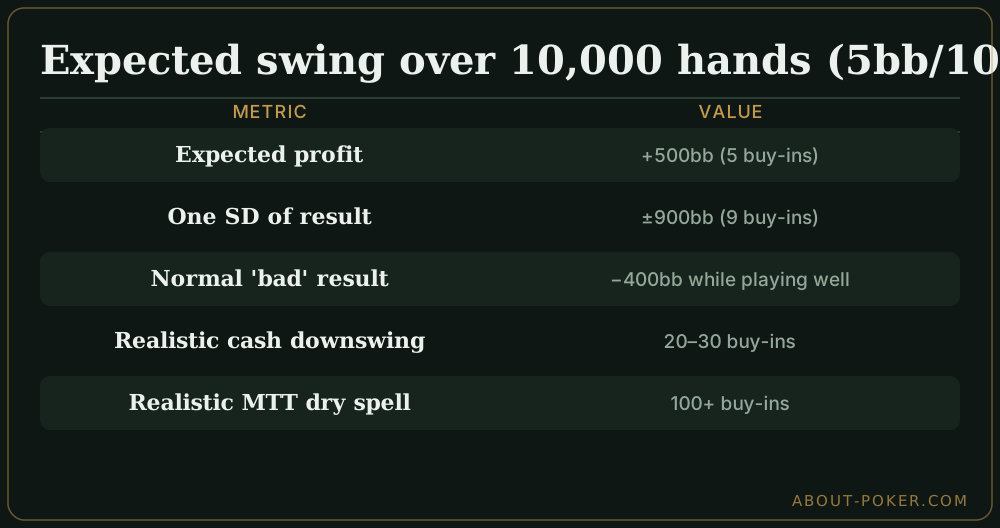
Consider a solid online player: 5bb/100 win rate, 90bb/100 standard deviation. Because standard deviation (90) is eighteen times the win rate (5), variance completely swamps the edge over short samples.
Over 10,000 hands, the expected profit is 5bb × 100 = 500bb, but the standard deviation of that result is 90 × sqrt(100) = 900bb. In plain terms: your average result is +500bb, but a one-standard-deviation swing is ±900bb. That means a result of −400bb over 10,000 hands is completely normal — inside one standard deviation of expectation. At 100bb per buy-in, −400bb is a 4 buy-in loss over ten thousand hands while playing well.
Stretch that out. Downswings of 20–30 buy-ins across a longer sample are entirely within the range of normal for this player. Nothing is broken; the math simply says winners spend real time losing. This is precisely why a 30+ buy-in bankroll withstands the run that a 15 buy-in roll would not.
Why tournaments are far worse
Tournament payout structures are top-heavy — most of your return comes from rare deep runs and wins. That makes downswing length brutal: a strong MTT player can go 100+ buy-ins without a significant cash and still be a long-term winner. This is why tournament bankroll requirements are measured in hundreds of buy-ins, not dozens. If you play MTTs and judge your ability by month-to-month results, you will conclude you’re bad during stretches when you’re actually running below a positive expectation.
How to survive a long downswing
- Keep playing your game. The downswing is not evidence to change a winning strategy. Review for real leaks, but don’t overhaul what works because of variance.
- Move down, never up. If the roll drops below your rules, drop stakes. Moving up to recover faster is how downswings become busts.
- Judge decisions, not results. Ask “did I play this well?” not “did it win?” Over a big sample, good decisions win; over a swing, they don’t have to.
- Trust your sample size. A win rate measured over hundreds of thousands of hands is real. A losing month is not a new win rate.
Downswing reality checklist
- Expect cash downswings of 20–30 buy-ins as normal, not catastrophic.
- Expect tournament dry spells of 100+ buy-ins.
- Size your roll for the swing you’ll realistically face, not the one you hope for.
- Measure your win rate over a large sample before drawing any conclusion.
- When underwater, move down and keep playing well — don’t chase.
The players who last aren’t the ones who avoid downswings; everyone gets them. They’re the ones who expected the length, sized their roll for it, and kept making good decisions while the graph pointed the wrong way.
Frequently asked
How long does a normal poker downswing last?
Longer than most players expect. A winning cash-game regular can run break-even or worse over tens of thousands of hands, and 20–30 buy-in downswings are entirely normal. In tournaments, dry stretches of 100+ buy-ins without a big cash happen to solid players.
What determines how long a downswing runs?
Your win rate relative to your variance. A small edge against high standard deviation produces long, deep downswings; a large edge shortens and shallows them. Volume matters too — the more hands you play, the more the extreme stretches average out.
Is a long downswing proof I'm a losing player?
Not by itself. Downswings this long occur even for genuine winners because of variance. Judge your game by decision quality over a large sample and by a properly measured win rate, not by the current swing.
How deep can a downswing go in buy-ins?
For cash, 20–30 buy-ins is normal and worse is possible; this is exactly why a 30+ buy-in roll is recommended. Tournament players should expect much deeper swings in buy-in terms because of the top-heavy payout structure.