Withdrawing Poker Profits
When and how to withdraw poker profits: a simple withdrawal rule that protects your roll, tax and record basics, and a worked cash-out plan.
On this page · 6 sections
Withdrawing poker profits is where discipline either pays off or unravels. A winning player who never takes money out is really just building an ever-bigger stack to eventually lose, while one who cashes out too aggressively keeps grinding under-rolled. The goal is a rule that lets you enjoy your winnings without ever threatening your ability to keep playing your stake. Set that rule once and withdrawals stop being an emotional decision.
The core withdrawal rule
The cleanest rule is simple: keep your bankroll at its target, and withdraw only the overflow. First decide your target roll for your stake — for example 30 buy-ins for a cash game, using the framework in how much bankroll for poker. Anything above that target is genuine profit you can safely remove. Anything below it, and every dollar you win rebuilds the roll before you touch it. This single principle prevents the two classic errors at once: hoarding winnings you could enjoy, and skimming money you actually need to play.
Two workable withdrawal methods
Beyond the overflow rule, two structured approaches work well:
- Threshold skimming. Set a ceiling (say 35 buy-ins). Whenever your roll crosses it, withdraw back down to your target (30 buy-ins). You only ever remove true surplus.
- Percentage of profit. Each month, withdraw a fixed share of your net profit — 30-50% is common — and reinvest the rest to grow the roll and fund future moves up.
Threshold skimming suits players happy at their current stake; percentage-of-profit suits players who want to keep climbing while still enjoying some winnings along the way.
A worked cash-out plan
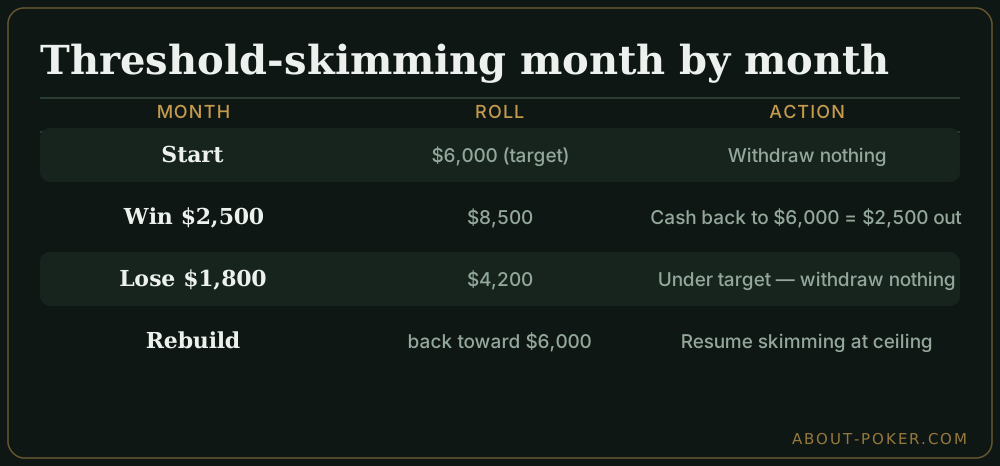
Suppose you play $1/$2 with a $6,000 target roll (30 buy-ins) and use threshold skimming with a $7,000 ceiling.
- Start of month: roll is $6,000, exactly on target — withdraw nothing.
- Good month: you win $2,500, roll hits $8,500.
- Ceiling is $7,000, so you withdraw down to your $6,000 target: a $2,500 withdrawal, roughly your whole profit, because you were already fully rolled.
- Next month you lose $1,800, roll drops to $4,200 — well under target, so you withdraw nothing and rebuild.
Notice the asymmetry that keeps you safe: you take profit only when comfortably over target, and you automatically stop withdrawing the moment variance pulls you below it. Over a year this smooths your income without ever leaving you under-rolled.
Tax and record-keeping
In many jurisdictions poker winnings are taxable whether or not you withdraw them, so cashing out is usually not the taxable event — earning the profit is. That makes clean records essential regardless of your withdrawal habits: log wins, losses, buy-ins, cash-outs, and dates. A tidy ledger also makes your own withdrawal rule easy to apply, because you always know your exact roll and target. Rules differ enormously by country, so treat this as a prompt to check local law, not as advice. The mechanics of moving money off sites safely are covered in the companion piece on withdrawing poker profit.
Withdrawals for professionals
For a professional, withdrawals are salary, and the stakes are higher. Pros keep personal and poker money in separate accounts, hold a larger roll than a recreational player at the same stake, and pay themselves a steady monthly amount rather than reacting to every upswing. The danger for a pro is withdrawing living expenses during a downswing and quietly slipping under-rolled; the defence is a bigger buffer and a fixed salary that lags a month or two behind results. The full framework for treating poker as income sits in professional poker bankroll.
Common withdrawal mistakes
The frequent errors are predictable: withdrawing after a big win when you were already under-rolled, treating the whole online balance as spendable money, and letting the roll balloon out of laziness so that a normal downswing feels catastrophic. Avoid all three by defining your target roll, choosing one withdrawal method, and following it mechanically. The discipline is not glamorous, but a player who withdraws by rule keeps both a healthy bankroll and the actual enjoyment of the money they have won — which is, after all, the point of winning it.
Frequently asked
When should I withdraw poker profits?
Withdraw only the amount above your target bankroll for your current stake. If your roll exceeds the buy-in count you need, the surplus is genuine profit you can safely take. If you are below target, everything you win goes back into the roll first.
How much of my winnings should I cash out?
A common rule is to keep your bankroll at its target and skim only the overflow, or to withdraw a fixed percentage of monthly profit (say 30-50%) while reinvesting the rest. Never withdraw money you would need to continue playing your stake.
Do I owe tax on poker withdrawals?
In many countries poker winnings are taxable income regardless of whether you withdraw them, so the withdrawal itself is not usually the taxable event. Rules vary widely by jurisdiction — keep records of wins, losses, and cash-outs and check local law rather than assuming.
Should professionals withdraw differently from recreational players?
Yes. Pros must withdraw enough to cover living expenses, so they typically hold a larger roll and pay themselves a steady 'salary' from profits, keeping personal and poker money strictly separate. Recreational players can be more flexible since poker is not their income.