Continuation Bet Bluffs
A c-bet bluff wins the pot when the flop misses your opponent more than you. Which boards to fire, which hands to pick, and the fold-equity math.
On this page · 8 sections
A continuation bet bluff is the workhorse of aggressive poker: as the preflop raiser, you fire the flop with a hand that has little showdown value, aiming to take the pot down before it develops. It works because ranges are asymmetric. When you raise preflop and one player calls, your range is packed with big cards and premium pairs, while the caller’s range is more capped. Most flops miss both of you — but your range represents the strong hands more credibly, so the caller folds often enough to make the bet print.
Why the c-bet bluff works
Think about a heads-up single-raised pot. The board comes with a high card like an ace or king. As the raiser, you have every Ax and Kx that flopped top pair, plus the overpairs. The caller who flatted preflop rarely has as many of those combos. When you bet, he has to fold all his air, all his low pairs that missed, and much of his weak pair holdings, because he can’t be sure you don’t have the top pair you’re representing. That credibility gap is the entire edge behind the continuation bet bluff.
The math is forgiving
Required fold percent = bet ÷ (bet + pot).
- One-third pot c-bet: 0.33 ÷ 1.33 ≈ 25 percent.
- Half-pot c-bet: 0.5 ÷ 1.5 ≈ 33 percent.
- Two-thirds pot c-bet: 0.67 ÷ 1.67 ≈ 40 percent.
A small c-bet only needs to work a quarter of the time. Since a typical caller misses the flop and folds far more than 25 percent of the time on dry boards, the bet is profitable on fold equity alone — and that’s before counting the times a pure bluff like a backdoor-draw hand rivers a winner.
Read the board texture
Board texture decides whether you should fire. Fire your c-bet bluffs on:
- Dry, high-card boards (A72 rainbow, K83 rainbow) that hit your range and miss the caller’s.
- Boards where you hold the top card as a blocker to the caller’s strongest pairs.
Slow down or check on:
- Low, connected, coordinated flops (654, 987 two-tone) that smash a flatting range.
- Middling boards (T98) where the caller’s suited connectors and mid pairs thrive.
A worked example
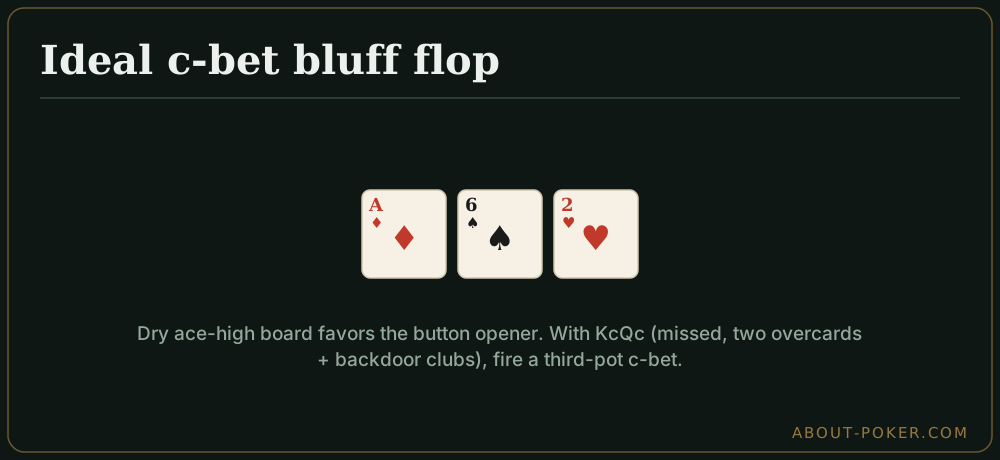
You open AJ offsuit from the cutoff, the big blind calls. Flop comes K 7 2 rainbow. You completely missed. Pot is $12; you bet $4 (one-third pot). That size only needs to work 25 percent of the time. The big blind’s calling range is full of small pairs, suited gappers, and broadway hands that whiffed this king-high rainbow board — he folds well over half of it. Even the times he calls with a pair or a floated king, you still hold the Ace and Jack as overcards to catch up sometimes. This is a textbook profitable c-bet bluff: dry board, capped opponent, cheap price, low fold requirement.
Picking the right bluffing hands
Not all missed hands make equal c-bet bluffs. The strongest choices carry backup:
- Backdoor flush and straight draws that can turn into real equity.
- Overcards to the board that beat a floated pair when they hit.
- Blocker hands that remove the caller’s best continues.
Pure air with no backdoors is the weakest bluff and the first hand you should check-fold or give up with. If a caller likes to float, mixing in the occasional check-back and then betting later — a delayed line related to floating — keeps you from being run over.
When to shut it down
The c-bet bluff loses value when you have no fold equity. Skip it multiway, where someone usually connected. Skip it against calling stations who never fold a pair — with those opponents, only bet for value or with a hand that can improve, as the broader when to bluff principles spell out. And skip it on boards that crush the caller’s range; there, checking to control the pot beats firing into a hand that isn’t folding.
Sizing your c-bet bluff
On dry, static boards you don’t need a large c-bet to fold out air, so a small size — a quarter to a third of the pot — accomplishes the goal cheaply while asking for only a 20 to 25 percent fold. On wetter boards where the caller has more draws and pairs to continue with, a bigger c-bet around two-thirds pot both charges those draws and folds out the weaker made hands. The key discipline is consistency: use the same size for your value c-bets that you use for your bluffs on a given texture. If you bet big only when you have it and small only when you’re bluffing, observant players read your hand off the sizing and neutralize the whole line.
C-bet bluff quick checklist
- Am I heads-up and in position, where fold equity is highest?
- Does this board hit my preflop raising range more than the caller’s?
- Does my hand carry a backdoor draw, an overcard, or a useful blocker?
- Is my size the smallest that still folds out the hands I’m targeting?
- Is my opponent capable of folding, or is he a station I should just check to?
Frequently asked
What is a continuation bet bluff?
It's a bet on the flop by the preflop raiser with a hand that has little or no showdown value, made to win the pot by folding out the caller. It leverages the fact that the raiser's range hits many flops harder than the caller's, so the caller often has to fold.
When should you c-bet as a bluff?
C-bet-bluff most on dry, high-card boards that connect with your preflop raising range and miss a flat-caller's range, and when you're heads-up and in position. Bet less often on wet, low, connected boards that favor the caller and in multiway pots.
How often should a c-bet bluff work to profit?
Required fold percent equals bet divided by (bet plus pot). A one-third pot c-bet needs to work about 25 percent of the time; a half-pot c-bet needs about 33 percent. Because those thresholds are low, small c-bet bluffs are often profitable even before you count the times you improve.
Should you c-bet bluff multiway?
Rarely. Each extra player makes it far more likely someone connected with the flop, so your fold equity collapses. Multiway, tighten your c-bet bluffs sharply and lean on hands with real equity like flush and straight draws.