Overbet Bluffs
An overbet bluff bets more than the pot to fold out bluff-catchers on polarized boards. When it works, which blockers to pick, and the fold-equity math.
On this page · 8 sections
An overbet bluff bets more than the pot — typically 1.25x to 2x — to put maximum pressure on an opponent’s bluff-catchers. It’s a specialist tool, not an everyday move. The large size asks a lot of your opponent, but it also asks a lot of you: overbets need to work far more often than standard bets, so they only belong in polarized spots where your range is credibly nutted or air and your opponent is stuck with mediocre hands he doesn’t want to stack off with.
Why overbet at all
The point of an overbet is leverage. A pot-sized bet asks your opponent to risk one pot to win two; an overbet asks him to risk more than the pot on a hand that’s rarely the nuts. On the right board, that pressure folds out hands a normal bet would keep — the second pairs, the weak top pairs, the bluff-catchers that would happily call for less. Overbetting is the purest expression of a polarized bluff sizing strategy: you’re not trying to get thin value or fold out air, you’re trying to make one-pair hands lay down.
The demanding math
Required fold percent = bet ÷ (bet + pot).
- 1.25x pot overbet: 1.25 ÷ 2.25 ≈ 56 percent.
- 1.5x pot overbet: 1.5 ÷ 2.5 = 60 percent.
- 2x pot overbet: 2 ÷ 3 ≈ 67 percent.
A 2x overbet must fold out two-thirds of your opponent’s range to break even as a pure bluff. That’s a steep requirement, which is exactly why overbet bluffs live only in spots where villain is heavily capped and you have blockers cutting into his calls.
Board and range conditions
Overbet bluffs need the right stage set. The conditions:
- Your range is polarized — you’d credibly hold sets, straights, or flushes here that your opponent cannot.
- His range is capped to one-pair bluff-catchers with no nutted combos.
- You hold blockers to the hands that would call the overbet.
- You’re heads-up; overbet bluffs are almost never right multiway.
If your range isn’t credibly nutted on this runout, an overbet represents nothing and a good opponent calls wider, not tighter.
A worked example
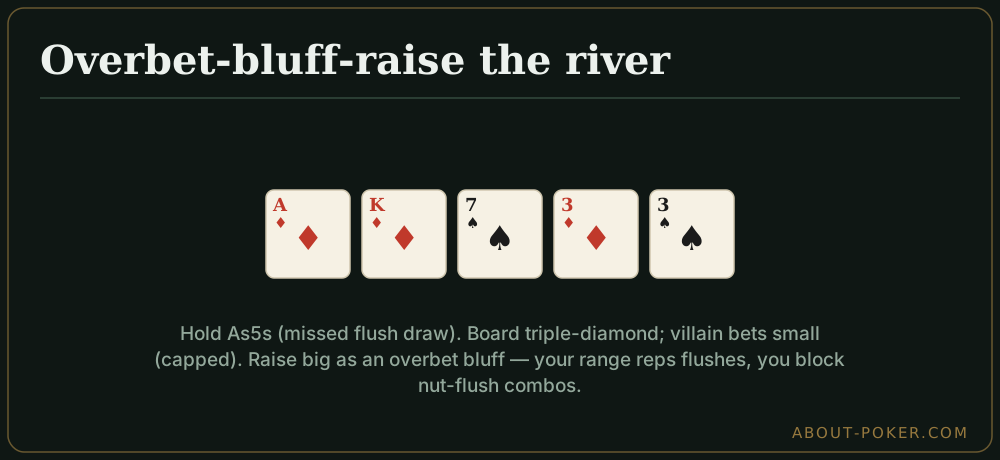
You raise As Ks preflop and the big blind calls. Board runs Ks 9d 4c, turn 2h, river 7s — you flopped top pair top kicker but let’s say you’d checked the turn and now, on a blank river, your line is capped for value. Consider instead a genuine bluff spot: you hold Qs Js on a river of Ah Th 5c 2d Kh. The board has three hearts and a broadway texture where you’d credibly have the nut flush and sets. You hold the Kh — blocking his king-high flushes and top pairs of kings. Your queen-jack made nothing. A 1.5x pot overbet needs a 60 percent fold; against his capped one-pair range, with the Kh removing a slice of his strongest calls, that pressure folds out enough Ax and Kx to profit. Without that blocker, the same overbet would be far too thin.
Choose blockers, not hope
The overbet bluff lives and dies on blocker value. Before you fire a huge bet, ask which of your opponent’s best calls your own cards make impossible. Holding the nut-flush card on a flushing board, or the top-pair blocker on a paired board, meaningfully cuts his continuing combos. An overbet bluff with a random air hand — no blockers, no story — is just donating chips at a bad price.
Balance and discipline
Because overbetting is so distinctive, opponents notice it fast. If you only ever overbet with the nuts, they fold everything and your value dries up; if you only overbet as a bluff, they call everything and your bluffs go broke. A credible overbet range mixes real value with bluffs at roughly the ratio the size demands — a 2x overbet supports about two value combos per bluff. Overbet bluffs also pair naturally with multi-street aggression: an overbet as the final shot of a triple barrel can be devastating when the whole runout tells a nutted story. Fire them rarely, fire them with blockers, and never fire them into a station.
Why range polarization matters most
The reason overbets work on some boards and fail on others comes down to whether your range is polarized. A polarized range is one made up of very strong hands and pure bluffs, with few mediocre hands in between — precisely the shape that wants a giant bet. If a board and betting line let you credibly hold sets, straights, and flushes alongside your busted draws, an overbet forces your opponent’s one-pair hands into a brutal guess. But if the runout means your range is mostly medium-strength hands, an overbet represents nothing you could plausibly have, and good opponents simply call wider or raise. Ask yourself before overbetting: on this exact runout, do I have enough nutted combos to back up this size? If not, size down.
Overbet bluff quick checklist
- Is my range polarized here, with credible nutted combos plus air?
- Is my opponent capped to one-pair bluff-catchers?
- Do I hold blockers that remove his best calls?
- Am I heads-up rather than multiway?
- Can this player actually fold a strong-ish hand to a huge bet?
- Do my value overbets on this board outnumber my bluffs at the right ratio?
Frequently asked
What is an overbet bluff?
It's a bluff that bets more than the size of the pot, usually 1.25x to 2x pot. The large size maximizes pressure on your opponent's bluff-catchers and needs to work more often than a normal bet, so it's reserved for polarized spots where your range is either nutted or air.
When should you overbet bluff?
Overbet-bluff on boards where your range is polarized and contains many nutted combos your opponent can't have, when he's capped to one-pair bluff-catchers, and when you hold blockers to his best calls. Avoid overbet bluffs against calling stations and on boards that favor his range.
How often does an overbet bluff need to work?
Required fold percent equals bet divided by (bet plus pot). A 1.5x pot overbet needs to work about 60 percent of the time; a 2x pot overbet needs about 67 percent. Because those thresholds are high, overbet bluffs demand strong reads and good blockers.
Do overbet bluffs need to be balanced with value?
Yes. If you only ever overbet with the nuts, opponents fold everything, and if you only overbet as a bluff, they call everything. A credible overbet range mixes nutted value hands with well-chosen bluffs at roughly the right ratio for the size.