Dealing With Variance Mentally
Variance is luck's grip on your short-term results. Learn to separate decisions from outcomes, size your emotions to the long run, and stay sane through swings.
On this page · 7 sections
Variance is luck’s grip on your short-term results — the reason you can play a hand perfectly and still lose, or play it badly and win. Dealing with variance mentally is about accepting that grip instead of fighting it, so that swings stop dictating your emotions and your play. You can’t reduce variance at the table; you can only change how you carry it in your head.
What variance is doing to you
Poker rewards good decisions only in the long run. Over a single session, a week, even tens of thousands of hands, luck can completely mask skill. A winning player can be stuck for a month; a losing player can crush for a weekend. This is not a flaw in the game — it’s the reason weaker players keep coming back, because variance lets them win often enough to feel skilled.
The mental problem is that human brains demand cause and effect. When effort and result stop lining up, it feels wrong — unfair, unstable, personal. That mismatch is the real engine behind tilt, self-doubt, and burnout. Understanding the mechanism is the first defense; variance explained covers the math, and this page covers how to live with it.
Separate the decision from the outcome
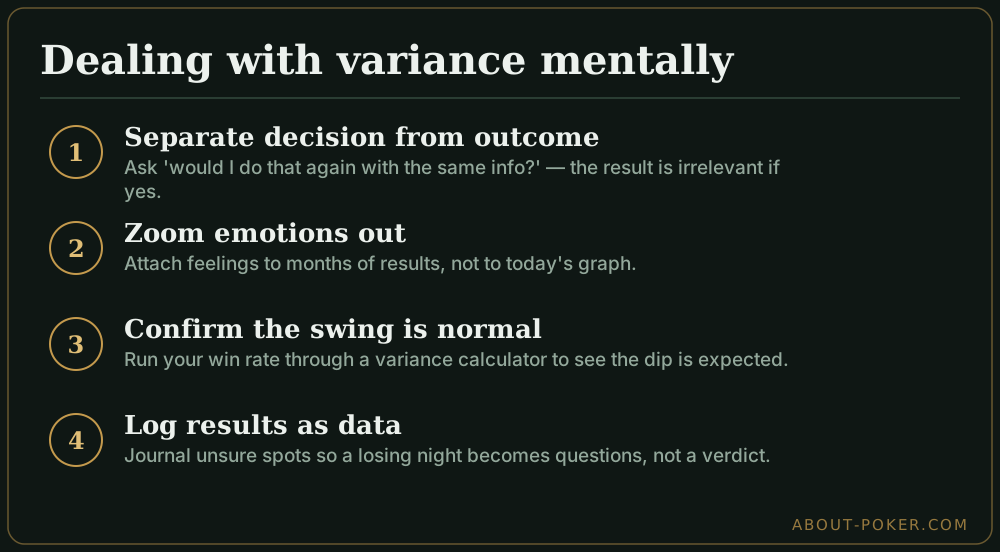
The single most important mental skill in poker is judging yourself on decisions, not results. You got it in with aces against a flush draw and lost — that’s a good decision with a bad outcome. You called down with bottom pair, hit a lucky two-pair on the river, and won — that’s a bad decision with a good outcome.
If you let outcomes grade your play, you’ll “learn” all the wrong lessons: punishing yourself for correct plays that lost and reinforcing spew that happened to win. Grade the process instead. Ask “would I make that decision again with the information I had?” If yes, the result is irrelevant. This is the mental habit that quietly separates winners from everyone else.
Size your emotions to the long run
Most players emotionally over-react to tiny samples. One losing session feels like proof you’ve lost your edge; one great night feels like you’ve leveled up. Both are noise. The fix is to consciously zoom out — attach your emotions to your results over months and hundreds of hours, not to today’s graph.
A concrete tool helps here: run your win rate through a variance calculator and look at how wide the realistic swings are. Seeing in black and white that a break-even stretch of 30,000 hands is normal for your win rate drains the panic out of it. What felt like a crisis is revealed as a routine dip inside a rising trend.
A worked example
You’re a 5bb/100 winner online — a genuinely good result. Over three weeks you’re stuck for 15 buy-ins and you feel like you’ve forgotten how to play. Every session you’re bracing for the next cooler.
You review the hands and your decisions are almost all sound — you’re getting it in ahead and losing, missing every draw, running your sets into higher sets. That’s the tell: this is variance, not a leak. You run the numbers and confirm that a downswing of this size is well within the normal range for your win rate over that many hands. Nothing is broken.
The mental shift is decisive. Instead of “I’m a losing player now,” the story becomes “I’m a winning player in a normal dip.” That reframe stops the doubt from bleeding into your decisions — which is exactly how a variance downswing turns into a skill downswing when you let it rattle you. For the tactical side of surviving these stretches, see dealing with downswings.
Turn results into data, not verdicts
The antidote to variance messing with your head is to make results informative instead of emotional. Keep a log — sessions, hands you weren’t sure about, spots you want to review. When you journal and review systematically, a losing session becomes a set of data points and questions rather than a referendum on your ability.
Over time this rewires how a bad night lands. Instead of “I lost, I’m bad,” it’s “I lost; here are two spots to check and the rest was variance.” The results still happen — you’ve just stripped out the part that used to spend your chips on the next session.
Common mistakes
- Results-oriented thinking: grading plays by whether they won. The deepest and most common leak.
- Sample-size blindness: treating a session or a week as meaningful evidence about your skill.
- Chasing: trying to end a downswing right now by moving up or playing longer — which invites tilt and turns bad luck into bad play.
- Refusing to review: assuming everything is variance so you never find real leaks hiding inside the swing.
A variance-mindset checklist
Grade decisions, not outcomes. Zoom your emotions out to months, not sessions. Use a variance calculator to see that your swings are normal. Log the hands you’re unsure about so results become data. Do these consistently and variance stops feeling like an enemy — it becomes the background weather you’ve learned to dress for. Return to the mental game hub for the full framework.
Frequently asked
How do I deal with variance mentally in poker?
Separate the decision from the outcome — judge yourself on whether you played the hand well, not on whether it won. Understand that swings are normal and expected, size your emotional reactions to the long run instead of one session, and track your play so results stop feeling random.
How long can a poker downswing last?
Longer than most players expect. Even solid winners can experience break-even or losing stretches spanning tens of thousands of hands purely from variance. A variance calculator can show how wide these swings realistically get for your win rate.
Why does variance mess with my head so much?
Because our brains crave cause and effect, and variance breaks it — you can play perfectly and lose, or badly and win. That mismatch between effort and result feels unfair and unstable, which is why it triggers tilt, doubt, and burnout more than any single bad beat.
Is tilt caused by variance?
Variance provides the triggers — the bad beats and losing runs — but tilt is your reaction to them. You can't remove variance, but you can change how you respond, which is why dealing with variance mentally is a learnable skill rather than a matter of luck.