Journaling Your Poker Sessions
A poker journal turns scattered sessions into a feedback loop. Learn what to log, a simple template, and how journaling exposes leaks tracking software misses.
On this page · 6 sections
Tracking software tells you what happened — winrate, all-in adjusted results, positional stats. It says nothing about why you played the way you did. A poker journal fills that gap. It’s the record of your mental state, your reasoning, and your mistakes, and over time it becomes the single best tool for catching leaks that live in your head rather than your stats. Journaling is boring, it takes two minutes, and it’s one of the highest-return habits in the game.
What a journal captures that your database can’t
Your tracker knows you called a river with second pair. It doesn’t know you called because you were on hour four with no dinner, annoyed at a needler two seats over, and secretly wanted to prove a point. That context is the actual leak. The bad river call is a symptom; the fatigue, the food, and the ego are the disease.
A journal is where you write down causes, not just outcomes. Patterns emerge fast: “I spew every time I’m stuck two buy-ins,” or “my worst sessions all start after a bad day at work.” Those are the insights that move a winrate, and they never appear in a graph. This is the same feedback loop covered in poker journaling and session review, applied deliberately to every session.
A simple session-journal template
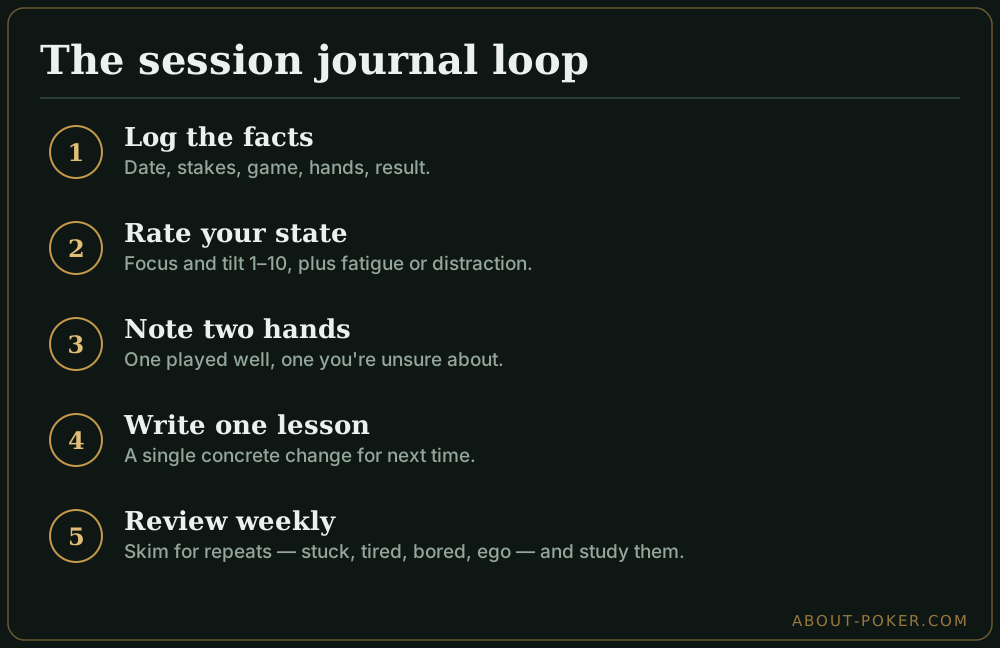
Keep it short enough that you’ll actually do it. Right after you stop playing, fill in:
- The facts — date, stakes, game type, hands or hours, result in big blinds or dollars.
- Mental state — how focused and how tilt-prone were you, 1 to 10? Any fatigue, alcohol, distraction?
- Two hands — one you played well, one you’re unsure about. Just the key decision, not a full history dump.
- One lesson — a single concrete thing to do differently next time.
That’s it. The four-line version beats the elaborate spreadsheet you abandon after a week. If you want to go deeper on a specific spot later, flag it and take it into your solver work as part of building a study routine.
A worked example
Here’s a real-shaped entry:
June 12 — 200NL zoom, 3 tables, 2h10m, −180 bb. Focus 6/10, tilt 8/10. Started stuck one buy-in in the first 20 minutes and never reset. Hand played well: folded top pair to a big turn+river line vs a nit, saved a stack. Hand unsure: 3-bet AJo from the button vs a UTG open, got 4-bet, called, missed, spewed off. Should’ve folded pre or 5-bet jammed as a bluff — the flat is the worst option. Lesson: no loose 3-bet flats out of position when I’m already stuck. That’s my tilt tell.
Notice the lesson isn’t “run better.” It names a specific spot and the mental trigger. Three weeks of entries like that and you’ll see “when stuck early” appear over and over — at which point you can build a rule around it.
Journaling as a tilt early-warning system
The mental-state score is the quietly powerful part. If you log a focus and tilt number every session, you build a baseline. When you notice you’ve rated yourself tilt 7-plus three sessions running, that’s a signal to take a day off or drop stakes before it costs you a buy-in — not after. Reviewing those numbers is far more actionable than trying to remember how you felt. It pairs naturally with the techniques in how to stop tilting.
Common journaling mistakes
- Only journaling after losses. You learn as much from a winning session where you played badly and got lucky. Log those too — the results hid the leak.
- Writing a novel. A long entry you skip is worthless. Short and consistent wins.
- Recording facts your tracker already has. Don’t re-type stats. Journal the why, the mindset, and the lessons.
- Never re-reading it. A journal you never revisit is a diary. Once a week or once a month, skim your entries and look for repeated words: “stuck,” “tired,” “bored,” “ego.” Those repeats are your real leak list.
Turning entries into a study queue
The final step is closing the loop. Each week, pull the “unsure hand” and the “lesson” from your entries into a short list. Those are your study priorities — the spots where you already know you’re guessing. Take them to a solver, a coach, or a study group. This is how a journal stops being a record and becomes an engine: it feeds your study with problems that actually come from your game, not generic theory. Combined with the habits on the mental game hub, it’s the difference between playing a lot of poker and actually improving at it.
Frequently asked
What should I write in a poker journal?
Log the objective facts (stakes, duration, result), then the parts software can't capture: your mental state, one or two tough hands, any tilt or fatigue, and a single concrete lesson. The mindset notes matter as much as the hands because they reveal the leaks a database never shows.
How often should I journal my poker sessions?
Every session, even briefly. A two-minute entry right after you stop is worth more than a detailed write-up you never do. Consistency is what turns a journal into a pattern-finding tool; sporadic entries just become a diary.
Does journaling actually improve poker results?
It improves them indirectly by closing the feedback loop. Journaling forces you to name your mistakes and mental-state triggers, and naming them is the first step to fixing them. It's especially powerful for catching tilt and fatigue patterns that tracking software can't see.