Recovering From a Downswing
A downswing ends, but recovery is a decision you make daily. A concrete plan to rebuild your bankroll, your game, and your confidence after a losing run.
On this page · 6 sections
A downswing ends on its own — variance always regresses eventually. But recovery is different. Recovery is what you do while you wait, and it decides whether you come out the far side sharper or shell-shocked. The goal of recovering from a downswing is not just to win your money back; it is to rebuild the bankroll, the game, and the confidence, in that order, without doing fresh damage along the way.
Recovery is two projects, not one
The mistake most players make is treating a downswing as a single problem: “I need to win money back.” That framing pushes you toward exactly the wrong moves — jumping stakes to recover faster, playing longer sessions, taking thin gambles. Split it instead. One project is your money (protect the bankroll, reduce risk of ruin). The other is your mind (kill tilt, restore focus, rebuild belief). These two projects sometimes pull in opposite directions, and when they do, the mind wins. A player with a healthy bankroll and a broken headspace will spew it all back; a calm player with a small roll can grind up from almost anything.
Step one: stop the bleeding
Before you can climb, the hole has to stop getting deeper. Move down in stakes — one level at least, two if the losses have shaken you. This does three things at once: it shrinks your risk of ruin, lowers the emotional stakes of each pot, and lets you win sessions again, which your brain badly needs. Cut your table count too. If you normally play six tables, drop to two. Multi-tabling on autopilot is fine when you are running well and thinking clearly; during recovery you want every decision to get full attention. For a deeper look at protecting the roll while you rebuild, see our bankroll management hub.
Step two: prove it was variance
You cannot rebuild confidence on a foundation you do not trust. So audit the downswing. Pull 15–20 of the biggest pots you lost and review them cold, away from the felt. Ask: given only what I knew at the time, was this the right decision? If your play holds up, you have proof it was variance — and that proof is the single most powerful confidence tool you own. If instead you find a repeated leak (calling too wide out of position, stacking off with one pair, spewing river bluffs), that is good news: leaks are fixable, and fixing one turns a losing stretch into a lesson. This diagnostic step is also central to dealing with downswings before they spiral.
A worked example
You are a 3bb/100 winner at NL200 who drops 22 buy-ins over 40,000 hands — a swing well inside normal variance for that win rate. Instead of firing up eight tables of NL200 to “get it back,” you drop to NL100 and two tables. At the same 3bb/100 you expect to earn 3 big blinds per 100 hands, so NL100 buy-ins come back at roughly one buy-in per 33,000 hands of expectation — slow, but steady. More importantly, at NL100 a 22-buy-in swing is a $2,200 problem instead of a $4,400 one, and each winning session there is direct, tangible evidence that your game is intact. After a few clean weeks you move back to NL200 calmer and sharper than the version of you that was tilting off stacks.
Guard against tilt-driven relapse
The dangerous moment in recovery is not the bottom of the downswing — it is the first day you feel better. That is when players jump back to their old stakes, chase, and reopen the wound. Keep your tilt defenses up until the recovery is boring. Set a stop-loss (say, three buy-ins) and honor it without negotiation. If you feel the old heat rising, take a hand off, breathe, and remember that the market of good spots is not going anywhere. Our guide on how to stop tilting covers the specific triggers to watch for.
The recovery checklist
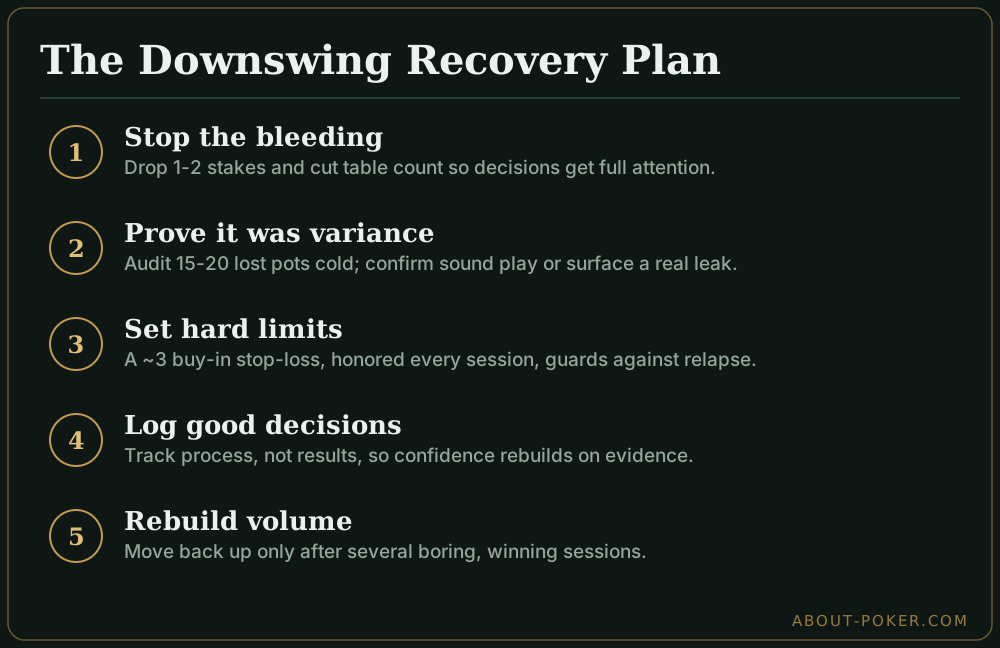
- Move down one or two stakes and cut your table count until decisions feel sharp again.
- Audit 15–20 lost pots to confirm variance and surface any real leak.
- Set a hard stop-loss (about three buy-ins) and honor it every session.
- Log the good decisions, not the results — build confidence on process evidence.
- Rebuild volume gradually; move back up only after several boring, winning sessions.
- Protect sleep and routine — a rested brain recovers faster than a stressed one.
Recovery is not a heroic comeback session. It is a series of small, disciplined choices that let variance do the boring work of regressing to your true win rate. Give it time and volume, and the graph turns.
Frequently asked
How do I recover from a big downswing?
Separate recovery into two projects: money and mind. Move down in stakes to protect the bankroll and lower pressure, cut your table count so decisions get sharper, and review hands to confirm the losses were variance rather than leaks. Rebuild volume slowly and let results catch up.
How long does it take to recover from a downswing?
There is no fixed timeline because recovery depends on your win rate and volume, not on the calendar. At a 3bb/100 win rate, climbing out of a 20-buy-in hole can take tens of thousands of hands. Focus on playing well and putting in volume rather than watching the graph.
Should I take a break after a downswing?
A short break helps if you are tilted, sleeping badly, or dreading sessions. But long breaks can let fear calcify. The better fix is usually smaller stakes and shorter sessions so you stay in rhythm while the pressure drops.
How do I get my confidence back after losing?
Confidence returns through evidence, not willpower. Win a few small sessions at a lower stake, log the good decisions you made, and let the wins accumulate. Confidence built on volume and sound play is far more durable than confidence built on a hot streak.