Setting a Stop-Loss
A stop-loss caps the damage a bad session can do. Learn how many buy-ins to set, why the emotion stop beats the money stop, and how to actually obey it.
On this page · 7 sections
A stop-loss is a limit you set in advance for how much you’ll lose in one session — and then quit when you hit it, no exceptions. Setting a stop-loss is the single most reliable guardrail in poker because it caps the damage on your worst days, when your judgment is least trustworthy. It’s not about playing scared; it’s about deciding your quit rule while you’re still calm enough to think.
Why a stop-loss works
A stop-loss does two jobs at once. First, it caps the financial bleed from a bad session — variance and tilt can only take so much before the door closes. Second, and less obvious, it removes a decision you’re bad at making in the moment: should I keep playing? When you’re stuck and emotional, that question has no good answer, because the part of your brain that should answer it is compromised. A pre-set rule answers it for you.
The deeper losses in poker almost never come from the initial bad beat. They come from what you do afterward — the wider calls, the tilt bluffs, the “get it back” mentality. A stop-loss slams the door before that second, self-inflicted wave of losses can build. It’s the enforcement mechanism behind how to stop tilting.
How many buy-ins?
There’s no universal number, but sensible defaults exist. For cash games, 2 to 3 buy-ins is a common stop-loss. The right figure balances two errors:
- Too tight (e.g. 1 buy-in) and you’ll quit good games constantly on normal variance, leaving value on the table.
- Too loose (e.g. 6+ buy-ins) and the stop-loss never actually protects you — you’re deep in the hole and probably tilted long before it fires.
Tournament players can’t use a buy-in stop mid-event, so their stop-loss is about re-entries: cap how many bullets you’ll fire in one day. The principle is identical — decide the ceiling before you’re chasing.
The three types of stop
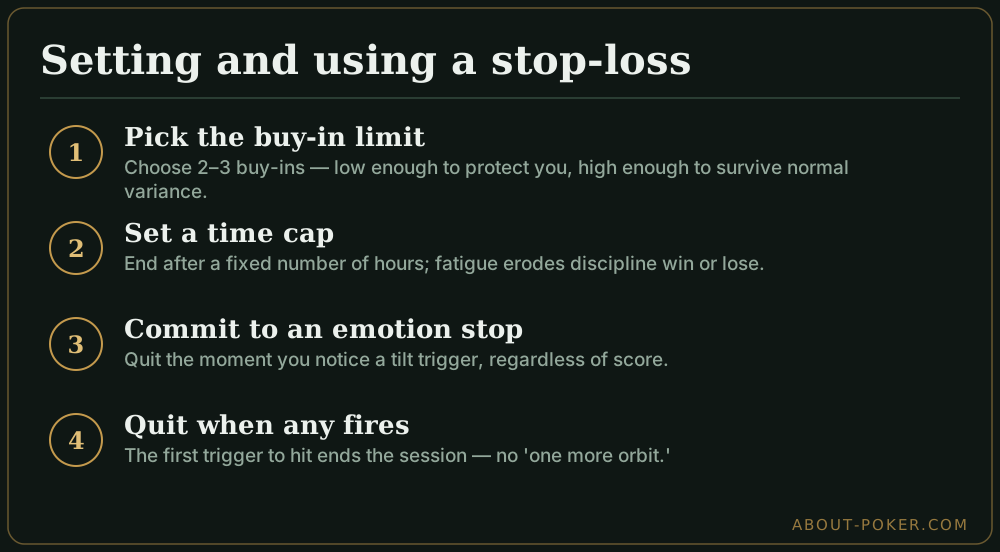
A complete stop-loss isn’t just a dollar figure. Layer three triggers, and quit when any of them fires:
- Buy-in stop: quit after losing your set number of buy-ins.
- Time stop: quit after a fixed number of hours, win or lose — fatigue kills discipline.
- Emotion stop: quit the moment you notice a tilt trigger, regardless of score.
The emotion stop is the strongest of the three. Money lost to variance is recoverable; a tilted hour is where bankrolls actually die. If you internalize only one, make it that one.
A worked example
You sit down in a $1/$2 cash game with a $200 buy-in and a pre-set 3-buy-in stop-loss ($600). Early on you lose a flip and a cooler — down $400, two buy-ins. It stings, but you’re calm, the game is soft, and neither trigger has fired, so you keep playing correctly.
Then you get it in with aces, lose to a runner-runner flush, and feel the heat rise — the urge to punish the guy who cracked you. That’s your emotion stop firing, even though you’re only down about $500, short of the money stop. You quit anyway. You go home down two and a half buy-ins on bad luck — and not down five buy-ins from the tilt spiral that was about to start. The stop-loss just saved you more than it “cost.”
The hard part: actually obeying it
Setting a stop-loss is easy. Honoring it when you’re stuck and the game is juicy is the real skill — this is pure discipline. A few tactics that make it stick:
- Write it down before you play, or say it out loud to a friend. A committed number is harder to renegotiate.
- Never move up stakes to “win it back.” That’s the exact opposite of a stop-loss and the fastest way to a disaster session.
- Treat “one more orbit” as a red flag, not a plan. If you’re bargaining with your own rule, you’ve already hit it emotionally.
The bankroll connection
A stop-loss and bankroll management are the same discipline at two time scales. Bankroll management protects you across your career; the stop-loss protects you across a single session. Both work by capping downside so that variance and tilt can never take a fatal bite. If your stakes are right-sized for your roll, hitting a stop-loss is an inconvenience, not a catastrophe — which is exactly why it’s easy to obey.
A stop-loss checklist
Before every session, set three numbers: your buy-in stop, your time cap, and your commitment to an emotion stop. During the session, quit the instant any one fires. Afterward, note whether you obeyed — the sessions where you didn’t are your most expensive lessons. For the full mental-game framework, head back to the hub.
Frequently asked
What is a stop-loss in poker?
A stop-loss is a pre-set limit on how much you'll lose in one session before you quit. It caps the damage a bad run or a tilt spiral can do, and it removes the exhausting in-the-moment decision of whether to keep playing.
How many buy-ins should my stop-loss be?
A common cash-game stop-loss is 2 to 3 buy-ins. The right number is personal — set it low enough that hitting it doesn't threaten your bankroll or your composure, and high enough that normal variance doesn't trip it every session.
Does a stop-loss cost me money by making me quit winnable games?
Rarely. The edge you lose by leaving a good game occasionally is far smaller than the losses a stop-loss prevents when you're tilted or the game has turned. The point is protecting against your worst state, not maximizing every session.
What's an emotion stop versus a money stop?
A money stop quits at a fixed loss; an emotion stop quits the moment you notice tilt, regardless of score. The emotion stop is stronger because most damage happens after you lose control, not after you lose a set dollar amount.