Sleep, Diet and Poker Performance
How sleep, food and hydration decide whether your last hour of poker plays like your first. A practical guide to fueling long sessions without crashing.
On this page · 6 sections
Poker is one of the few competitive activities where your body sits still for hours while your brain works flat out. That mismatch fools people into treating it like a purely mental game. It isn’t. Sleep, diet, and hydration set the ceiling on how well your brain can perform, and no amount of study fixes a decision-making engine that’s running on four hours of sleep and a sleeve of energy drinks. If your last hour at the table consistently plays worse than your first, the cause is usually physical, not strategic.
Why fatigue hits poker skill specifically
The skills poker rewards — working memory, impulse control, reading patterns, and staying patient through boredom — are exactly the ones that degrade first under fatigue. Sleep loss doesn’t make you dumber across the board; it strips out the prefrontal control that stops you from limping a marginal hand out of restlessness or calling a river you know is beat.
Research on sleep restriction is consistent: after a week of five to six hours a night, people perform on attention tasks as if they were legally drunk, yet they feel fine. That last part is the trap. A tired poker player rarely thinks “I’m too tired to play well.” They just start spewing and blame variance. Tilt and fatigue produce nearly identical leaks, which is why tired play and emotional play are worth treating as the same red flag.
A worked example: the last-hour leak
Say you play a four-hour online session, four tables, roughly 350 hands an hour. In the first hour you fold your junk, three-bet your value, and pass on thin river calls. By hour four you’re bored, your blood sugar has crashed from a big pasta dinner at the start, and you start calling down with second pair “to see it.”
If just three of those extra hero-calls cost you 40 big blinds each over the last hour, that’s 120 bb — at 2NL through 200NL, that single tired hour can erase a full session’s winrate. You didn’t get unlucky. You out-lasted your fuel. Fixing the food and the fatigue is a bigger winrate move than most strategy tweaks, and it’s covered further in sleep, health and fitness for poker.
Eating for a stable session
The goal during play is flat blood sugar, not maximum energy. A large carb-heavy meal spikes glucose, then crashes it an hour or two later — right when you need to stay sharp. Instead:
- Eat a moderate meal with protein, fat, and some complex carbs before you start.
- During the session, snack small and often: nuts, jerky, cheese, fruit, a light sandwich.
- Save the big indulgent meal for after you’ve stopped playing.
Protein and fat digest slowly and keep you level. Sugary snacks and soda feel great for twenty minutes and then leave you foggy and irritable — a physiological on-ramp to tilt.
Hydration and caffeine timing
Mild dehydration measurably reduces concentration and reaction time, and it’s easy to hit when you’re locked in and forgetting to drink. Keep water at the table and sip steadily; treat a full glass like part of your setup.
Caffeine is a real tool if you use it deliberately. A moderate dose early in a session sharpens focus. The mistake is stacking cups late into the night — the crash often lands mid-session, and the caffeine still in your system wrecks the sleep you need to recover for tomorrow. Cap your intake and stop several hours before bed.
Sleep is where the edge is actually built
Study and volume only convert into skill if your brain consolidates them, and consolidation happens during sleep. Chronically shorting sleep to grind more hours is a losing trade: you add low-quality volume and subtract the recovery that turns experience into intuition. If you have to choose between one more tired hour tonight and a full night’s sleep, the sleep is almost always more valuable.
This ties directly into focus and attention at the table — sustained focus is a resource that recharges overnight and drains during play. You can’t out-discipline a sleep deficit; you can only stop digging the hole.
A pre-session physical checklist
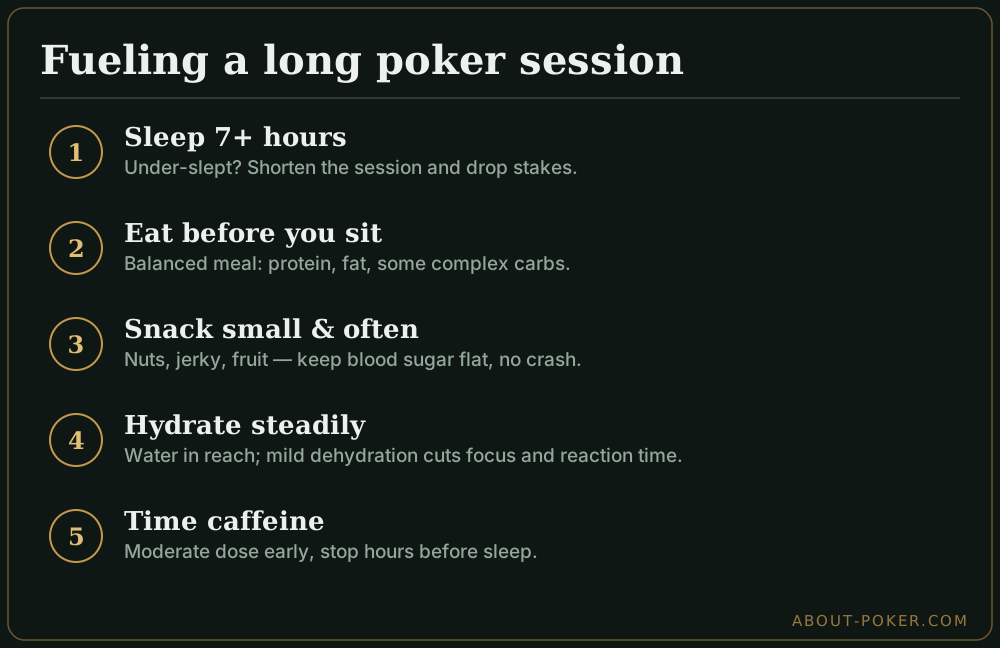
Before you sit down, run a quick body check the same way you’d check your bankroll:
- Sleep — did I get at least seven hours? If not, shorten the session and lower the stakes.
- Food — have I eaten a balanced meal in the last two hours, and do I have snacks ready?
- Water — is there a full glass or bottle within reach?
- Caffeine — is it timed so I won’t crash mid-session or ruin tonight’s sleep?
- Energy — on a scale of one to ten, am I above a six? Below that, this is a study day, not a grind day.
None of this is glamorous, and none of it shows up in a strategy video. But over thousands of hands, the player who fuels the machine beats the player who only tunes it. Treat your body as part of your poker game, because at the table, it already is. For more on the full picture, start with the mental game hub.
Frequently asked
Does sleep really affect poker results?
Yes, more than most players admit. Sleep deprivation degrades working memory, impulse control, and pattern recognition — the exact skills poker rewards. A player running on five hours makes the same category of loose, tilty errors as a player on a light downswing, but the cause is physical rather than emotional.
What should I eat during a long poker session?
Favor slow-digesting protein and fat with some complex carbs, and avoid a single heavy carb-heavy meal that spikes then crashes your blood sugar. Small, spaced snacks — nuts, jerky, fruit, a sandwich — keep energy stable. Save the big meal for after the session.
Is caffeine good or bad for poker?
Moderate caffeine early in a session can sharpen focus, but stacking cup after cup late at night wrecks the sleep you need to recover, and the crash often lands mid-session. Time it deliberately, cap it, and stop several hours before you plan to sleep.