The Poker Growth Mindset
A growth mindset treats every hand as data, not a verdict. How to separate results from decisions, learn from mistakes, and keep improving instead of stalling.
On this page · 6 sections
Two players lose the same big pot on a river card. The first thinks, “I always get unlucky, I’m just not a winner.” The second thinks, “Was my line sound? If so, this is variance; if not, I just found something to fix.” Same hand, opposite futures. That gap is the poker growth mindset — the belief that skill is built through effort and feedback rather than handed out at birth — and it is the single most important mental habit a developing player can install.
Fixed vs. growth, at the felt
Psychologist Carol Dweck’s distinction between a fixed and a growth mindset maps onto poker with unusual precision. A fixed mindset treats ability as a static trait: you are either a good player or you are not, and every loss is evidence against you. A growth mindset treats ability as trainable: every hand, win or lose, is data about your process. The fixed player avoids tough games because losing would threaten their self-image; the growth player seeks them out because tough games teach fastest. Over a career, the growth player’s willingness to be uncomfortable is what separates them. This is the foundation beneath building a winning poker mindset.
Separate the decision from the outcome
The core skill of a growth mindset in poker is decoupling the quality of a decision from the result of a hand. Poker is a game where you can do everything right and lose, and everything wrong and win — over a single hand, the cards decide, not your play. Only over the long run does skill dominate. So the growth player learns to ask one question after a hand: given what I knew at the time, was that the best decision? If yes, a loss is variance and you let it go. If no, you have found a lesson. Notice what this does — it makes both good and bad results useful instead of emotional. Our guide on poker journaling and session review is where this question becomes a routine.
A worked example
You get it in on the flop with a set of sevens against an opponent’s flush draw. You are roughly a 2-to-1 favorite — about 66% — and the flush comes on the river. A fixed mindset stews: “Why does this always happen to me?” A growth mindset checks the decision: getting stacks in as a 66% favorite is a clear, profitable spot, and you would take that gamble every single time. The result was bad; the decision was excellent. There is literally nothing to fix, so you file it as variance and move on with your confidence intact. Now flip it: you called a big river bet with a bluff-catcher and lost. On review you realize villain never bluffs that sizing. Different hand, different verdict — this one is a leak, and finding it is a win disguised as a loss.
Mistakes are inventory, not indictments
A growth mindset reframes mistakes from verdicts about you into inventory to work through. One misplayed hand is noise. The same misplay five times is a leak — and leaks are the most valuable thing you can find, because fixing one improves every future hand of that type. Keep a running list of recurring errors and you convert vague self-criticism (“I play badly when tired”) into concrete, solvable items (“I open too wide from early position in the last hour of a session”). The players who improve fastest are not the ones who make fewer mistakes; they are the ones who catalog their mistakes and grind through the list. This is also how you climb the ladder described in poker levels of thinking.
Effort and feedback, not talent
The final piece is trusting the loop: effort plus honest feedback produces growth, reliably, for almost everyone willing to do it. Talent shortens the runway but does not replace the work — plenty of naturally gifted players stall because a fixed mindset makes them defensive about feedback. The growth player, by contrast, actively wants to know what they got wrong, because each correction is progress. That hunger for feedback, more than raw ability, is what a growth mindset really is.
The growth-mindset checklist
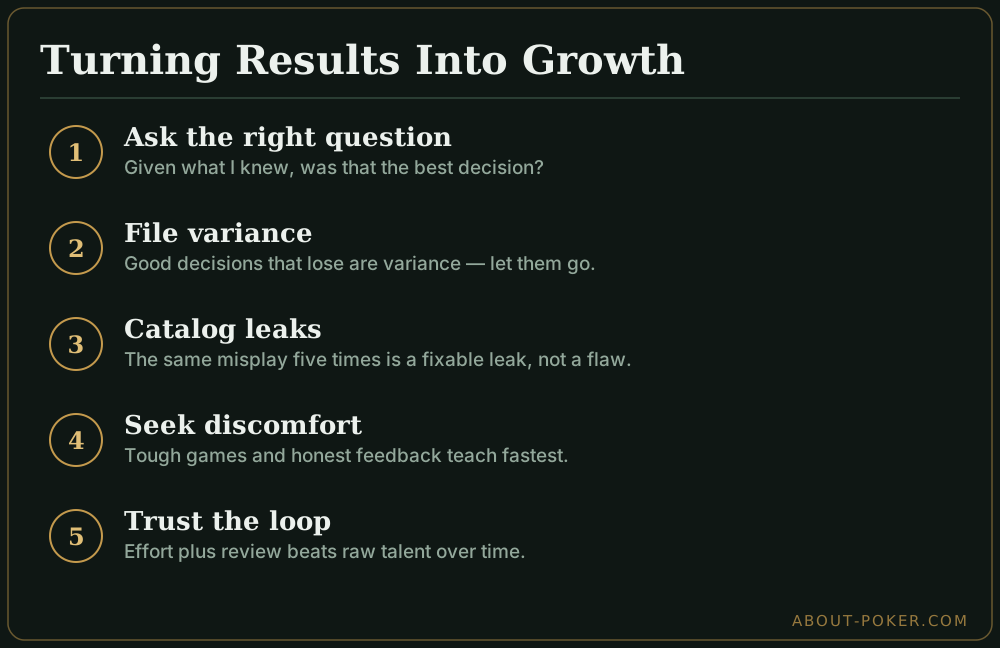
- Judge decisions, not outcomes — ask “was that the best choice given what I knew?”
- File good decisions that lose as variance; keep your confidence intact.
- Treat repeated mistakes as leaks, not character flaws — and fix them one by one.
- Seek tough games and honest feedback instead of protecting your self-image.
- Trust the loop: consistent effort plus review beats raw talent over time.
Adopt this frame and the emotional weather of poker changes. Losses stop being indictments and become information, and information is the only thing that ever made anyone a better player.
Frequently asked
What is a growth mindset in poker?
A growth mindset treats skill as something you build through effort and feedback, not a fixed talent you either have or don't. In poker it means seeing losses and mistakes as data that shows you where to improve, rather than as proof you are a bad player.
How do I stop taking bad results personally?
Judge decisions, not outcomes. A good decision that loses is still a good decision because poker pays off over the long run, not per hand. Reviewing whether your process was sound — separate from whether the hand won — trains you to stop tying your self-worth to the last card.
Why is mindset so important in poker?
Because poker gives noisy, delayed feedback: you can play well and lose for weeks. Without a growth mindset, that noise convinces players they are broken and pushes them into tilt or quitting. With one, the same stretch becomes a solvable puzzle.
How do I actually learn from my mistakes?
Write them down and look for patterns. One misplayed hand is noise; the same misplay five times is a leak. Reviewing flagged hands regularly turns scattered errors into a short, fixable list — which is what improvement actually looks like.