JJ vs AQ: Preflop Odds & Equity
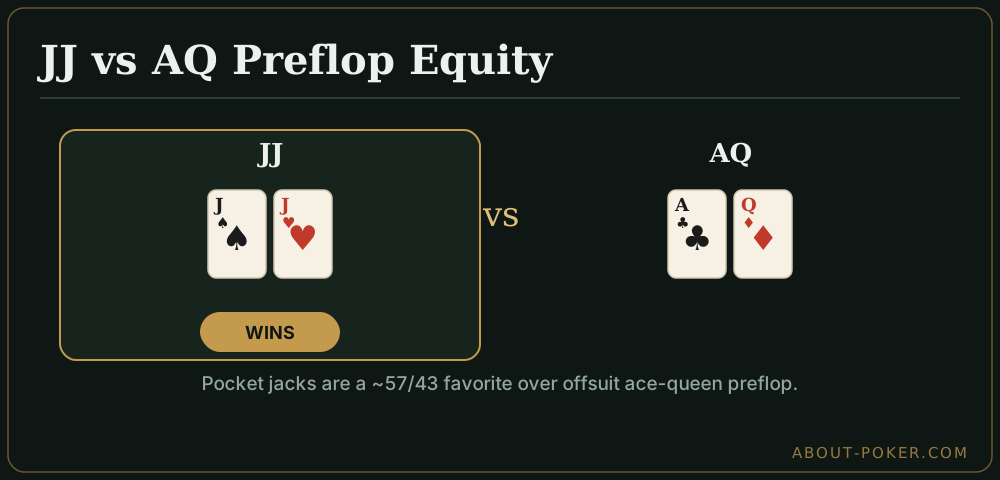
Pocket jacks against ace-queen is the classic race — jacks are about a 57/43 favorite preflop. Here are the exact equities and why the pair stays ahead.
On this page · 7 sections
You look down at J♠ J♥, the money goes in, and villain rolls over A♣ Q♦. The table calls it a flip — and they are close. This is a race, with the jacks holding a steady edge at about 57/43. Ace-queen has two live overcards, but a made pair that only needs to survive keeps the lead. The whole hand comes down to one question: does ace-queen pair up?
The headline equity
Every number below comes from a full board enumeration cross-checked with a Monte Carlo run:
| Matchup | JJ equity | AQ equity |
|---|---|---|
| JJ vs AQo (offsuit) | 57.0% | 43.0% |
| JJ vs AQs (suited) | ~55% | ~45% |
Jacks win a little more than half the time. Suited ace-queen adds flush outs and shaves a point or two, but the pair stays in front in both versions. If you want to see this resolve card by card, drop the hands into the equity calculator.
Why jacks hold the edge
Jacks are a made pair; ace-queen is not. To win, ace-queen has to improve, and to lose, the jacks only need the board to miss the big cards. That head start is why the pair is favored even though the opponent holds two premium cards.
Count what ace-queen is drawing to:
- Pair an ace: three aces remain.
- Pair a queen: three queens remain.
- That is six overcard outs, plus straight and flush chances.
Six outs across five board cards means ace-queen pairs at least one card roughly half the time — but not quite often enough to overcome the jacks’ head start. The jacks also flop a set about 11.8% of the time, adding insurance on the boards where ace-queen does connect.
A worked example
Say 100 big blinds go in for a 200 big blind pot. Preflop, jacks own about 114 of those blinds in equity, ace-queen about 86. Now watch a flop rewrite it.
Flop Q♦ 8♠ 4♥: ace-queen pairs top pair and leaps to roughly 87%, while the jacks are down to two remaining jacks for a set, around 9%. Flip the flop to 7♣ 6♦ 2♠, missing ace-queen completely, and the jacks soar to about 90% while ace-queen needs one of six cards on the turn or river. That is the race in motion: an near-even preflop split that resolves almost entirely on whether the flop brings an ace or a queen.
How this compares to JJ vs AK
The instructive contrast is against ace-king. JJ is about 57/43 over AQ and roughly 56/44 over AK — almost identical, because both AK and AQ have the same six live overcards. The tiny difference favors the jacks slightly more against AQ, since the queen is a lower card and connects to fewer nut straights. Counting those live cards is the heart of combinatorics, and it explains why every “pair vs two big cards” spot lands near the same flip.
The jacks’ hidden problem: overcards on the turn and river
The 57/43 headline is comforting, but it flatters the jacks in a way that matters at the table. Even when the flop bricks — no ace, no queen — the danger is not over, because two more cards are coming and ace-queen still has six live overcards. A jacks player who slams in three streets of chips on a queen-high or ace-high runout is often paying off the exact hand they were a favorite over preflop. The equity edge is a preflop edge; it decays every time a scare card lands.
Put numbers on it. Preflop the jacks are 57%. On a brick flop like 7-6-2 they leap to around 90%. But that 90% is over two cards, not the hand — ace-queen still hits one of six outs about 24% of the time by the river. So even a “great” flop for jacks leaves a one-in-four chance of losing, which is why an overpair that never slows down on scary turns and rivers bleeds value. Playing JJ well after the flop is mostly about respecting the overcards that arrive later.
Why “just a race” undersells position and initiative
Two identical 57/43 races are not worth the same amount of money. If you are the preflop aggressor, in position, and holding the jacks, you get to control the pot size and often win without showdown when ace-queen misses — turning a 57% edge into far more than 57% of the pot in practice. If you are out of position and passive, that same raw edge realizes poorly, because you will check-call scare cards and pay off the times ace-queen connects. So the takeaway is not just “jacks are ahead,” but “jacks are ahead and want to be the driver” — take the initiative, apply pressure on bricks, and let the overcards fold out their equity rather than seeing every river for free.
From equity to a decision
At 57/43 this is a race, so the profit lives in the margins — fold equity and pot odds — not the raw flip.
| Situation | Read | Line |
|---|---|---|
| You shove JJ, called by AQ | ~57% | Favorite; happy to get it in |
| You call off JJ vs an AQ shove | ~57% | Slight favorite; weigh stack risk |
| You shove AQ into a JJ caller | ~43% | Dog, but fold equity can rescue it |
Lock in the anchor — JJ is a ~57/43 favorite over AQo, ~55/45 vs AQs — and every jacks-versus-two-broadway spot becomes a question of the surrounding math, not the flip. Turn that into a real line with preflop all-in odds, sharpen your counting with combinatorics, and work through the poker odds & math hub.
Frequently asked
What are the odds of JJ vs AQ preflop?
Pocket jacks win about 57% of the time against offsuit ace-queen, with ace-queen around 43%. Suited ace-queen closes it slightly to roughly 55/45. The pair is the favorite in every version.
Is JJ ahead of AQ?
Yes. Jacks are a made pair and only need the board to miss the big cards, while ace-queen must pair up or hit a draw. That gives the jacks a steady 57/43 edge over AQo.
Why is JJ vs AQ called a race?
Because it is close to a coin flip. Ace-queen has six overcard outs plus straight and flush chances, so it wins over 40% of the time — enough that the outcome feels like a flip even though the pair is favored.
Should you get all-in with JJ against AQ?
As a 57/43 favorite the money goes in fine in most cash-game spots. In tournaments the value often comes from fold equity when you are the one shoving, since the raw edge is thin.