KK vs AK: Preflop Odds & Equity
KK is about a 70% favorite over offsuit AK and 66% over suited AK all-in preflop. Here are the exact kings-vs-ace-king equities and where AK's outs come from.
On this page · 8 sections
You open K♠ K♥, get three-bet, and shove. Villain snap-calls and shows A♣ K♦. Good news: you’re roughly a 70/30 favorite and about to win the pot two times out of three. The only hand that flips this — aces — didn’t show up. Against ace-king, pocket kings are a comfortable 2-to-1 favorite, and two numbers settle it: ~70% vs offsuit AK, ~66% vs suited AK.
The headline equities
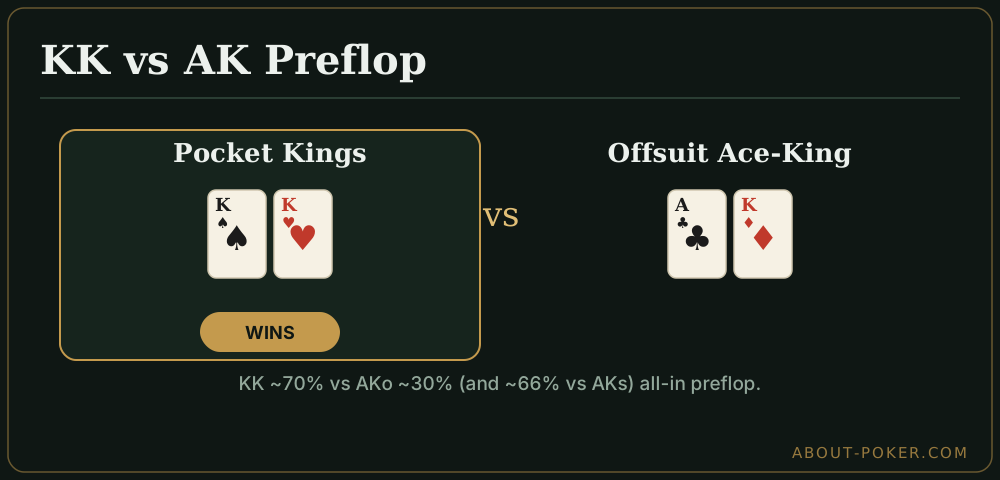
All-in preflop, pocket kings beat offsuit ace-king about 70% of the time and suited ace-king about 66%.
| Matchup | KK equity | AK equity |
|---|---|---|
| KK vs AKo (offsuit) | ~70% | ~30% |
| KK vs AKs (suited) | ~66% | ~34% |
You win about two hands in three either way. The four-point swing between offsuit and suited comes entirely from AK’s flush potential, covered below.
Why kings run over ace-king
Ace-king is a strong hand, but preflop it’s unpaired — against a made pair it has to improve to win most of the time. Count what AK is actually chasing when it runs into kings:
- Pair an ace: three aces remain in the deck (AK holds one of the four). This is AK’s main out.
- Pair a king: nearly dead. KK holds two kings and AK holds one, so a single king is left — and catching it makes trips for the kings, not for AK.
- Runner-runner straights, flushes, and two pair fill the rest.
So AK is effectively drawing to three aces plus backdoor scraps, which pins it near 30-34%. Kings are already a made pair and only lose when ace-king manages to get there.
The suited premium is all flushes
Suited ace-king does better than offsuit for one reason: flush outs. A♠ K♠ can complete a spade flush that A♠ K♥ never can, and those extra runner-runner flush run-outs add about four points of equity to AK. Nothing about the aces or straights changes between the two versions — that four-point flush bump is the entire difference between 66% and 70%. This is a clean lesson in how small structural features move equity at the margins.
Don’t confuse it with a race
AK is famous as a “coin flip,” and that’s true — against a lower pair like QQ or JJ, where its two overcards are live. Against kings, only the ace is a real overcard, and the king is nearly dead, so AK collapses to a 30-34% underdog. Same hand, different opponent, completely different number. Kings are not flipping against big slick; they’re a 2-to-1 favorite.
A worked example
Effective stacks are 100 big blinds. You open K♠ K♥, an opponent three-bets, you four-bet, and they jam A♣ K♦. You call. You’re a 70% favorite for a 200-big-blind pot — a massive, easy get-it-in.
Over the long run, this is one of the spots that pays your rent. You’ll lose it 30% of the time, usually when villain pairs their ace, and it’ll feel like a bad beat because AK “looked strong.” It wasn’t behind by a little — it was behind 2-to-1. This is precisely the input the preflop all-in odds method converts into a snap-call.
The range problem
The real question with kings is never “am I ahead of AK” — you clearly are. It’s “how much of villain’s range is aces?” Aces are only 6 combinations, while ace-king is 16 combos (4 suited + 12 offsuit), and most jamming ranges also fold in QQ and lower pairs that kings dominate. Weigh those combinations and kings get in against an unknown opponent almost every time — the 16 combos of AK you’re crushing swamp the 6 combos of AA you fear.
What actually happens after the flop
The 70/30 number is the whole-hand average, but it helps to see how the equity swings once the board comes. On a blank flop with no ace — say something like 8-5-2 — your kings jump to roughly 90% equity, because ace-king now has only the turn and river to pair its ace and is drawing thin. That is why you almost never lose these all-ins on the flop; the pain comes later.
When an ace flops, the picture flips hard. Ace-king pairs its ace on the flop about 26% of the time, and when it does, your kings collapse to around 8-9% equity with two cards to come — you are suddenly the one drawing to two outs (the case king) plus runner-runner. This is the exact texture that produces the “bad beat” feeling: you were a 70% favorite preflop, but a single ace on the flop reverses the hand almost completely. Understanding that the danger is concentrated in that one flop card, not spread evenly, is what keeps you from misreading a normal 30% loss as unlucky. The math never promised the ace would not come; it only promised it comes less than a third of the time.
Why you still get it in every time
New players sometimes see the ace flop so often that they start looking for folds preflop. Resist that. The 30% you lose is already priced into the 70% you win — you do not get to keep the favorite’s edge without paying it back on the ace-high boards. Over a large sample, jamming kings into ace-king is one of the most profitable recurring spots in the game precisely because you win it 70% of the time for a full stack.
The only real decision is the range read, not the matchup. If a specific opponent’s all-in range is only aces, then yes, fold — but that range essentially never exists, because almost everyone also gets it in with AK, QQ, and often AA-through-JJ or worse. Weigh the combinations and the fear evaporates.
Lock in the two anchors — KK is ~70% over AKo and ~66% over AKs — and every kings-versus-big-slick spot collapses into one read: is villain’s shove really aces? Almost never enough of the time to fold. Build the surrounding skills through equity, combinatorics, preflop all-in odds, and the poker odds & math hub.
Frequently asked
What are the odds of KK vs AK preflop?
Pocket kings are about a 70% favorite over offsuit ace-king and roughly 66% over suited ace-king. In both cases KK wins about two times out of three — close to a 2-to-1 favorite.
Why does KK beat AK if AK has an ace?
Ace-king is unpaired preflop, so it has to improve to win, while kings are already a made pair. AK is mostly drawing to pair its ace (three outs) plus runner-runner help, which pins it near 30%.
Is KK vs AK a coin flip?
No. AK flips against lower pairs like QQ or JJ, but against kings it's a clear underdog at 30-34% because the kings already have it out-ranked and AK can't easily catch up.
Why does suited AK do better than offsuit against KK?
Suited ace-king picks up runner-runner flush outs that offsuit AK can't make, adding about four points of equity — the whole gap between the ~66% and ~70% figures for kings.