KQ vs QJ: Preflop Odds & Equity
King-queen against queen-jack is a domination spot — KQ is about a 70/30 favorite preflop. Here are the exact equities and why the shared queen hurts QJ so much.
On this page · 7 sections
King-queen against Q♠ J♥ is not a race — it is a domination, with KQ a heavy favorite at about 70/30. The reason sits in one shared card: both hands hold a queen, and whenever that queen pairs, king-queen wins on kicker. That single overlap turns what looks like two broadway hands into a lopsided matchup.
The headline equity
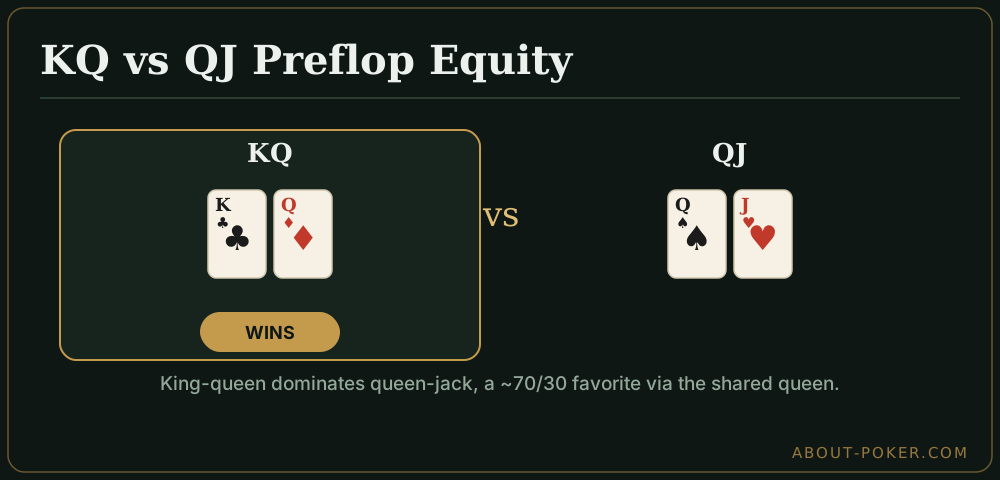
Every figure comes from a full board enumeration cross-checked with a Monte Carlo run:
| Matchup | KQ equity | QJ equity |
|---|---|---|
| KQo vs QJo | 70.4% | 29.6% |
| KQs vs QJo | ~72% | ~28% |
| KQo vs QJs | ~67% | ~33% |
King-queen wins about seven times in ten. Suits shift it a few points either way, but QJ never climbs out of underdog territory. Watch it settle at these numbers in the equity calculator.
Why the shared queen is fatal
The core idea is domination: QJ shares its queen with KQ, so pairing the queen — normally a great result — makes king-queen the winner every time. That poisons half of queen-jack’s pairing outs.
Sort out what actually helps QJ:
- Pair the queen: looks like an out, but KQ’s king kicker wins. Dead.
- Pair the jack: three jacks remain and this is clean. Live.
- Straights: the jack connects to more straights (using T, 9, and the queen) than the king does, giving QJ its best swing outs.
- Flush: only if suited, and even then KQ often has the higher flush if same-suited.
Take away the queen outs and QJ is mostly drawing to three jacks plus straights — barely enough for 30%. To learn how much a single shared card costs, work through equity in poker.
A worked example
Say 100 big blinds go in for a 200 big blind pot. Preflop, king-queen owns about 141 blinds of equity, queen-jack about 59. Now watch a flop.
Flop Q♦ 8♠ 4♥: both pair the queen — and this is the trap. King-queen has top pair with the best kicker and sits around 90%, while queen-jack is drawing nearly dead, needing a jack for two pair or a runner-runner miracle. Change the flop to J♣ 7♦ 2♠, pairing QJ’s jack instead: now QJ leads with a pair while KQ has only its overcards, and the underdog jumps to roughly 70%. The difference between those two flops is exactly why the shared card matters so much.
Why domination beats a flip
Compare this to a true race like KQ versus a small pair (about a coin flip). Against QJ, king-queen is a 70/30 monster because it does not just have to win a flip — it has queen-jack crushed on the shared card. That is the difference between hands that fight over the same board and hands that draw to different outs. Recognizing domination before the money goes in is the practical payoff of combinatorics: it tells you when a “close” broadway battle is actually a slaughter.
How suits change the domination
The suit lines in the table are worth pausing on, because they show how a flush draw either deepens or dents the domination. When king-queen is suited and queen-jack is not (KQs vs QJo), king-queen climbs to about 72/28: it keeps every advantage of the shared queen and adds a flush its opponent cannot make. When the roles reverse (KQo vs QJs), queen-jack gets its own flush outs and claws back a few points to roughly 33% — still a clear dog, but with a real escape route the offsuit version lacks.
The trap is being same-suited — both hands in, say, hearts. That looks like it helps queen-jack, but it often does not: when both make a flush, king-queen makes the higher one, so QJ’s flush frequently completes into a second-best hand that costs it a stack. A dominated hand that draws to a dominated flush is the worst kind of “out.” This is the recurring theme of domination: the cards that look like queen-jack’s rescue are the exact cards that trap it into paying off.
Recognizing domination before the money goes in
The practical skill is spotting a shared-card spot at the table, not just reading the number afterward. When a hand you are considering shares its higher card with a likely opponent range, you are the dominated one — pairing that shared card makes you second-best. QJ facing a KQ or AQ range is the classic example: the queen, your best-looking card, is a near-dead out. Flip it around and the same logic tells you when you hold the domination — KQ against a range of weaker queens and jacks is a hand to press hard.
A useful rule of thumb: two random broadway cards clash far more often than beginners expect, and a shared top card is worth roughly 40 points of equity swing (from the ~30% dominated side to the ~70% dominating side). That is a bigger gap than most “big vs small pair” flips, which is why folding a dominated broadway to a raise-and-reraise from a tight player saves far more chips than folding a coin-flip.
From equity to a decision
At 70/30 this is a clear edge, and the lesson runs both directions.
| Situation | Read | Line |
|---|---|---|
| You hold KQ vs a QJ shove | ~70% | Strong; get it in |
| You hold QJ vs a KQ shove | ~30% | Avoid stacking off; you are dominated |
| QJ open-raised, KQ 3-bets | — | KQ applies pressure; QJ should tread carefully |
Lock in the anchor — KQ is a ~70/30 favorite over QJ — and every “shared broadway card” spot becomes a domination read rather than a guessed flip. Sharpen your counting with combinatorics, build the full line with preflop all-in odds, and explore the poker odds & math hub.
Frequently asked
What are the odds of KQ vs QJ preflop?
King-queen wins about 70% of the time against queen-jack, with QJ around 30%. Suit changes it only a little. This is a domination matchup, not a coin flip.
Why is KQ such a big favorite over QJ?
Both hands share the queen, so when either pairs it, king-queen wins on kicker. That kills many of queen-jack's best outs and leaves it relying mainly on pairing the jack or making a straight or flush.
What is a dominated hand in poker?
A dominated hand shares a card with a stronger hand and loses to it on kicker. QJ is dominated by KQ because pairing the shared queen makes KQ the winner, so QJ's queen outs are effectively dead.
Can QJ still beat KQ?
Yes, about 30% of the time. QJ can pair its jack, make a straight (the jack connects to more straights than the king), or catch a flush. Those clean outs keep it a live but clear underdog.