Odds of Winning a Coin Flip Twice
The odds of winning a poker coin flip twice in a row, why 52% flips are not 50/50, and how compounding all-ins decide tournament survival.
On this page · 6 sections
Poker players call a near-50/50 all-in a coin flip, most often a pocket pair racing against two overcards. The single flip is easy to reason about, but the question that decides tournaments is what happens when you have to win two, three, or four of them in a row. The math of compounding independent events is unforgiving, and understanding it changes how you think about survival and variance.
First, the flip is not exactly 50/50
The classic flip is a pocket pair against two higher unpaired cards, like 8h 8s versus Ac Kd. The pair is already made, and the overcards need to pair up to win. Run the numbers and the pair is about 52% to win, with the overcards around 48%. It is close, but the pair has a real, small edge. Suited and connected overcards like Ac Kc claw a point or two back because they add flush and straight outs, nudging the race toward 50/50 or slightly worse for the pair.
So when people say coin flip, the honest figure is closer to 52/48 than a clean even-money bet. For the full menu of these matchups and their exact percentages, see preflop all-in odds.
Winning two flips in a row
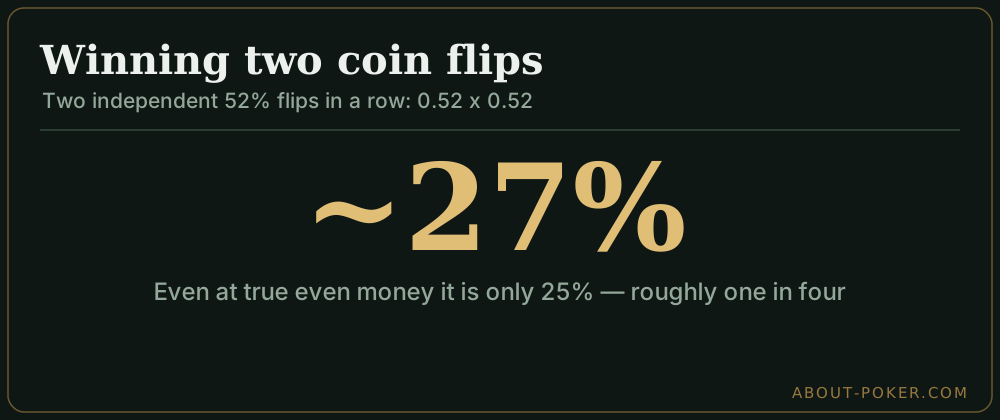
Two all-ins are independent events, so you multiply the probabilities. If each flip is a clean 50%, then winning both is 0.5 times 0.5, which is exactly 25%, or one in four. If each flip is the more realistic 52% for the pair, then winning both is 0.52 times 0.52, about 27%.
Either way, the headline is the same: even though each individual flip is basically even money, winning both is only about one chance in four. Most of the time, at least one of the two goes against you. That is the counterintuitive heart of compounding probability, and it is why players who need to win several races to advance so often fall short.
A worked tournament example
Imagine you are near the money bubble with an average stack and you know you will need to get all-in twice as a slight favorite to reach the final table. Say each spot is 55/45 in your favor, a bit better than a pure flip. The chance you win both is 0.55 times 0.55, about 30%. So even holding the better hand in both spots, you bust before the final table roughly 70% of the time.
Now push it to three consecutive flips at true 52%: 0.52 to the third power is about 14%, roughly one in seven. Four in a row is around 7%, one in fourteen. This is exactly why deep tournament runs are so rare and so streaky. It is not that good players are unlucky; it is that stringing together the required wins is mathematically hard even when every spot is fair.
Why this shapes tournament strategy
Because compounding flips are so punishing, skilled tournament players work hard to avoid unnecessary flips and to accumulate chips in spots where they hold a bigger edge. Getting it in as a 52% favorite is fine, but getting it in as a 70% or 80% favorite is far better, and stacking those larger edges is what separates consistent final-table players from the field. When you can choose your battles, you want fewer flips and more clear favorites, because the multiplication works in your favor when each event is heavily weighted your way.
This connects directly to expected value. A flip has near-zero chip EV, so it neither builds nor destroys your expectation on average, but it dramatically increases variance. The concept is covered in depth in expected value in poker. Sometimes taking a zero-EV flip is correct because of tournament equity and fold pressure, but you should know you are trading variance for position, not gaining chips on average.
Common misconceptions about back-to-back flips
The most common error is the gambler’s fallacy: believing that after losing one flip you are due to win the next. Each flip is independent. Losing the first does nothing to change the odds of the second, which remain about 52%. The deck has no memory.
The second mistake is treating a string of flips as if the odds add rather than multiply. Some players reason that if a flip is 50%, then two flips give them a good shot at winning one, which is true, but they confuse that with winning both. Winning at least one of two 50% flips is 75%, while winning both is only 25%. Know which question you are answering.
A third error is undervaluing edge. Because flips are close, players sometimes take them casually, but over a tournament career the difference between routinely getting it in at 55% versus 45% is enormous. Small edges compound in your favor exactly as small deficits compound against you. For the broader framework on how these probabilities stack, see poker probability and odds.
Quick reference
Win one clean flip: about 50%, or 52% if you hold the pair. Win two in a row: about 25 to 27%, roughly one in four. Win three in a row: about 12 to 14%, one in seven or eight. Win four in a row: around 7%, one in fourteen. Keep these in mind and you will stop being surprised when a tournament run ends on a flip, and you will start appreciating just how much has to go right to reach a final table.
Frequently asked
What are the odds of winning a coin flip twice in poker?
A true poker coin flip is roughly 52% for the pair against two overcards, not a perfect 50/50. Winning two independent flips in a row is 0.52 times 0.52, about 27%, or a little better than one in four. If you treat it as an even 50/50, the answer is exactly 25%.
Is a pair versus two overcards really a coin flip?
Almost, but not exactly. A pocket pair like 8-8 against two higher unpaired cards like A-K is about 52% to 48% in favor of the pair. The pair is slightly ahead because it is already made, while the overcards must pair up. Suitedness and connectedness of the overcards shift this by one or two points.
Why do coin flips matter so much in tournaments?
Deep runs in tournaments almost always require winning several all-ins where you are close to a flip. Because these outcomes compound, surviving three flips in a row is only about one chance in eight even at true odds. That compounding is why variance in tournaments is enormous and why even great players go long stretches without a cash.