PLO Preflop Hand Selection
Which PLO hands to play and which to fold. Learn the four traits of strong starting hands — connectedness, suitedness, high cards, and no danglers.
On this page · 6 sections
Hand selection is where most PLO profit is made or lost before a single flop is seen. New players coming from Hold’em drastically overvalue their four cards, playing anything with a pair or two big cards. But because every hand improves so much in Omaha, the gap between the best and worst starting hands is enormous, and tight, quality-focused selection is the foundation of a winning game. Here is how to choose.
The four traits of a strong hand
A good PLO starting hand has four cards that cooperate. Evaluate every hand against four traits.
- Connectedness. Cards close in rank make straights and wraps. K-Q-J-T is fully connected; K-Q-8-3 is not.
- Suitedness. Being suited — ideally to an ace — sets up nut flushes. Double-suited hands have two flush possibilities.
- High card strength. High cards make top pairs, overpairs, and the top end of straights, which are the nut hands that win big.
- No danglers. A dangler is a fourth card that does nothing. If one card is disconnected and offsuit, you are effectively playing three cards.
The best hands score well on all four. A-A double-suited leads the pack; premium rundowns like J-T-9-8 double-suited are close behind. Our detailed PLO starting hands guide ranks the specific holdings.
Why quality matters so much
In PLO everyone flops something, so being the one who flops the better something is what pays. A hand where all four cards work together flops the nut draw, the nut flush draw, or top set far more often than a hand with a dangler. Marginal hands flop marginal draws — the dominated, second-best holdings that lose stacks. Selecting for cooperation is really selecting for how often you flop the nuts or a draw to them.
A worked example
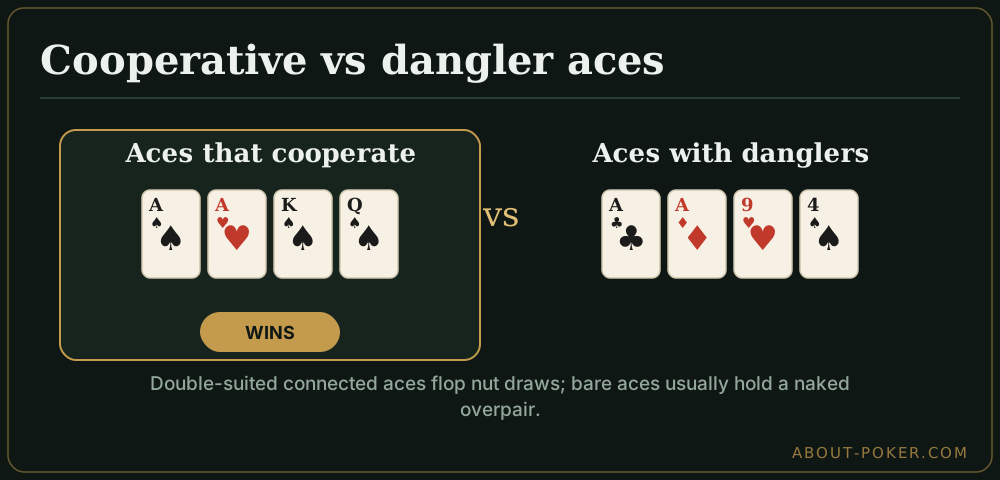
Compare two hands that both look playable to a Hold’em eye. Hand A is As-Ah-Ks-Qh — aces double-suited with connected high cards. Hand B is Ac-Ad-9h-4s — aces with an offsuit, disconnected 9 and 4. Both have aces, but they are worlds apart.
Hand A flops well constantly: it makes overpairs, top pairs, nut flush draws in two suits, and Broadway straight draws. Hand B has aces and two danglers; after the flop it usually holds only a naked overpair with no redraw, which is exactly the vulnerable hand that gets stacked in PLO. Preflop, A-A double-suited is roughly a 65 to 70 percent favorite over a random rundown, while bare aces with danglers realize far less of their equity postflop. Play A aggressively; play B cautiously or fold it out of position.
Position and hand selection
The same hand plays differently by seat. In early position, tighten to hands that make the nuts — big connected and double-suited holdings. In late position and the button, you can add more speculative rundowns and suited aces because you act last and realize more equity. Blinds require care: defending too wide out of position with mediocre four-card hands is a common leak. The seat-by-seat opening frequencies are laid out in PLO preflop ranges.
Hands to avoid
Fold hands that fail the four traits. Watch for these traps:
- Danglers. Any hand with a clearly disconnected, offsuit fourth card, like K-K-7-2.
- Non-nut suits. Small suited cards make second-best flushes that cost you stacks.
- Low disconnected cards. Hands like 8-6-4-2 rainbow make weak draws and dominated pairs.
- Trips or quads preflop. Holding three or four of a rank removes your own outs; A-A-A-x is much weaker than it looks.
Discipline to fold these, even when they contain an ace or a pair, is what keeps your average flopped hand ahead of the field.
Preflop selection checklist
Before you call or raise, score your hand on the four traits and count your danglers. If all four cards connect, contribute to a nut flush, or reach the top of a straight — and you have no dangler — the hand is strong and you can play it aggressively, adjusting for position. If one card dangles or your flushes are non-nut, downgrade sharply. When two or more cards are dead weight, fold. Tight, cooperative hand selection built on these four traits, refined by position, is the bedrock of profitable PLO. Return to the Omaha and PLO pillar to connect this with postflop play.
Frequently asked
What makes a good PLO starting hand?
Four cards that work together: connectedness for straights, suitedness for nut flushes, high card strength for top pairs and overpairs, and no dangler. Hands where all four cards cooperate flop strong draws and made hands far more often.
Is Aces double-suited the best PLO hand?
Yes. A-A double-suited is the premium PLO hand because it holds the best pair, two nut-flush possibilities, and blocker value. It is roughly a 65 to 70 percent favorite preflop against a random double-suited rundown.
What is a dangler in PLO?
A dangler is a fourth card that does not connect with your other three, wasting a quarter of your hand. A holding like K-Q-J-2 rainbow has a dangling deuce that rarely contributes, making the hand much weaker than it looks.