PLO vs NLHE Adjustments
Moving from Hold'em to PLO? Learn the key strategic adjustments — hand values, the nuts, drawing, and bet sizing — that make Omaha a different game.
On this page · 8 sections
Plenty of strong Hold’em players sit down in a Pot-Limit Omaha game, apply their instincts, and lose. The strategy is not just harder — in several key ways it is inverted. If you are making the switch, these are the adjustments that matter most, roughly in order of how much money they save you.
Adjustment 1: respect the nuts
In Hold’em, top pair top kicker and overpairs win big pots all the time. In PLO, they are frequently second-best. Because every player holds four cards, straights and flushes appear constantly, and the “strong” Hold’em hand is often drawing thin or dead. The mental shift is to stop asking “is my hand strong?” and start asking “how close am I to the nuts, and how often am I beaten?”
This single adjustment saves more money than any other. A hand that would stack off in Hold’em — say an overpair on a coordinated board — is often a fold-or-pot-control hand in PLO. Our comparison of Omaha vs Hold’em covers how deeply this reshapes hand values.
Adjustment 2: overpairs are not monsters
A bare pair of aces is a premium starting hand in PLO, but an unimproved pair of aces on the flop is a modest holding. It needs to improve or win a small pot. Hold’em players get stacked repeatedly by treating aces the way they would in No-Limit — jamming an overpair into a board where opponents have a wrap draw, a set, and two pair combos all live. In PLO, plan to keep the pot small with unimproved overpairs unless you have redraws.
Adjustment 3: draws are king
In Hold’em a flush draw has 9 outs and a straight draw 8. In PLO a big wrap can have 13–20 outs and often more equity than a made hand on the flop. This flips your aggression: you should be building pots and semi-bluffing with big nut draws far more than you would in Hold’em, and you should be far more cautious with vulnerable made hands facing action. Learning which draws are worth the aggression is central to how to learn PLO.
Adjustment 4: pot-limit changes the geometry
You cannot overbet-shove in PLO. The most you can bet is the size of the pot, which means stacks go in over more streets and pot-building becomes a multi-street plan rather than a single overbet jam. This has a subtle consequence: to get all-in by the river, you often need to start building the pot on the flop. If you wait until the river to commit, the pot may be too small to get stacks in. Plan your bet sizing across streets with the pot limit in mind.
Adjustment 5: hand selection over hand quantity
Four cards feel like license to play everything — after all, most hands “connect somehow.” That is the trap. The winning PLO player is selective, choosing hands that make the nuts: coordinated high cards, double-suited holdings, and connected rundowns. Low, disconnected four-card hands make second-best flushes and non-nut straights that cost stacks. See our PLO starting hands guide for the tiers that matter.
A worked example
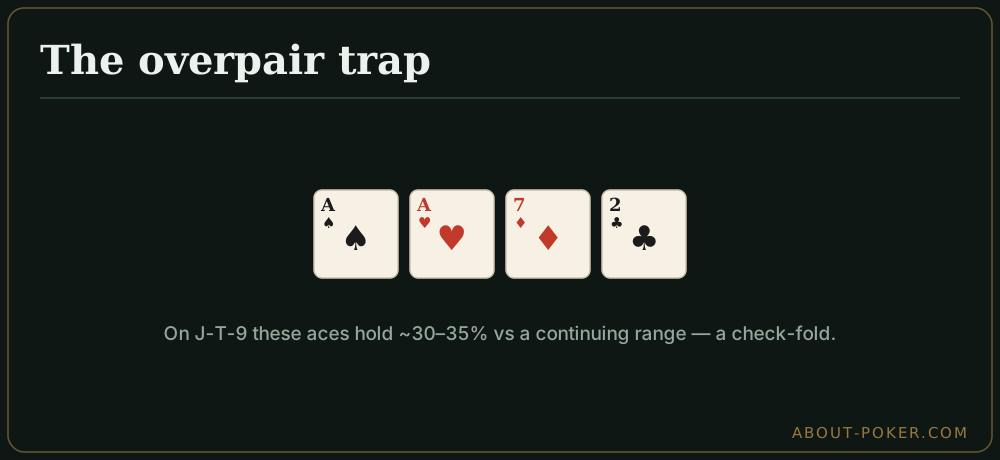
You hold A♠A♥7♦2♣ in PLO — aces, but rainbow-ish and with terrible side cards. The flop comes J♠T♠9♦. In Hold’em, aces here would still be a strong overpair worth a bet. In PLO, this is close to a disaster: the board is a straight-and-flush machine, and your unimproved aces have almost no equity against the wraps, two pairs, and combo draws your opponents hold. You have no spade for a flush blocker, no straight coverage, and no redraw.
Run it out and against a typical continuing range your aces might have only around 30–35% equity on this flop despite “holding an overpair.” A Hold’em player who c-bets and stacks off here is lighting money on fire. The correct PLO play is to check-fold or bet small and give up cheaply — the exact opposite of the Hold’em instinct. Contrast that with the same board holding A♠A♥K♠Q♠, which has an overpair plus nut-flush draw plus Broadway coverage and can happily get money in.
Common mistakes Hold’em players make
- Stacking off with overpairs on coordinated boards.
- Overvaluing top two pair — beaten far more often than in Hold’em.
- Drawing to non-nut flushes and straights, which are second-best money-losers.
- Playing too many hands because four cards “connect somehow.”
- Bluffing without blockers, forgetting opponents also arrive with strong ranges.
Quick checklist for the transition
- Am I close to the nuts, or just holding a hand that would be strong in Hold’em?
- Do I have redraws before I commit chips with a made hand?
- Am I building the pot early enough to get stacks in by the river?
- Did I select this hand for nut potential, or just because four cards are always “something”?
Internalize these five adjustments and the game stops feeling like Hold’em gone wrong and starts feeling like the deep, draw-driven game it actually is.
Frequently asked
What is the biggest adjustment from Hold'em to PLO?
Learning to respect the nuts. In Hold'em, top pair and overpairs win huge pots; in PLO they are frequently second-best because opponents make straights and flushes far more often. The single biggest leak for Hold'em players is overvaluing hands that would be strong in Hold'em but are marginal in PLO.
Do overpairs still win in PLO?
Rarely as standalone hands. A bare pair of aces in PLO is a modest holding that needs to improve or hold up against a small pot. Stacking off with an unimproved overpair on a coordinated board is a classic Hold'em-brain mistake in Omaha.
Is bet sizing different in PLO?
Yes, structurally. PLO is pot-limit, so your maximum bet is the size of the pot — you cannot shove overbets like in No-Limit Hold'em. This caps how fast money goes in and makes pot-building over multiple streets more important.
Should I play tighter or looser in PLO?
Tighter in terms of nut potential, even though it feels like you can play more hands with four cards. The winning adjustment is to select hands that make the nuts — coordinated, high, suited holdings — rather than playing any four cards because they 'connect somehow.'