PLO Wraps Explained
A wrap is PLO's most powerful straight draw, hitting from multiple directions for up to 20 outs. Learn how wraps work, how to count them, and how to play them.
On this page · 6 sections
The wrap is the signature draw of pot-limit Omaha and the reason the game feels so explosive. A wrap is a straight draw that uses all four of your hole cards to attack the board from multiple ranks at once, producing far more outs than anything possible in Hold’em. Understanding wraps — how they form, how to count their outs, and how to play them — is essential to playing PLO well.
What a wrap actually is
In Hold’em, an open-ended straight draw has eight outs: two ranks with four cards each. In Omaha, because you hold four cards, your hand can connect with the board on three or four ranks simultaneously. When your cards “wrap around” one or two board cards, several ranks complete a straight. That is a wrap. The name comes from the way your holdings surround the connecting cards, catching straights above and below the board.
The size of a wrap is measured in outs. A minimum wrap adds a few outs beyond a basic draw; the maximum wrap has 20 outs, making it a favorite over most made hands on the flop. For a slower-paced introduction with more diagrams, see our companion piece on what is a wrap in PLO.
How to count wrap outs
The method is simple once you practice it. Identify every rank that completes a straight, then count how many cards of that rank remain in the deck. Remember the deck has four of each rank; subtract any you hold and any that would pair the board or complete something better.
- A 9-out wrap uses two ranks plus one extra card.
- A 13-out wrap uses three full ranks (roughly, three times four minus overlaps).
- A 17-out wrap uses four ranks with some blocked.
- A 20-out wrap uses five clean ranks with all four copies live.
Multiply outs by about 2 per street for a quick equity read. A 20-out wrap is roughly 40 percent per card and around 70 percent to complete by the river when two cards are coming — genuinely a monster.
A worked example
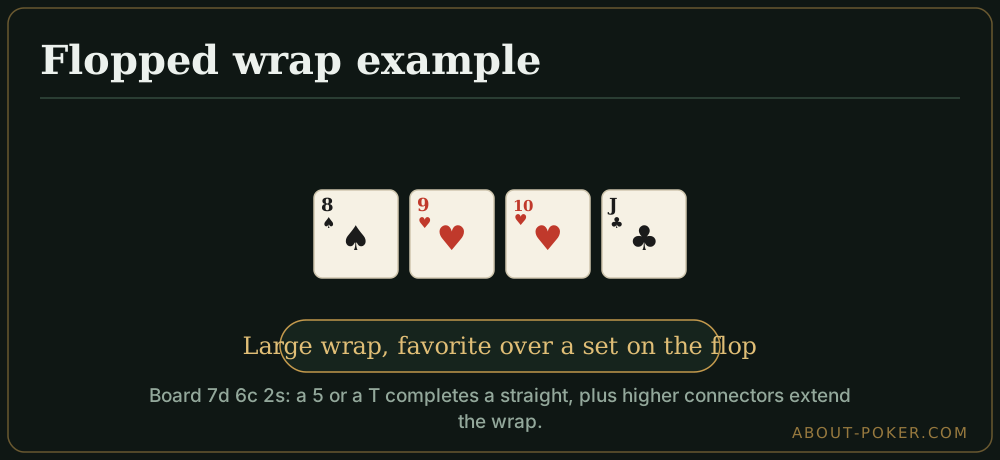
You hold 8s-9h-Th-Jc. The flop is 7d-6c-2s. Now walk the ranks. A 5 makes 5-6-7-8-9. A 6 is on the board. A 7 is on the board. A 10 makes 7-8-9-10-J. A jack you hold, but any board straight already counts. Working carefully: fives (four), tens (three left since you hold one), plus the higher and lower connectors give you a large wrap. Counting the clean ranks that complete a straight — 5, 10, and the tens-jacks-queens extensions — this hand is a 17- to 20-out wrap depending on exact copies. Against a set of sevens you are a clear favorite to make your straight by the river.
Because you are ahead, you raise. This is the classic wrap play: get chips in while your draw is stronger than the made hand fighting you for the pot.
Nut wraps versus dominated wraps
Not every wrap is worth stacking off with. The key question is whether you hit the nut straight or a dominated one. A wrap that completes to the low end of the straight can cost you your stack when an opponent holds the higher wrap. Before you commit, ask which of your outs make the nuts and which make a second-best hand that pays off a bigger draw.
Blockers help here. Holding cards that remove your opponent’s higher straight makes your wrap cleaner and your bluffs more credible. Combine a wrap with a nut flush draw and you can exceed 20 total outs — the true PLO monster. We cover the full aggression framework in playing PLO draws.
Playing wraps by street and position
On the flop, big nut wraps are raising hands, not calling hands, because building the pot lets you get stacks in as a favorite and adds fold equity. In position you can also take free cards when the pot balloons. Out of position, pressing with a pot-sized bet denies your opponent’s equity and simplifies later streets.
By the turn, reassess. A wrap that whiffed the turn now has one card to come and roughly half the equity it had on the flop, so slow down with the marginal ones. Track how the board interacts with your specific outs — a paired or three-flush board can kill even a huge wrap. For deeper turn and river play, our PLO strategy pillar links the full set of guides.
Wrap checklist
Before committing to a wrap, confirm three things. First, count your clean outs and separate nut outs from dominated ones. Second, check the board for flush and pair threats that dirty your outs. Third, weigh position and fold equity. A clean, nut-heavy wrap with fold equity is a raise; a dominated wrap on a wet board is a fold. Master that filter and wraps become your most profitable weapon in PLO.
Frequently asked
What is a wrap in PLO?
A wrap is a straight draw that uses your four hole cards to wrap around the board cards, giving you outs from several ranks at once. Where Hold'em maxes at eight straight outs, a big wrap can have 13, 17, or 20 outs.
What is the biggest possible wrap?
A 20-out wrap is the maximum in Omaha. It happens when your four connected cards surround two board cards so that five different ranks all complete a straight, with all four copies of each rank live.
Is a wrap better than a made straight?
A large wrap is often a favorite over a made hand on the flop, but it is not a made hand yet. You still need to complete it. Big wraps are played aggressively precisely because their equity is so high.