Managing an Online Session
How to manage an online poker session: setting stop-losses and time limits, spotting tilt early, choosing when to quit, and running a clean review afterward.
On this page · 6 sections
Winning players and losing players often make the same decisions at the table. Where they diverge is around it — in when they sit down, how long they stay, and when they walk away. Managing a session is the discipline that protects your strategy from your emotions. You can play flawless poker for an hour and give it all back in the ten minutes you should have already logged off. This guide is about not doing that.
Set the boundaries before you start
The worst time to decide how much you are willing to lose is while you are losing it. Set two numbers before the first hand: a time limit and a stop-loss. The time limit is however long you can realistically hold your A-game — for most people 60 to 120 minutes. The stop-loss is the number of buy-ins you will accept losing before you quit, commonly two to three.
These are not arbitrary rules; they are pre-commitments made by your calm, rational self to bind your future frustrated self. Write them down or set a timer. The whole point is that they are decided when you have nothing at stake, so they still hold when you have plenty. Our guide to staying focused online poker covers the attention side of the same problem.
Watch for tilt before it costs you
Tilt does not announce itself. It creeps in as a slightly wider call here, a stubborn hero-call there, a bet made out of irritation rather than a plan. The early signs are physical and mental: a tight jaw, faster clicking, a running internal commentary about how unfair the deck is, the urge to “get it back” from the player who cracked your aces.
Learn your personal tells and treat them as hard stops. The moment you notice you are playing to punish an opponent rather than to make money, you have already left your A-game. That is not a signal to try harder; it is a signal to take a break or quit. A stop-loss handles the money side of tilt, but self-awareness handles the earlier, cheaper side.
A worked example: the stuck-two-buy-ins spot
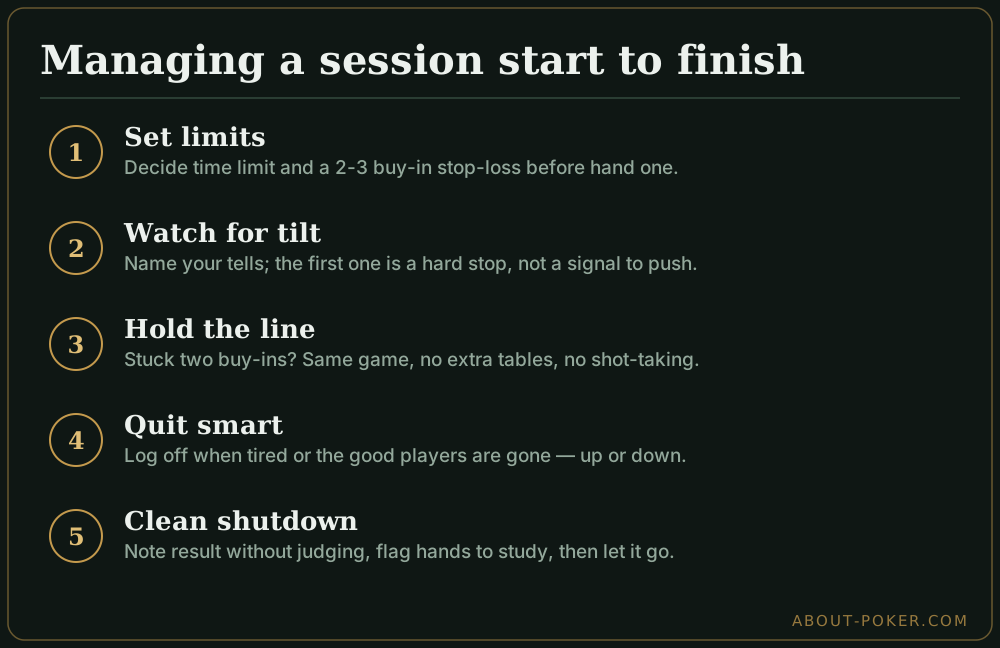
You sit down with a plan: 90 minutes, three-buy-in stop-loss. An hour in you are down two buy-ins after a cooler and a bad river. You feel the pull to load a fourth table and play faster to grind it back. Here is the correct read: being stuck is precisely the condition under which the stop-loss exists. Your judgment is compromised by the loss, the urge to speed up is tilt talking, and adding a table cuts your thinking time exactly when you can least afford it.
The disciplined move is to keep playing your same, tight game within your remaining one-buy-in cushion, and to quit instantly if you hit the third. You do not add tables, you do not jump stakes, you do not “take a shot to get even.” The variance that put you down two buy-ins is normal — see online poker variance and swings — and the plan was built for exactly this moment.
When to quit even while winning
Quitting is not only about protecting losses. The right frame is: quit when your expected value per hour has dropped, regardless of the scoreboard. That happens when you are tired, when your focus has slipped, or when the game composition has soured — the recreational players busted and got replaced by tough regulars.
A player up three buy-ins in a juicy game with fresh energy should keep going. A player up one buy-in who is yawning, misclicking, and now surrounded by good regulars should log off. Result-based quitting (“I’m up, bank it” or “I’m down, one more”) is emotional; state-based and game-based quitting is professional.
The clean shutdown
How you end a session shapes the next one. Do not slam the laptop after a bad beat and stew all night. Take three minutes to close out properly: note the final result without judging it, flag one or two hands that felt tricky for later study, and consciously separate the outcome from the decision quality. A losing session with good decisions is a good session; a winning one full of spew is a warning.
Then actually stop thinking about it. Replaying a cooler for an hour in bed does nothing for your bankroll and everything for your sleep debt, which is a leak of its own.
A session-management checklist
- Pre-set a time limit and a stop-loss before the first hand, and honor both.
- Name your tilt tells and treat the first one as a mandatory break.
- Never add tables or move up stakes to chase a loss inside a session.
- Quit on your state and the game quality, not on whether you are up or down.
- Run a short, non-judgmental review at the end and flag hands to study, then let it go.
Session management is unglamorous, and that is exactly why it separates players. The edge you protect by quitting on time and honoring a stop-loss is edge you would otherwise hand straight back — quietly, hand by hand, in the sessions you should never have kept playing.
Frequently asked
How long should an online poker session be?
Only as long as you can keep playing your A-game. For most players that is 60 to 120 minutes before focus dips. Set a time limit in advance and take a short break at it; extend only if you are genuinely still sharp, not because you want to chase a loss back.
What is a stop-loss in poker?
A stop-loss is a pre-set number of buy-ins you allow yourself to lose in a session before you must quit — commonly two to three buy-ins. It exists to protect you from your worst self, because the moment you are stuck is exactly when tilt makes you play badly and lose more.
Should I quit when I am winning?
Quit based on your state, not the scoreboard. If you are playing well and the games are good, a winning session is no reason to stop. If you are tired, distracted, or the good players have replaced the bad ones, quit whether you are up or down.