Online Poker Bankroll by Format
How big a bankroll each online format needs: buy-in guidelines for cash, sit and gos, MTTs, and spins, why they differ, and a worked example for each.
On this page · 7 sections
The single most common bankroll mistake online isn’t playing too high — it’s applying one buy-in rule to every format. Twenty buy-ins is fine for a cash grinder and a fast road to ruin for someone firing 100-runner tournaments. Different formats have wildly different variance, so they need wildly different bankrolls. This guide gives you a number for each and, more importantly, the reason behind it.
Variance sets the number
Bankroll requirements come from one thing: how bumpy the ride is. The math behind buy-in guidelines is really about surviving downswings — how deep can the luck run against a winning player before the bankroll can’t absorb it? Cash games pay out every hand, so the ride is relatively smooth. Tournaments pay only the top ~15% and load most of the prize pool onto the final table, so a winning player can — and routinely does — go a hundred buy-ins between big scores. Same edge, completely different swings, completely different bankroll.
Cash games: 30–50 buy-ins
Cash is the smoothest format because your stack converts to money continuously and you can reload any time. For a solid winner:
- Conservative: 40–50 buy-ins.
- Standard: 30 buy-ins.
- Aggressive shot-take: 20 buy-ins, with a firm rule to drop down if you lose 5.
At a $0.50/$1.00 game (a $100 buy-in), 40 buy-ins is $4,000. That cushion means a normal 10–15 buy-in downswing — which every winner hits eventually — doesn’t force you off the game or into money you can’t lose. See the beginner bankroll guide for how to build this from a small start.
Sit & gos: 50–100 buy-ins
Single-table sit and gos sit between cash and MTTs. They pay the top three of nine, so variance is real but bounded — you’re never chasing a 1-in-500 score. Fifty buy-ins is a workable floor; 100 is comfortable. Turbo and hyper-turbo structures push variance higher (more all-ins, less play), so lean toward the top of the range for those, and toward 100-plus if you play spin-and-gos, whose lottery-style multipliers are the swingiest sit-go format of all.
Multi-table tournaments: 100–300 buy-ins
MTTs are the variance monster. In a 1,000-runner field, roughly 150 players cash and the top few take the lion’s share. A genuine winner can play dozens of events without a final table purely through variance. Guidelines:
- Small fields (under ~50 runners): 100 buy-ins.
- Mid fields: 150–200 buy-ins.
- Large fields (500+): 200–300 buy-ins.
If your average buy-in is $22, a large-field roll is $4,400–$6,600. That sounds enormous relative to the buy-in — and it is, because the swings are enormous too.
A worked example
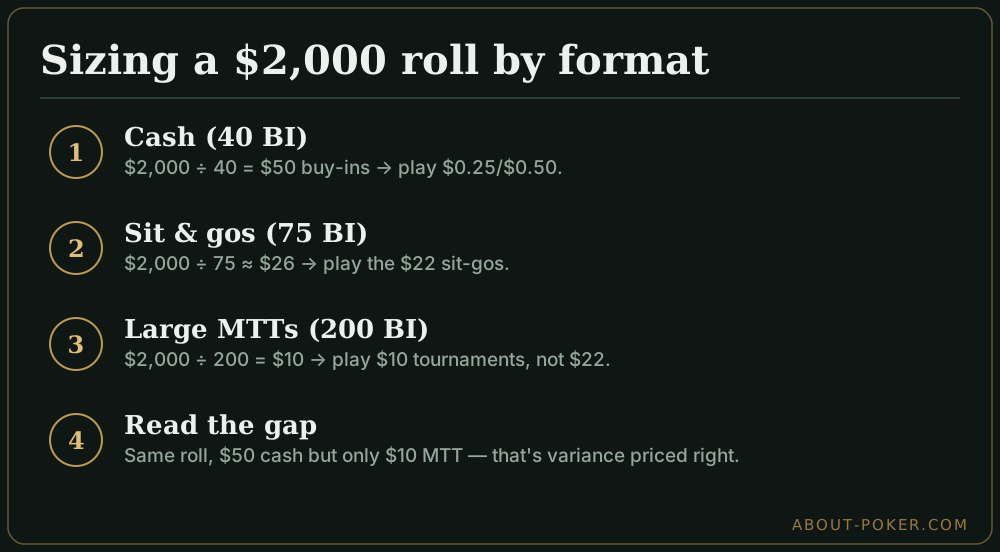
Say you have $2,000 and you want to know what you can play in each format.
- Cash (40 buy-in rule): $2,000 ÷ 40 = $50 buy-ins → play $0.25/$0.50 comfortably.
- Sit & gos (75 buy-in rule): $2,000 ÷ 75 ≈ $26 → play the $22 sit-gos.
- Large MTTs (200 buy-in rule): $2,000 ÷ 200 = $10 → play the $10 tournaments, not the $22s.
Notice the same $2,000 supports a $50 cash game but only a $10 tournament. That’s not caution for its own sake — it’s the variance of each format priced correctly. A player who plays $22 MTTs on this roll isn’t being brave; they’re roughly 90 buy-ins under-rolled and one normal downswing from broke.
Keep the formats separate in your head
Because each format needs a different number, don’t run one blended bankroll. Decide how much you’re allotting to cash versus tournaments and track it. Otherwise an MTT dry spell quietly eats your cash roll, and you wake up under-rolled for both. If you’re mixing formats, the format overview is worth a read for how the swings compare.
A quick checklist
- Cash: 30–50 buy-ins.
- Sit & gos: 50–100; more for turbos and spins.
- MTTs: 100–300, scaling with field size.
- Take shots only with a written drop-down rule.
- Track a separate allotment per format so one doesn’t drain another.
The through-line is simple: the swingier the format, the deeper the roll. Get that right and no single downswing can end your poker.
Frequently asked
Why does bankroll depend on the format?
Because variance differs enormously between formats. Cash games pay out steadily, so a small bankroll survives. Large-field tournaments pay a tiny fraction of players and hinge on rare big scores, so the same win rate comes with brutal swings that demand a far larger cushion.
How many buy-ins do I need for online cash games?
A common conservative guideline is 30 to 50 buy-ins for a given stake. Twenty can work for a solid winner playing tight, but 40-plus gives you room to survive a bad run without moving down. If you take shots higher, keep a plan to drop back if you lose a few buy-ins.
How many buy-ins for online tournaments?
Far more than cash — commonly 100 buy-ins for small fields and 200 or more for large multi-table events. The bigger the field and the more top-heavy the payouts, the deeper the swings, and the more buy-ins you need to ride them out without going broke.
Should I have a separate bankroll for each format?
Conceptually yes. Because each format has its own variance and buy-in requirement, mixing them in your head leads to under-rolling the swingiest ones. Track what you've allotted to each format so a tournament downswing doesn't quietly bleed your cash-game roll.