Playing Fast-Fold Poker Well
Playing fast-fold poker well means tight ranges, position discipline, and volume. A practical guide to winning at Zoom, Snap, and Rush pools.
On this page · 6 sections
Playing fast-fold poker well comes down to one idea most players get backwards: the point of the format is not to play more hands, it’s to fold more efficiently. Zoom, Snap, and Rush all move you to a fresh table the instant you muck, so folding costs you nothing but a second. That single design choice should make you tighter, more patient, and more mechanical than you’d ever be at a normal table.
Why the format rewards tight play
At a regular table, folding for an orbit feels wasteful — you’re paying blinds and watching others battle. Fast-fold removes that cost entirely. Fold your first two cards and you’re immediately dealt a new hand somewhere else. There is no boredom tax, no reason to talk yourself into a marginal open just to “stay in the action.”
The result is that discipline is nearly free. Every hand you play should clear a real threshold: it’s strong enough, or it’s in position, or both. The fast-fold format already grinds through 150 to 250 hands an hour on a single table, so you don’t need to manufacture volume by loosening up. Let the software do that work while you wait for good spots.
Build ranges you can run on autopilot
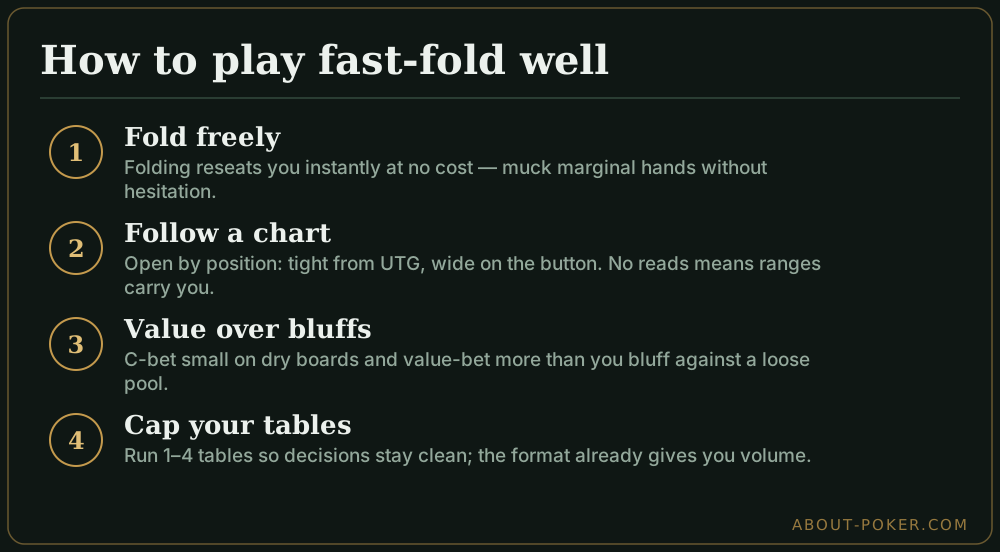
Because you can’t develop reads on a rotating cast of strangers, your ranges have to carry the load. Memorize a clean, position-based opening chart and follow it without deviation. A workable baseline:
- Under the gun (6-max): roughly the top 15% of hands — big pairs, strong broadways, AK–AJ, KQ.
- Cutoff: open around 25–27%, adding suited connectors and smaller pairs.
- Button: open 45%+, since you’ll have position on every remaining street.
- Small blind: raise-or-fold; avoid limping into the big blind’s positional edge.
The exact percentages matter less than consistency. This is the same skeleton you’d use in a normal game — see online cash game strategy — but in fast-fold you apply it more rigidly because you have nothing else to lean on.
A worked example
You’re on the button with A♣Q♠. The cutoff opens to 2.5 big blinds. You three-bet to 8bb. Both blinds fold, the cutoff calls. Flop comes Q♦ 7♥ 3♣.
You’ve flopped top pair, top kicker in a three-bet pot, in position, against an unknown. This is a clear continuation bet — around 33% of pot (about 5.5bb into ~17bb). Against the fast-fold population, most opponents fold their air and continue with worse queens, sets, and draws you’re happy to get value from. If you get raised on a dry board like this by an unknown, you can slow down, but you rarely fold top-pair-top-kicker to a single raise. The key: you didn’t need a read. Position, a strong preflop hand, and a good board did the work.
Common mistakes to avoid
The errors that quietly kill fast-fold winrates are almost all about impatience and pace:
- Opening too wide from early position. Out of position against unknowns is the worst place to be creative.
- Chasing draws without odds because “the next hand is right there” mentally discounts the chips already in the pot.
- Over-bluffing rivers. The population folds enough that thin value beats hero bluffs; bet good hands, give up junk.
- Auto-piloting into fatigue. High hands-per-hour means mistakes compound fast. A 90-minute session here has the decision volume of a much longer normal session.
Volume, tabling, and focus
Fast-fold and multi-tabling pull in opposite directions if you’re not careful. The format already delivers volume, so stacking six or eight tables on top of it mostly multiplies errors. Most winning regulars run one to four fast-fold tables. If you want to scale up, read multi-tabling online poker first and add tables only once your one-table decisions are clean and quick.
Protect your focus. Because you fold and move constantly, there’s no natural pause to reset. Build your own: take a real break every 45–60 minutes, sit out rather than open-limp when your attention drifts, and quit when your fold decisions start feeling like calls.
A quick checklist
Before you sit down for a fast-fold session, run this:
- Do I have a position-based opening chart I’ll follow without exception?
- Am I set up to play few enough tables to make clean decisions?
- Will I c-bet small on dry boards and value-bet more than I bluff?
- Do I have a break schedule and a stop-loss for the session?
Get those four right and you’re already ahead of most of the pool. Fast-fold rewards the player who treats folding as a weapon, not a waste — the fresh table is always one click away, so make each hand you actually play count.
Frequently asked
What is the biggest mistake in fast-fold poker?
Playing too loose. Because folding is free and instant, many players open too many hands trying to see flops. The winning approach is the opposite: fold most hands, and play a tight, position-aware range that punishes the loose pool.
Do reads matter in fast-fold poker?
Very little. You rarely see the same opponent twice in a large shared pool, so player-specific reads decay fast. Instead of reads, lean on solid default ranges, position, and population tendencies like people folding too much to river bets.
How many tables should I play in fast-fold?
Because the format already floods you with hands, most winning regulars run one to four fast-fold tables at most. The auto-fold-and-move design means you don't need many tables to hit high hands-per-hour, and fewer tables means fewer mistakes.