Playing Multiple Formats Online
How to play cash, sit and gos, and tournaments online without your strategies bleeding into each other: what changes between formats and how to switch cleanly.
On this page · 7 sections
Plenty of online players run cash tables, a couple of sit and gos, and a tournament all at once — and plenty of them lose money doing it, not because any one format beats them, but because the formats blur together. Each rewards a different instinct, and when those instincts leak across tables, you play every format slightly wrong. Playing multiple formats well is really the skill of keeping them separate in your head.
Why formats don’t mix by default
The three big formats reward genuinely different play:
- Cash games are deep (100 big blinds), continuous, and patient. You can wait for spots and fold your way out of trouble.
- Sit & gos and tournaments are governed by shrinking stack depth. As blinds rise, the game shifts from postflop poker to preflop push-fold, and survival and pay jumps (ICM) start to matter more than raw chip EV.
The result: the correct play with the same hand differs by format. Ace-ten offsuit is a routine fold to a raise in a deep cash game and a clear all-in shove with 12 big blinds late in a tournament. Play them the same way and one of the two is a mistake.
The core danger: instinct bleed
The specific way multi-format play costs you is habit transfer. You’ve been folding patiently at your deep cash tables for an hour; your tournament stack drops to 10 big blinds; and out of habit you fold a hand you should be shoving, because your reflexes are still in cash mode. Or the reverse: you get short-stack aggressive in a tournament, then apply that same recklessness to a 100-big-blind cash pot and spew a stack. The tables aren’t beating you — your own carried-over instincts are.
A worked example
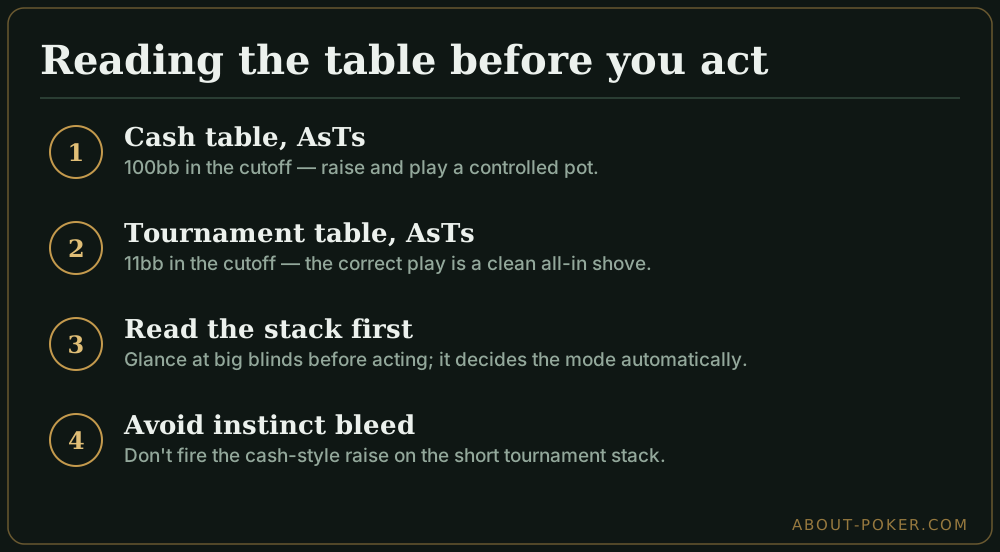
You’re four-tabling: two cash tables and two tournaments. On a cash table you pick up As Ts in the cutoff — with 100 big blinds and position, you raise, planning to play a controlled pot. Fine. Two seconds later a tournament table pops: you have 11 big blinds in the cutoff and the same As Ts. Here the correct play is a clean all-in shove — folding wastes fold equity you can’t recover, and flat-calling leaves you an awkward stack. The same hand, two opposite correct actions. The multi-format skill is registering which table you’re on before your hand moves. Players who lose at this fire the cash-style raise on the tournament table, get re-shoved on, and fold away a third of their stack.
How to switch cleanly
You can’t eliminate the mental switching cost, but you can shrink it:
- Group by depth. Cash tables together, tournaments together, physically arranged on screen. When your eyes move to the tournament cluster, your brain knows the mode has changed.
- Cap the mix. Two of each is plenty for most players; four cash plus four tournaments is a recipe for mode-confusion errors. This is the same discipline as multi-tabling — add slowly, drop if errors appear.
- Read the stack first, always. Before any action, glance at your stack in big blinds. That one habit converts most format decisions automatically: deep means play poker, short means push-fold.
- Prefer similar formats. The easiest mix is several tables of the same structure. Combining things that feel alike removes most of the switching entirely.
Bankroll and format mixing
Remember that each format needs its own bankroll cushion, because their variances differ sharply — tournaments swing far harder than cash. If you’re going to spread across formats, size your roll for the swingiest one you play and keep separate mental buckets, as covered in the bankroll basics. A hot cash session can mask a brutal tournament downswing if you’re only watching the total.
Beginners: one format first
None of this applies until you can beat a single format. Learning cash and tournaments at the same time means you learn both half as fast and confuse the strategies while you do. Pick one, beat it, then add a second — and even then, add it the way you’d add a table, one at a time, watching your results.
A quick checklist
- Know how each format’s stack depth changes correct play.
- Read your stack in big blinds before every action.
- Group tables by format on screen.
- Cap the total; drop tables if you make mode errors.
- Size bankroll for your swingiest format and track buckets separately.
- Master one format before adding another.
Get this right and multiple formats become a strength — more volume, more games to select from — instead of a blur of half-correct decisions.
Frequently asked
Can I play cash and tournaments at the same time?
You can, but it's the hardest combination to run well, because they reward opposite instincts — cash play is deep and patient, tournament play is stack-depth-driven and often short. If you mix them, keep the counts low and be deliberate about which mindset each table needs.
Why is switching formats risky?
Because habits from one format become mistakes in another. Playing a 15-big-blind push-fold tournament stack the way you'd play a 100-big-blind cash stack, or vice versa, leaks money fast. The danger isn't the switch itself — it's carrying the wrong instincts across it.
What's the easiest multi-format combination?
Formats with similar stack depths and rhythms mix best — for example several sit and gos of the same structure, or cash tables at the same stake. Combining things that feel alike keeps your decisions consistent and reduces costly mode-switching errors.
Should beginners play multiple formats at once?
No. Learn one format until you're beating it before adding another. Trying to master cash and tournaments simultaneously means you learn both slowly and confuse the strategies. Depth first, breadth later.