Understanding Rakeback
Rakeback explained in plain terms: how the rake is charged, how flat and tiered deals actually pay, and how to turn a break-even win rate into a profit.
On this page · 6 sections
Rakeback is the most misunderstood number in online poker. New players either ignore it entirely or treat it as free money that will save a broken game. The truth sits in between: rakeback is a rebate on a cost you are already paying every single hand, and understanding it changes how you evaluate stakes, sites, and your own results.
What the rake is first
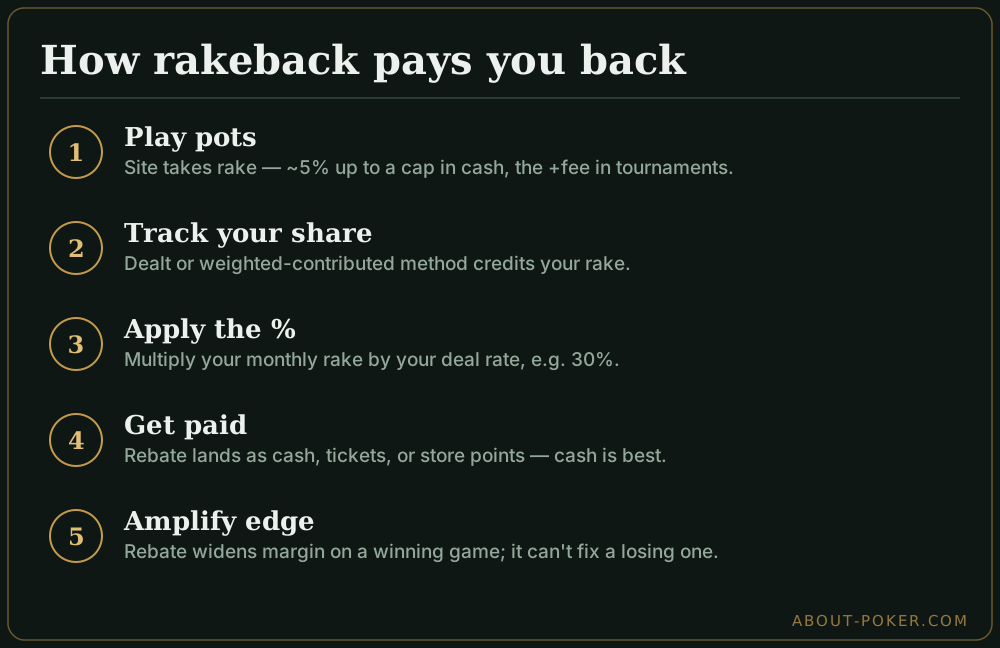
Before rakeback makes any sense, you have to see the rake clearly. In a cash game, the site keeps a small cut of most pots — commonly 5% up to a capped ceiling, so a $200 pot at 5% rake with a $3 cap costs the players $3 total. In tournaments, the rake is the entry fee: a “$50 + $5” buy-in means $50 goes to the prize pool and $5 to the house. That fee is the site’s revenue and, over a year of volume, it is one of the largest single expenses a serious player has. See our overview of online poker rakeback and rewards for how different rooms structure it.
How rakeback returns part of it
Rakeback is simply a percentage of the rake you personally generated, paid back to you. The site tracks your contribution — usually by the “dealt,” “contributed,” or “weighted contributed” method — then multiplies your total rake by your deal percentage. A 30% deal on $800 of monthly rake returns $240. Nothing about your play changes; the money just comes back after the fact, typically weekly or monthly.
The contribution method matters more than beginners expect. Under “dealt,” everyone at a table that pays rake gets equal credit whether they folded preflop or won the pot. Under “contributed” or “weighted contributed,” you only get credited for pots you actually put money into, which favors tighter players slightly. When you compare two deals, confirm you are comparing the same method.
A worked example
Say you play 100,000 hands of $0.50/$1 online over a year and generate roughly $6 of rake per 100 hands. That is 100,000 ÷ 100 × $6 = $6,000 in rake for the year. Now suppose your raw win rate before rakeback is a slim 1 big blind per 100 hands — about $1,000 profit over those 100,000 hands.
With no rakeback you earn $1,000. With a 30% deal you add 0.30 × $6,000 = $1,800. Your total becomes $2,800 — nearly triple your at-the-table earnings. That is why grinders obsess over it: at thin margins, the rebate can be the majority of your income. Flip the raw result to a small loss of -$800, and the same $1,800 rebate turns a losing year into a $1,000 winning one.
Flat deals versus tiered rewards
There are two broad structures. A flat deal pays the same percentage regardless of volume — clean, predictable, easy to compare. A tiered rewards program pays more as you climb monthly rake thresholds, so a casual player might effectively get 15-20% while a top-tier grinder reaches 50% or more.
The trap is chasing a headline top-tier number you will never reach. If a program advertises “up to 60%” but you only play enough to land in the 25% band, a flat 35% deal elsewhere is strictly better for you. Always compute the effective percentage at your realistic monthly volume, then compare like for like. Volume-based programs also reset monthly, so a bad month can knock you down a tier.
What rakeback does not do
Rakeback lowers your cost of playing; it does not create edge. A player who loses 5 big blinds per 100 hands is bleeding far faster than any rebate can refill. The correct mental model is a discount: it makes marginal spots more playable and turns a break-even game into a profitable one, but the underlying strategy still has to be sound. Pair it with the fundamentals in our online poker tips rather than leaning on it as a crutch.
It also should not push you to bad stakes. Playing higher than your bankroll or skill supports just to hit a rake tier is how players go broke with a “great deal” attached. The rake you generate at stakes you lose in is not a win.
Choosing a deal — a quick checklist
- Estimate your real monthly rake from your stake and volume before reading any offer.
- Compare effective percentages at that volume, not advertised maximums.
- Confirm the contribution method (dealt vs contributed) so the numbers are apples to apples.
- Check the payout schedule — weekly cash beats a locked annual bonus you might never clear.
- Read the clearing terms on any deposit bonus bundled with the deal; released-in-chunks bonuses are worth less than their sticker price.
Get those five right and rakeback stops being mysterious. It becomes what it actually is: a predictable rebate that quietly widens your margin on every hand you already intended to play.
Frequently asked
What does rakeback actually mean?
Rakeback is the portion of the rake you paid that a poker site or affiliate returns to you. If you generate $1,000 in rake in a month and hold a 30% deal, you get $300 back. It is a rebate on money already taken from pots you played, not a bonus on your deposits.
Is 30% rakeback good?
For most recreational and mid-stakes players, a straight 30% flat deal is solid. Some tiered reward programs pay the equivalent of 40-60% for very high-volume grinders, but they require huge monthly rake to reach the top tiers. Compare the effective percentage at your real volume, not the headline number.
Does rakeback make a losing player a winner?
Rarely on its own. Rakeback shrinks your losses and can flip a small loser or break-even player into a modest winner, but it cannot rescue a genuinely losing strategy. Think of it as a discount on your cost of playing, not a substitute for edge.