Playing Middle Position
Playing middle position means opening wider than UTG but staying disciplined with players still behind you. Learn the range, sizing, and 3-bet defense.
On this page · 6 sections
Middle position is the transition zone of the poker table — you’re past the tight discipline of under the gun but not yet in the profitable late seats. Playing it well means opening a wider, well-constructed range while respecting that several opponents, including the powerful cutoff and button, still get to act after you. Get the range right and middle position becomes a steady source of profit; get greedy and it becomes a trap.
Where middle position sits
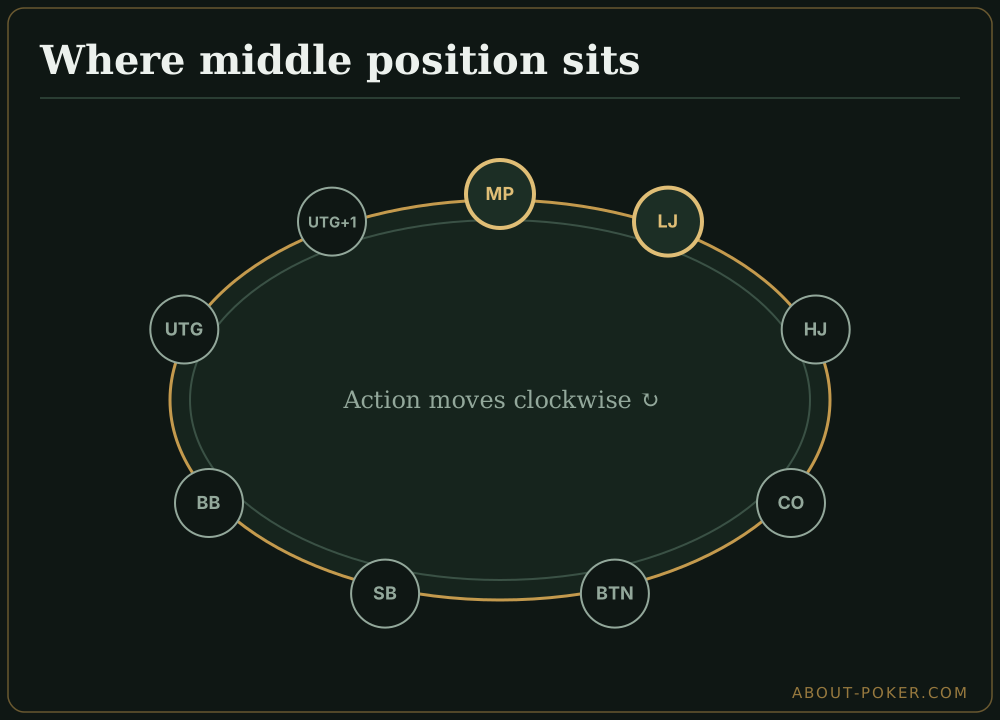
In a nine-handed game the seats run: small blind, big blind, under the gun, UTG+1, UTG+2, then the middle-position seats, the lojack, the hijack, the cutoff, and the button. The exact labels vary, but middle position generally covers the seats after early position and before the hijack. The lojack is the last of these and is often treated as the doorway to late position.
The key fact never changes: you still have more players behind you than in front. That’s fewer than UTG faces, which is why you can loosen up — but it’s not the near-freedom of the button.
The middle position opening range
A reasonable full-ring middle-position range is about 15-19% of hands. Starting from the tight UTG range, you add:
- All pocket pairs down to 22
- Suited broadways: KJs, KTs, QJs, QTs, JTs
- More suited aces: ATs and the wheel aces A5s-A2s
- AJo and KQo as offsuit additions
By the time you reach the lojack you can push toward 20%. In 6-max the same seats open wider still because two of the tightest positions simply don’t exist. As always, cross-check your ranges against a full opening range chart by position so your seats line up in a consistent ladder from tight to loose.
A worked example
You’re in middle position with Kd-Qs, folded to you, and you open to 2.5 big blinds. The button 3-bets to 8. Here KQo is a fold in most games — you’re out of position against a range that has you dominated by AK, AQ, and pairs. Now change the hand to Ah-Qh in the same spot: this is a comfortable call or even a 4-bet bluff candidate because it flops well, has an ace blocker, and retains equity. The lesson is that not every hand you open can continue against pressure — you plan your opens knowing some will have to be folded to a 3-bet, and you keep enough strong hands that folding the weak ones doesn’t leave you exploitable.
Common middle position mistakes
- Opening like you’re on the button. The button gets to act last on every street; middle position doesn’t. Copying a button range from an MP seat means playing far too many weak hands out of position.
- Flat-calling too much against 3-bets. With players behind, cold-calling a 3-bet builds a bloated pot you’ll often navigate out of position. Prefer a tighter continue-or-fold approach.
- Ignoring the hijack and cutoff. These late seats will attack an MP open aggressively if they sense weakness. A consistent range and sizing keeps them honest.
- Auto-continuation-betting. In middle position you’ll often be in multiway pots; blindly c-betting every flop into two or three callers burns chips.
Adjusting to opponents and stacks
If the players behind you are tight and rarely 3-bet, you can open the top of your speculative range — extra suited connectors realize more equity when nobody punishes you. If a maniac sits on the button, tighten your opens and be ready to 4-bet your best hands for value.
Deep-stacked, suited and connected hands gain value because they can make the nuts and stack an opponent; short-stacked in a tournament, those speculative hands lose value and you shift toward high-card strength and pairs you can commit with. Middle position is where these adjustments start to matter, because you finally have a wide enough range that trimming or adding hands changes your win rate.
Middle position checklist
- Is my hand in the ~15-19% range appropriate for this exact seat?
- Am I opening (not limping) with a consistent size?
- Do I have a plan for the two or three late seats behind me?
- Am I folding the bottom of my range when a strong player 3-bets?
Middle position rewards a clear, laddered strategy: wider than UTG, tighter than the button, and always aware that late position is lurking behind you. Play a disciplined range, size consistently, and let your positional edge over the blinds and early seats do the work.
Frequently asked
What is middle position in poker?
Middle position is the group of seats between early position (under the gun) and late position (cutoff and button). In a nine-handed game it typically means the two or three seats often called MP and the lojack — the players who act after UTG but before the hijack.
How wide should you open from middle position?
Around 15-19% of hands in full ring, a bit wider in 6-max. You add suited broadways, more suited aces, and small pairs to the UTG range because there are fewer players left to act behind you.
Can you 3-bet light from middle position?
Occasionally, yes. Against a loose early-position opener you can 3-bet strong value hands for value and mix in a few suited blockers as bluffs, but keep it disciplined — several players still act behind you.
Is the lojack the same as middle position?
The lojack is the seat directly to the right of the hijack, essentially the last of the middle-position seats in a full-ring game. Many players treat it as the borderline between middle and late position and open it slightly wider than earlier MP seats.