Acting in Turn: Rules & Etiquette
Acting in turn keeps poker fair and readable. Learn the clockwise order, why premature action is penalized, and the etiquette that keeps games clean.
On this page · 7 sections
Poker action moves one player at a time, clockwise, and you make your decision only when it legally reaches you. That single discipline — acting in turn — is what keeps the game fair and readable. Act too early and you leak information to players who haven’t decided yet; act too late and you stall the table. Getting turn order right is the first piece of table craft every new player should master.
What “in turn” actually means
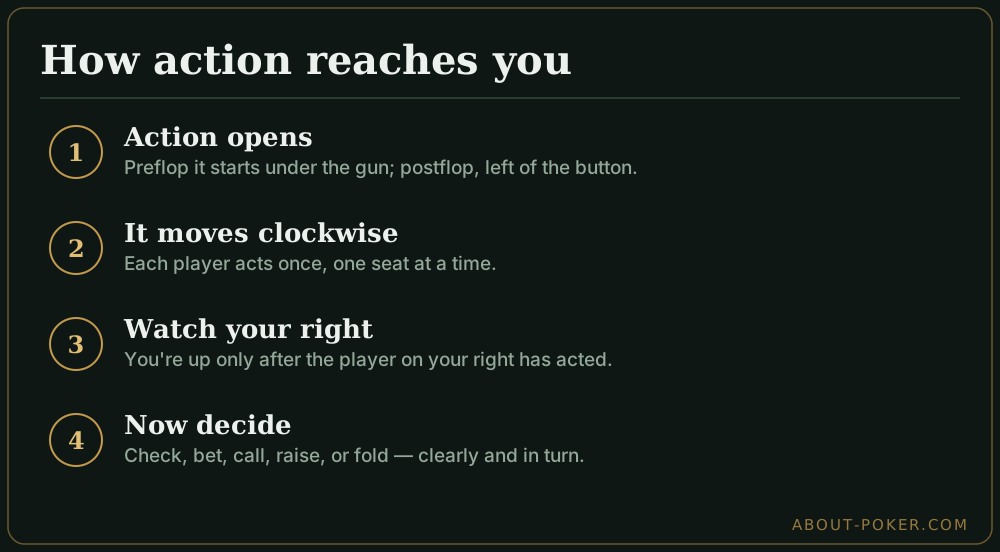
The dealer runs the betting order clockwise. Preflop, action opens with the player to the left of the big blind (under the gun) and ends with the big blind. On the flop, turn, and river, it starts with the first live player to the left of the button and moves around from there.
It’s genuinely your turn only after everyone before you has acted and the dealer’s attention reaches you. Until then you do nothing — no chips forward, no verbal declaration, no reaching for cards. A good habit: watch the player on your right. When they act and the action clearly points at you, you’re up. Not before.
Why acting in turn matters
The whole point is that no player should get free information. Suppose you’re last to act and the player before you visibly grabs chips to bet while it’s still someone else’s turn. Now every player between them and you knows a bet is coming — they can plan their fold or raise around information they were never supposed to have.
Enforcing turn order protects the players who still have to act. It’s the same reason betting out of turn is penalized: the sequence of decisions is part of the game’s fairness, not just a formality. Acting in turn also keeps the pot clean — the dealer can track exactly who owes what without untangling premature actions.
A worked example
You’re on the button in a $2/$5 cash game. The under-the-gun player opens to $15. It folds around to the cutoff, who you can see is about to muck — but the action is technically still on the player between UTG and the cutoff, who is thinking.
If you announce “call” now, you’ve acted out of turn. Here’s how the dealer handles it: your call is noted but held. If the two players ahead of you both fold and the price to you stays $15 — unchanged — your call stands. But if the player who was thinking suddenly raises to $45, your premature call is voided. The price to you changed, so you regain every option: fold, call the $45, or reraise. You were never bound to a decision made under conditions that no longer exist.
That “action unchanged” rule is the core mechanic. Learn it and out-of-turn situations stop being confusing.
Etiquette that keeps it smooth
Beyond the formal rule, a few habits mark you as a considerate player:
- Don’t telegraph. Keep your chips still and your hands off your cards until it’s your turn. Even honest fidgeting can be read as intent.
- Be ready. Acting in turn doesn’t mean tanking every hand. Know roughly what you’ll do before it reaches you so the game keeps pace.
- Announce clearly. A verbal declaration in turn (“raise,” “call”) is binding and removes ambiguity. Say it once, clearly.
- Respect the “one player to a hand” rule. Don’t discuss your live hand or coach a neighbor; that’s a turn-order and integrity issue rolled into one.
For a fuller rundown of table conduct, see our guide to poker etiquette for beginners, and if you want to understand how the betting sequence flows across all four streets, read how turns work in poker.
Edge cases the rule covers
A few situations trip up newer players even once they understand the basic rule:
- A verbal declaration out of turn. If you say “raise” or “fold” before it’s your turn, most rooms treat it the same as a physical out-of-turn action: it’s held and binding only if the action reaches you unchanged. Saying “fold” early can be especially costly, because it gives the players between you free information that a hand is dropping out.
- Checking out of turn. A premature check is still an out-of-turn action. If someone ahead of you bets before your real turn, your check is voided and you now face the bet with all options open. But you’ve already signaled weakness — another reason to wait.
- The angle-shoot risk. Some players deliberately act out of turn to induce a reaction — for example, grabbing chips as if to bet, watching opponents react, then checking. This is an angle, not a strategy, and floor staff will warn or penalize repeat offenders. Don’t do it, and don’t be baited into reacting to it.
- Being skipped. Occasionally the dealer or table moves past you by mistake. Speak up immediately and calmly. If action has already progressed significantly, the floor decides how to fix it; if it’s caught right away, your turn is simply restored.
Live versus online action
Online, acting in turn is enforced automatically — the software simply won’t accept your input until the action is on you, and a timer keeps things moving. That safety net is why the rule feels invisible online and can catch you off guard when you sit down live.
Many sites offer pre-action checkboxes (“check/fold,” “call any,” “raise”). These are convenient, but they’re the online equivalent of a telegraph: an observant opponent using the same client can sometimes infer from your instant response that you pre-selected an action. Live, there’s no such crutch — you have to watch the player on your right, track the action yourself, and keep your chips and cards still until it’s genuinely your turn. The mechanics are identical; only the enforcement differs.
The bottom line
Acting in turn is simple to state — wait for the action to reach you, then decide — but it underpins the fairness of every hand. Watch the player on your right, keep your chips and cards still until you’re up, and announce your action clearly. Do that and you’ll never draw a warning, and you’ll never accidentally hand an opponent information they didn’t earn.
Frequently asked
What does acting in turn mean in poker?
Acting in turn means you only make your decision — check, bet, call, raise, or fold — when the action has legally reached you, moving clockwise from the player to the left of the button (or the big blind preflop). You wait for every player before you to act first.
Why is acting in turn so important?
It keeps information fair. If you acted early, players behind you would see your decision and gain an edge they didn't earn. Enforcing turn order protects the players who still have to act.
What happens if you act out of turn?
The dealer freezes your action. It becomes binding only if the situation in front of you is unchanged when your real turn arrives. If someone ahead of you bets or raises first, your premature action is voided and you get all your options back.