Can You Raise After Checking
Can you raise after checking in poker? Yes — it is called a check-raise and it is fully legal in most games. Here is exactly how and when it works.
On this page · 6 sections
Yes — you can absolutely raise after checking, and the move even has its own name: the check-raise. It is fully legal in essentially every casino and online game. The one thing to understand is how it works: checking does not end your turn permanently. If a player behind you bets, the action returns to you, and you are then allowed to fold, call, or raise. Raising after your own check is one of the most powerful and common plays in poker.
Checking does not close your options
A check simply means “I decline to bet for now, but I stay in the hand for free.” It is not a fold and it is not final for the round. As long as no one has bet yet, checking passes the action along. But here is the key: if someone after you bets, the betting reopens and comes back around to you. Now you have a live decision again — call, fold, or raise. So checking is better thought of as a pause, not a surrender of your right to raise. For the mechanics of the check itself, see poker rules on checking.
What makes it a check-raise
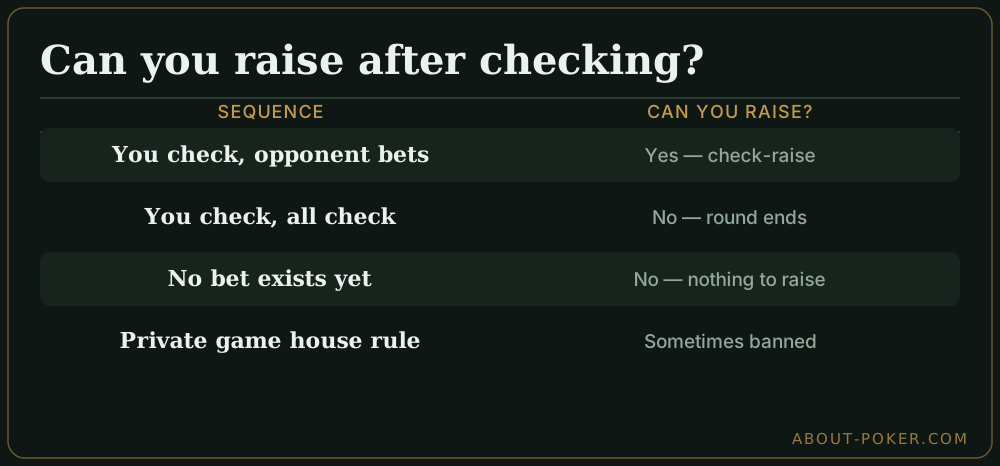
A check-raise is exactly the sequence its name describes: you check, an opponent bets, and then you raise. All three steps are required. You cannot check and raise into an empty pot, because there is no bet to raise — raising always means increasing an existing wager. So the play only exists when there is action behind you. If everyone behind you also checks, the round ends with a check-through and no raise happens. For the general rules on raising sizes and minimums, see how raising works in poker.
Why players check-raise
The check-raise is popular because it does two jobs. For value, it lets you trap: you check a strong hand, let an opponent bet into you, then raise to build a bigger pot than if you had bet yourself. As a bluff, it represents huge strength — you invite a bet, then raise to pressure your opponent off a hand they were happy to bet but not to defend against a raise. Because it can be either, a good check-raise is hard to read, which is precisely what makes it so effective.
A worked example
You are in the big blind and check the flop of 9♥ 8♥ 2♣ holding 7♦ 6♦ — an open-ended straight draw and even a backdoor flush possibility. The preflop raiser, sitting in the cutoff, bets half the pot. The action is back on you, and because you checked earlier you are fully entitled to raise. You raise to about three times their bet. This is a classic semi-bluff check-raise: you often win the pot right there, and when called you still have plenty of outs to make a straight. Note that none of this would be possible if the cutoff had also checked — the check-raise only exists because they bet after your check.
Common mistakes and misunderstandings
- Thinking a check “locks in” your turn. It does not; a bet behind you reopens the action.
- Trying to raise when no one bet. You cannot raise a nonexistent bet — that is just betting, and only if betting is still open.
- Assuming it is banned. In real casino and online poker, check-raising is always legal. Only a handful of old private “gentleman’s” games forbid it as a house rule.
- Check-raising with no plan. Decide in advance whether you are going for value or bluffing, and what you will do if re-raised.
- Slow-rolling the raise. Act in a reasonable time; do not stall to be deceptive after you have decided.
Quick checklist
- Did you check? Good — your turn can come back around.
- Did someone bet after you? If yes, you can raise.
- Decide: value raise (you are strong) or semi-bluff (you have outs/fold equity)?
- Choose a legal raise size — at least the minimum raise for that game.
- In a private game, confirm no house rule bans check-raising.
Bottom line: raising after checking is not only allowed, it is a cornerstone move. Checking keeps you in cheaply and disguises your hand; when an opponent bets, the check-raise lets you strike back for value or as a bluff.
Frequently asked
Can you raise after you check in poker?
Yes. If you check and an opponent then bets, the action comes back to you and you may fold, call, or raise. Raising after your own check is called a check-raise and is legal in nearly all games. It only works when someone bets after your check.
Is check-raising against the rules anywhere?
In standard casino and online poker it is always allowed. A few very old-fashioned home or private games ban it as impolite, but that is a house rule, not a real poker rule. Always ask about house rules in an unfamiliar private game.
Can you check and then raise your own bet?
No. You cannot raise a bet nobody has made. Raising after a check requires an opponent to bet first; only then can you raise. If no one bets after your check, the round simply ends with a check-through.
What is the point of check-raising?
A check-raise disguises a strong hand by inviting an opponent to bet, then raising to build the pot, or it applies pressure as a bluff. It puts more money in when you are strong and can win pots when you are not. It is one of the most powerful moves in poker.