Can You Split a Pot Three Ways
Can you split a pot three ways in poker? How three-player ties are divided, what happens to the odd chips, and worked examples for chopped boards and all-ins.
On this page · 5 sections
Yes, a pot can absolutely be split three ways — and even more. Whenever three players reach showdown with hands of exactly equal value, the pot is carved into three equal shares. It happens more often than beginners expect, especially when the community cards make the best hand and nobody’s hole cards matter. The mechanics are the same as any split pot, just divided by three instead of two, with a small twist for the leftover chips.
Three equal hands, three equal shares
Standard poker ranks hands by their best five cards, and suits never break ties. So if three players all end up with the identical best five-card hand, all three win, and the pot divides three ways. There is no cap on the number of winners — a pot can chop four, five, or even more ways if everyone plays the same board.
The dealer counts the pot down, divides by three, and pushes an equal stack to each of the three players. The only wrinkle is when the total does not divide cleanly, which brings us to the odd chip.
The odd-chip rule for three-way splits
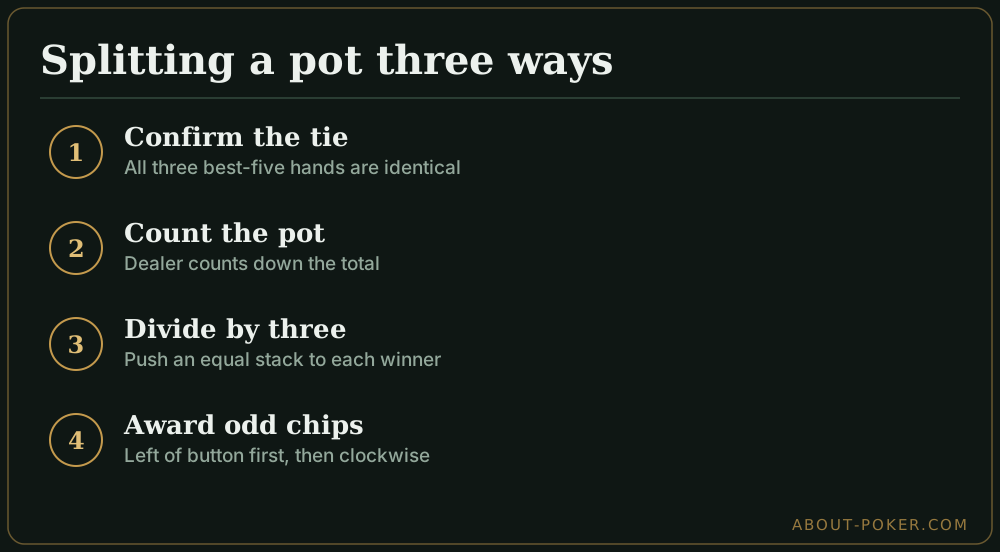
Say the pot is $301 in $1 chips and three players tie. Divided by three that is $100 each with one chip left over. That leftover is the “odd chip,” and it cannot sit in the middle — it has to go somewhere.
The standard cardroom rule: the odd chip goes to the player in the worst position, meaning the one closest to the left of the dealer button. If more than one chip is left over (for example a $302 pot leaves two odd chips), they are awarded one at a time, starting with the player left of the button and moving clockwise. So the first odd chip goes to the earliest position, the second to the next player clockwise, and so on.
High-low split games use a different tiebreaker — highest card by suit — but for a straightforward Hold’em or Omaha chop, position off the button is the rule. Our full breakdown of odd chip rules in split pots covers every variation.
A worked example
Three players see the river in a Texas Hold’em hand. The board reads Ah Kh Qc Js Tc — a ready-made Broadway straight, ace through ten, sitting right there in the community cards.
- Player A holds 9♦ 9♠.
- Player B holds 8♣ 7♣.
- Player C holds 2h 2s.
None of their hole cards beat the board. Every player’s best five-card hand is the exact same Broadway straight: A-K-Q-J-T. All three win. If the pot is $150, each player takes $50 and it divides perfectly. If the pot were $151, it splits $50 / $50 / $50 with one odd chip going to whichever of the three players sits closest to the left of the button.
This is the classic “the board plays” three-way chop — nobody’s pocket pair or connectors improved on the straight.
When an all-in changes the math
Three-way splits get more interesting when someone is all-in for less. An all-in player can only win chips from the portion of the pot they actually contributed to. That means the dealer builds a main pot and one or more side pots.
Imagine Player C was all-in for a small amount while A and B kept betting. The main pot — which C is eligible for — might split three ways if all three tie. But the side pot, built from A and B’s extra bets, is only contested between A and B. If A and B also tie for the side pot, they chop that two ways. C never touches it. The dealer awards each pot separately, so a single showdown can produce a three-way split on one pot and a two-way split on another. Our guide to all-in and side pots walks through building these pots step by step.
Common mistakes and checklist
- Assuming the highest hole card wins. If the board makes the hand, hole cards are irrelevant. Do not muck a winner thinking your partner “had more.”
- Forgetting suits do not break ties. A flush in spades does not beat the identical flush in hearts. If the five cards are equal in rank, it is a tie.
- Leaving the odd chip in the pot. It always gets awarded — never left for the next hand.
- Ignoring side pots on all-ins. Always check which players are eligible for which pot before splitting.
Quick checklist for any suspected three-way chop:
- Compare each player’s best five cards, not their hole cards.
- Confirm all three are genuinely identical in rank.
- Divide the pot by three.
- Award any odd chips starting left of the button, clockwise.
- Resolve side pots separately if anyone was all-in.
Three-way splits are perfectly legal and, once you see the board-plays pattern, easy to spot. Master the odd-chip rule and you will never be confused when the dealer starts counting out three equal stacks.
Frequently asked
Can a pot be split three ways?
Yes. If three players all show hands of exactly equal value at showdown, the pot is divided into three equal shares. This is common when the board plays and each player's hole cards do not improve on the five community cards. There is no limit to how many players can tie and chop a pot.
What happens to the odd chips in a three way split?
The pot is divided by three, and any leftover chips that cannot split evenly are the odd chips. In most cardrooms the first odd chip goes to the player closest to the left of the button, then the next, moving clockwise. High-low games use a different high-card-by-suit rule.
Can three players split a pot if one is all-in?
Yes, but side pots complicate it. An all-in player can only win the portion of the pot they contributed to. The main pot may split three ways while a side pot is contested by fewer players. The dealer builds the pots separately and awards each one independently.