How to Run a Freezeout Home Game
How to run a freezeout home game: pick a buy-in, set starting stacks and a blind schedule, seat players randomly, and pay out the top spots cleanly.
On this page · 5 sections
A freezeout is the cleanest tournament format there is: everyone buys in once for the same price, and when your chips are gone, you’re done. No rebuys, no add-ons, no math to track. That simplicity is exactly why it’s the best format for a home game — you collect the money up front, deal cards, and the last player standing wins. This guide walks through every decision you need to make before the first hand.
Set the buy-in and build the prize pool
Pick a buy-in that everyone is comfortable losing, because in a freezeout you can lose it all in a single hand. Common home stakes are $20, $50, or $100 per player. Collect all the money before dealing a card and put it somewhere visible — a jar or envelope — so there’s no confusion later.
The total prize pool is just the buy-in times the number of players. Nine players at $50 makes a $450 pool. Decide right now whether the whole amount goes to the players or whether you’re taking a small amount to cover food and drinks. If you are, tell everyone before they sit down. A home game should never quietly rake the pot.
Choose starting stacks and a blind schedule
Give every player the same starting stack. The actual number is arbitrary — 5,000 chips is a clean, popular choice. Deal blinds starting at 25/50, which gives each player 100 big blinds, a deep and playable stack. Make sure your poker chip values and colors support the whole schedule so you never run out of a denomination.
The blind schedule is what actually ends the game. Blinds rise on a timer so stacks get shallower and hands get decisive. A reliable home structure with 20-minute levels looks like this:
| Level | Small blind | Big blind |
|---|---|---|
| 1 | 25 | 50 |
| 2 | 50 | 100 |
| 3 | 75 | 150 |
| 4 | 100 | 200 |
| 5 | 150 | 300 |
| 6 | 200 | 400 |
| 7 | 300 | 600 |
| 8 | 500 | 1,000 |
Put one person in charge of a phone timer and have them call the blind change out loud each level. If you want a longer, more skillful game, use 25- or 30-minute levels. For a fast game, drop to 15.
Seat players and start dealing
Draw for seats randomly — have everyone pull a card, high card picks their seat first, and so on. This avoids any argument about position. The player to the left of the highest card gets the dealer button for the first hand, and the button moves clockwise every hand exactly as it does in any game, following the poker dealer button rules.
As players bust, the table shrinks. When you’re down to your final table combining what were two tables, or simply as seats empty, keep the button rotation honest — a busted player’s blinds still get posted by the players who reach those seats. The general flow follows standard poker tournament rules.
Worked example: paying out a 9-player game
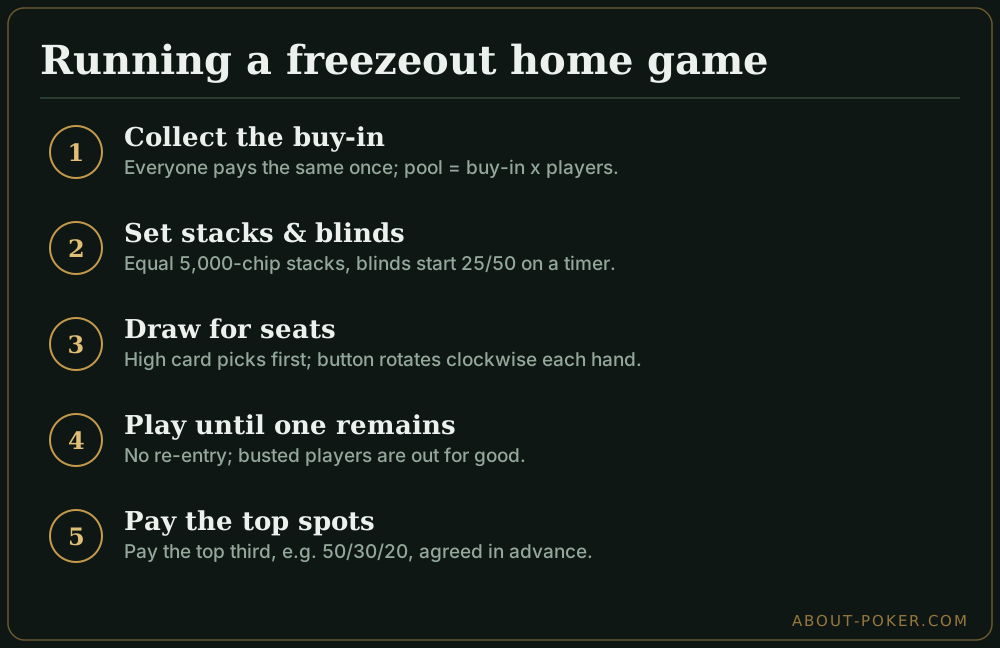
Say nine friends each put in $50 for a $450 pool. A clean payout for a single-table freezeout pays the top three, because roughly the top third of the field cashing feels fair and keeps more people invested late.
- 1st place: 50% = $225
- 2nd place: 30% = $135
- 3rd place: 20% = $90
The moment three players remain, everyone is “in the money,” and the tension jumps — that’s the money bubble bursting. When the third-place finisher busts, pay them their $90 immediately. The final two play heads-up until one player holds all the chips, then split the remaining $360 into $225 and $135. Learn more about structuring these in how poker payouts work.
A few rules to agree on up front
Before the cards fly, settle three things out loud so nobody argues at 1 a.m.:
- Table stakes. A player can only win from another player the amount they had in front of them at the start of the hand. This is universal tournament law.
- All-in and side pots. When a short stack is all-in and others keep betting, the extra chips form a side pot the all-in player can’t win.
- Chip-up / color-up. When small denominations clutter the table, pause to trade them for larger chips using the standard rounding rule (color up at the break).
Get those agreements out of the way and a freezeout basically runs itself. If you’re hosting for the first time, pair this with our full guide on how to set up a home poker game for everything from table felt to snacks.
Frequently asked
What is a freezeout in poker?
A freezeout is a tournament where every player buys in once for the same amount and cannot re-enter after busting. When your chips are gone, you're out. It's the simplest and most common tournament format for home games.
How many chips should each player start with?
A clean, common starting stack is 5,000 chips with blinds beginning at 25/50. That gives players 100 big blinds, which is plenty of room to play. The chip amounts are abstract — they only need to be consistent across the table.
How long should a freezeout home game last?
With 20-minute blind levels, a 6-to-9 player freezeout usually runs three to four hours. Longer levels make the game more skill-based but slower; shorter levels speed things up but add variance.
How should a home freezeout pay out?
A common structure pays the top third of the field. For a 9-player game, paying three spots roughly 50/30/20 of the prize pool works well. Always agree on the payout before the first hand is dealt.