Reading the Board: Rules & Etiquette
Reading the board in poker: how to build your best five-card hand, spot flushes and straights, know when you play the board, and the etiquette at showdown.
On this page · 5 sections
Reading the board is the most fundamental live-poker skill there is — and the one most likely to cost a beginner a pot they actually won, or hand them a loss they didn’t see coming. In Hold’em, five community cards sit face-up in the middle, and your job on every street is to work out the best five-card hand available: yours, and what your opponents might be holding. Get fluent at this and you’ll never again turn over a hand at showdown unsure whether you won.
The rule: your best five cards win
In Texas Hold’em you make the best possible five-card hand using any combination of your two hole cards and the five community cards. You can use both hole cards, one, or — occasionally — neither. There’s no requirement to use a specific number of your own cards, which surprises people coming from Omaha (where you must use exactly two).
That flexibility is why board reading matters. The board of Kh 9c 4d 2s 7h offers no help beyond a possible pair or flush draw, while a board of Qh Jh Th 3c 2c is loaded with straights and flush possibilities. Before you decide how you stand, you name the strongest hand the board makes on its own, then see how your hole cards improve on it. When you do turn your hand up, the order of who shows follows the showdown rules for who shows first.
Playing the board: when you can only tie
Sometimes the five community cards are your best hand and your hole cards add nothing. This is called playing the board, and it comes with a crucial catch: you can only tie, never win outright. Because every player still in the hand shares those same five cards, if the board is your best hand, it’s equally available to everyone.
Say the board reads Ah Kh Qh Jh Th — a royal flush in hearts sits on the felt. Everyone at the table has a royal flush regardless of their hole cards. The pot is chopped among all remaining players. If you hold two low off-suit cards and the board makes a straight, and your opponent also can’t beat that straight with their hole cards, you split. Recognizing when you’re merely playing the board saves you from betting a hand that can’t win.
Scanning the board efficiently
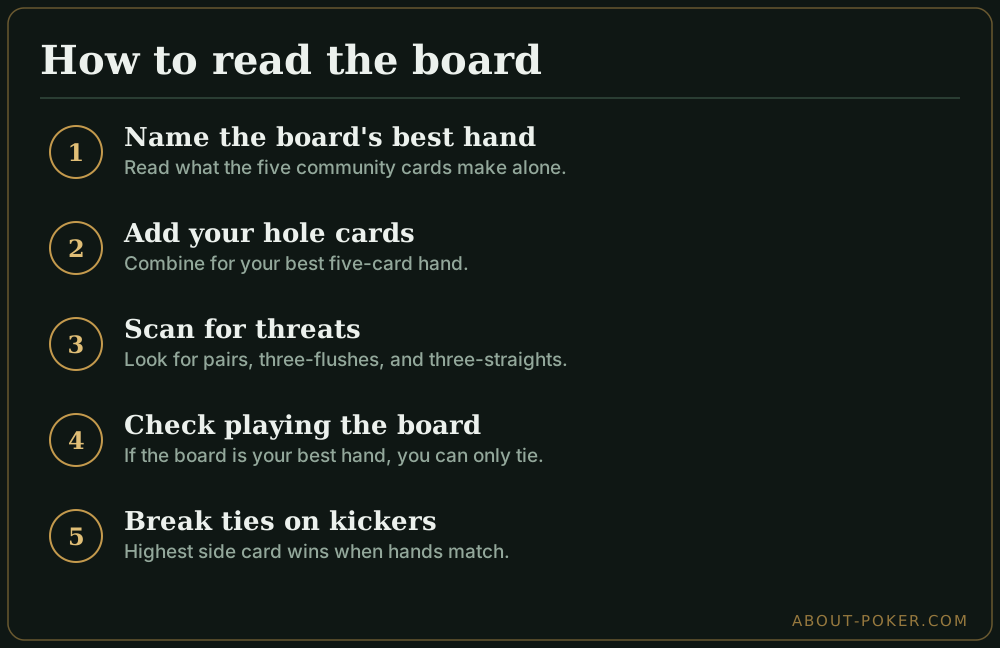
You don’t need to calculate every combination. Train yourself to scan for three threats every time a new card appears, especially by the river:
- Pairs on the board — a paired board means someone could have three of a kind or a full house.
- Three cards of one suit — three to a flush means anyone with two matching suited cards has a flush.
- Three connected cards — three cards within a five-rank window means a straight is possible.
Then layer in kickers. When two players share the same pair or flush, the highest side card decides it — the reason a strong kicker matters so much on unpaired boards.
Worked example: who wins on a scary river
You hold Ac Qc. The board runs out Qh 7c 4c 9s Kc. Walk it in order:
- Your best hand: Your two clubs, plus the three clubs on the board (
7c 4c Kc), give you a flush — the ace-high club flush, in fact, since you hold theAc. - The board alone: No made straight, no flush by itself (only three clubs), no pair — the board plays nothing on its own.
- The threats: Any opponent with two clubs also has a flush, but you hold the
Ac, the highest club, so you have the nut flush — no flush can beat you.
You confidently turn over the winner. Contrast that with holding Qs Qd on the same board: you’d have three queens, a strong hand — but that third club on the river means anyone with two clubs beats you. Reading the board tells you your set of queens went from a monster to a hand that must proceed carefully.
Etiquette when reading the board at showdown
Board reading isn’t just private math; there’s table etiquette around it:
- Don’t call the winner out loud while a hand is still live or before the dealer reads it — let the dealer make the ruling.
- Turn all your cards face-up at showdown; the dealer reads the board for everyone and the best hand wins even if a player misreads their own.
- Never muck a winner in a hurry. If you’re unsure, table your hand and let the dealer determine the best five cards — mucking gives up the pot.
- Be gracious about split pots. If two players play the board or tie, the pot chops cleanly; there’s no shame in a share.
The reassuring rule underneath all of this: the dealer reads the board and the best five-card hand wins, even if you can’t read it yourself. But the player who reads it fast and correctly is the one making the right bets long before showdown.
Frequently asked
What does reading the board mean in poker?
Reading the board means looking at the shared community cards and working out the best possible five-card hand available, both for yourself and for what your opponents could hold. It's the core skill that tells you where you stand in a hand.
What does playing the board mean?
Playing the board means the five community cards themselves make your best hand and your hole cards don't improve it. When you play the board, you can only tie, not win outright, because every remaining player shares those same five cards.
How do you find the best hand on the board?
In Hold'em you make the best five-card hand from any combination of your two hole cards and the five community cards. Scan the board for pairs, three to a flush, and three to a straight, then see how your hole cards combine with them.
Can the board make a straight or flush by itself?
Yes. If the five community cards contain a five-card straight or five cards of one suit, that's a made hand everyone shares. Your hole cards only matter if they beat it, such as a higher flush card or a card that extends the straight higher.