What Is a Boxed Card
What a boxed card is in poker — a card face-up inside the deck, how it is ruled, when it forces a misdeal, and how dealers handle it during a hand.
On this page · 6 sections
Shuffle a deck a few thousand times and eventually a card ends up flipped the wrong way inside it. When that face-up card turns up in the middle of an otherwise face-down deck, it is called a boxed card. It is one of the more colorful pieces of poker terminology, and the ruling is refreshingly simple: in most cases, a boxed card is treated as if it were never there.
Definition: a card face-up in the deck
A boxed card is a single card oriented face-up within a face-down deck (or vice versa). It is not a card that was accidentally flashed during dealing — that is an exposed card, handled differently. A boxed card is already reversed before it comes off the top, usually because it got turned during a sloppy shuffle, a riffle, or when the deck was squared up. The name comes from the card sitting “boxed” against the grain of the rest of the deck.
Because a face-up card obviously cannot serve as a concealed hole card or a properly dealt board card, poker needs a rule for what to do with it. For where this sits among other dealing quirks, see poker misdeals and irregularities.
The standard ruling: discard it as nonexistent
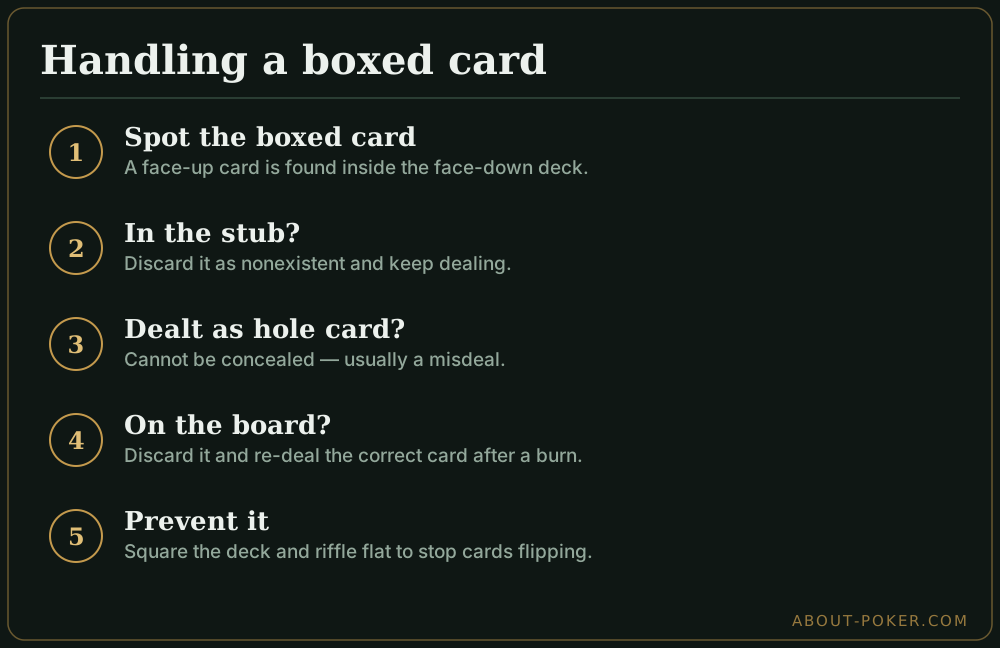
The universal rule for a boxed card discovered in the deck is that it is treated as if it does not exist. The dealer removes the boxed card and discards it — essentially like an extra burn card — and continues dealing with the next card off the top. Play is not interrupted, no one is penalized, and the hand proceeds normally.
This keeps things simple: rather than trying to figure out where the boxed card “should” have gone, the room just throws it away and moves on. A single discarded card from a 52-card deck does not affect the fairness of the deal.
When a boxed card causes a misdeal
The clean discard rule applies when the boxed card is caught in the stub — the undealt portion of the deck. It is different if a boxed card is actually dealt to someone:
- A boxed card dealt as a hole card cannot be concealed, so it typically forces a misdeal. The hand is collected, reshuffled, and re-dealt.
- A boxed card reaching the board is handled by procedure for that street, usually by discarding it and re-dealing the correct card after a burn.
The dividing line, as with most dealing errors, is timing. If significant action has already occurred, the room leans hard toward keeping the hand alive and correcting only what it must.
Worked example: boxed card during the deal
The dealer is pitching hole cards in a hold’em hand and, as the fourth card comes off the top, it lands face-up on the felt in front of a player — but it is face-up because it was boxed inside the deck, not because the dealer flashed it.
Because that card was already reversed in the deck, it is discarded as nonexistent. The dealer does not give the player a boxed card as a hole card; instead the discarded boxed card effectively acts like a burn, and the player receives the next card off the top. The deal continues in order, and no misdeal is needed because the problem was caught cleanly before that player had a live, concealed card. Contrast that with a genuine misdeal: if a boxed card had already been tucked into someone’s hand as a hole card and discovered later, the whole hand would be re-dealt.
How boxed cards are prevented
Boxed cards are almost always a shuffling problem, so clean mechanics prevent them:
- Square the deck before and after shuffling so no card can flip.
- Riffle flat and low to the table rather than in the air, where cards can spin.
- Cut and box the deck properly and give it a quick face-check when spreading.
- Wash new decks carefully; factory decks and worn cards both flip more easily.
Good dealing procedure is the real fix — a well-handled deck rarely produces a boxed card in the first place.
Quick checklist
- Boxed card = face-up card inside the deck, from shuffling — not a flashed card.
- Found in the stub: discarded as nonexistent, deal continues.
- Dealt as a hole card: usually a misdeal and re-deal.
- On the board: discarded, correct card re-dealt after a burn.
- Prevention: square, riffle flat, and check the deck.
A boxed card sounds alarming but is one of the tamest irregularities in poker — throw it away, deal the next card, keep playing. Only when a face-up card actually reaches a hand does the misdeal machinery kick in. For the full catalogue of dealing errors, see misdeals and irregularities, and for the betting flow around them, the betting rules. Back to the how-to-play hub.
Frequently asked
What is a boxed card in poker?
A boxed card is a card that is turned face-up inside an otherwise face-down deck. It usually happens when a card gets flipped during shuffling or dealing. The standard ruling is to treat the boxed card as if it does not exist — it is discarded like a burn card.
What happens when there is a boxed card?
A boxed card found in the stub is removed and discarded, and dealing continues with the next card. If a boxed card is actually dealt into a player's hand or onto the board, it usually forces a misdeal or is replaced by procedure.
Does a boxed card cause a misdeal?
Not always. A boxed card discovered in the deck is simply discarded and play continues. But a boxed card that reaches a player as a hole card typically causes a misdeal, since a face-up card cannot serve as a concealed card.
How is a boxed card different from an exposed card?
An exposed card is accidentally shown during dealing but was meant to be a live card; a boxed card is one that is already turned face-up inside the deck before it is dealt. Boxed cards are discarded as nonexistent, while exposed hole cards are replaced and become the burn.