What Is a Freeroll Situation
A freeroll in poker is a spot where you can't lose but might win. Learn how freeroll situations happen, a clear all-in example, and how to spot them.
On this page · 6 sections
A freeroll in a poker hand is a spot where you cannot lose the money that’s already in the pot, but you can still win it. Your downside is capped at breaking even (usually a split), while your upside is scooping the whole thing. That lopsided payoff — no risk, real reward — is exactly what “freeroll” means at the table.
Be careful with the word, though: it has two unrelated senses. One is a free-entry tournament. The other — the one this page is about — is an in-hand situation where you’re getting a free shot at more chips. Same word, very different meaning.
The core idea: no downside, real upside
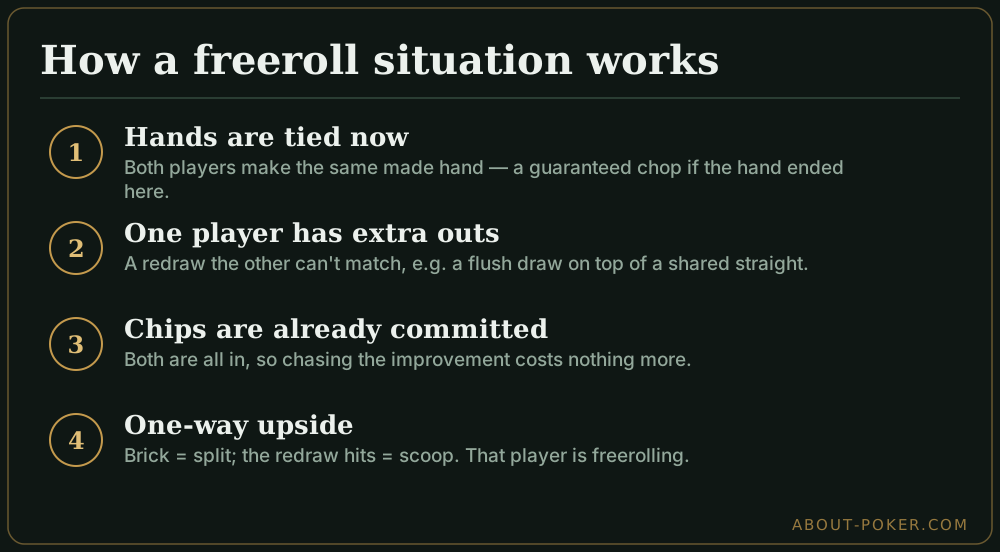
Picture two players who are all in and currently tied for the best hand. Neither can be beaten by the other as things stand, so at worst they chop the pot. But suppose one of those players holds a card that can still improve to a better hand while the other player has no way to catch up. The player who can improve is freerolling: if the board bricks, they split; if their card hits, they win everything. They put no extra money at risk to get that chance.
The key ingredients are always the same:
- Both players have the same made hand right now (a guaranteed tie in a vacuum).
- One player has extra outs to a better hand; the other has none that matter.
- The chips are already committed, so the freerolling player risks nothing more to chase the improvement.
A clear all-in example
You and one opponent get all in on the flop. The board is 9c 8c 7d, and both of you hold jack-ten for the same made straight:
- You: Jc Tc
- Opponent: Jh Td
Right now you have the identical straight — jack-high (J-10-9-8-7). If the hand ended here, you’d split the pot down the middle. That’s the guaranteed floor: you cannot lose.
But look at the suits. Your Jc Tc are both clubs, and there’s a 9c and 8c on the board. That means you have a flush draw — any club on the turn or river makes you a flush, which beats the straight your opponent is stuck with. Your opponent has no such draw; the best they can ever do is chop.
So on the last two cards, you are freerolling. If a club comes, you scoop the whole pot. If no club comes, you split. Your opponent risked their whole stack to, at best, get half of it back. You put in the same chips but with a live shot at all of them — and there are nine clubs left that make your flush, roughly a 35 percent chance to hit by the river. That’s a huge free edge on money already committed. For how these all-in spots get paid out, see all-in and side pots and splitting a tied pot.
Why the kicker matters so much
Most freerolls come down to a kicker or a higher shared card. If two players both flop the same straight but one also holds a flush draw in the suit on board, the flush-draw player is freerolling: the straight guarantees at least a chop, and the flush can only win. Understanding what a kicker is makes freerolls obvious, because the freeroller is essentially the player whose extra card can outrank the other’s on a later street.
A common home-game version: two players both make a straight to the same top card, but one has a redraw to a flush or a full house that the other simply can’t make. Same straight now, one-way upside later.
Freerolls in tournaments (the other meaning)
The second use of “freeroll” is a tournament you enter for free that still awards real prizes — cash, tickets, or satellite seats. Online rooms run them to attract new players; live rooms use them as promotions. These have nothing to do with the in-hand situation above beyond the shared spirit: you risk nothing and can only gain. When someone says “I played a freeroll last night,” they mean the tournament. When someone says “you’ve got a freeroll here,” they mean the hand.
How to spot a freeroll at the table
Run through this quick checklist when a big all-in develops:
- Are the two hands currently tied? If one player is already ahead, it’s not a freeroll — it’s just a favorite versus an underdog.
- Can only one player improve? Look for extra outs — a higher card of the same suit, a redraw to a fuller hand, a better kicker that can pair.
- Is more money at risk to chase it? If the chips are already in, the improvement is truly free.
If all three are true, someone is freerolling — and if it’s your opponent, you’re drawing dead to a chop at best.
Common mistakes and misreads
New players make two predictable errors around freerolls.
First, they confuse a freeroll with a strong favorite. Being 80 percent to win is great, but it’s not a freeroll, because you can still lose your whole stack. A freeroll specifically means your worst case is a tie.
Second, they get freerolled without noticing and celebrate a “chopped” pot that they were actually never going to fully win. In double-suited games like Omaha this happens constantly: two players flop the same straight, but one has the nut-flush redraw. The player without the redraw is quietly freerolled the rest of the way.
The lesson is simple. Winning half is fine when half is the ceiling — but recognize when you’re the one with only downside. If you’re tied and can’t improve while your opponent can, you’re on the wrong end of a freeroll, and the best you’ll ever do is get your money back. For the wider rules that govern these all-in showdowns, head back to the how-to-play hub.
Frequently asked
What does freeroll mean in poker?
A freeroll is a situation where you cannot lose the money already in the pot but you still have a chance to win it all. In the worst case you split the pot; in the best case you scoop it. That one-way upside is what makes it a freeroll.
Is a freeroll the same as a free tournament?
No. The word freeroll has two meanings. One is a tournament with no entry fee. The other, covered here, is an in-hand situation where you have nothing to lose and something to gain. Context tells you which is meant.
Can you have a freeroll before all the cards are out?
Yes, and that is the most common kind. When two players are all in and tied for the current best hand but one player can improve to beat the other, the player who can improve is freerolling on the remaining cards.
Do freerolls only happen heads-up?
They happen most clearly heads-up, but any time two players share the same made hand and only one can improve, the one who can improve is freerolling against the other, even in a multiway pot.