Multi-Table Sit & Gos
Multi-tabling sit & gos boosts volume but demands simpler decisions. Learn table counts, tiling, push/fold reliance and a worked ROI-versus-volume example.
On this page · 6 sections
Multi-tabling is how serious sit & go players turn a small edge into real money. A 4% ROI on one game at a time is a hobby; the same 4% ROI across thousands of games is an income. But adding tables is not free — every table you add pulls attention from the others, and past a point your decision quality drops faster than your volume rises. This page covers how to scale up without wrecking your win rate. For the foundational approach, see our multi-table SNG strategy guide.
Why volume matters so much
Sit & gos are a high-variance, thin-edge game. Your true skill edge only shows up over a large sample — often thousands of games. Multi-tabling is the only practical way to accumulate that sample in a reasonable timeframe. It also smooths your hourly rate, because more games running means fewer stretches where you sit card-dead at a single table.
The core equation is simple: total profit equals ROI times buy-in times number of games. Volume is a direct multiplier on your results, which is why even a modest ROI becomes meaningful at scale.
The ROI-versus-volume trade-off
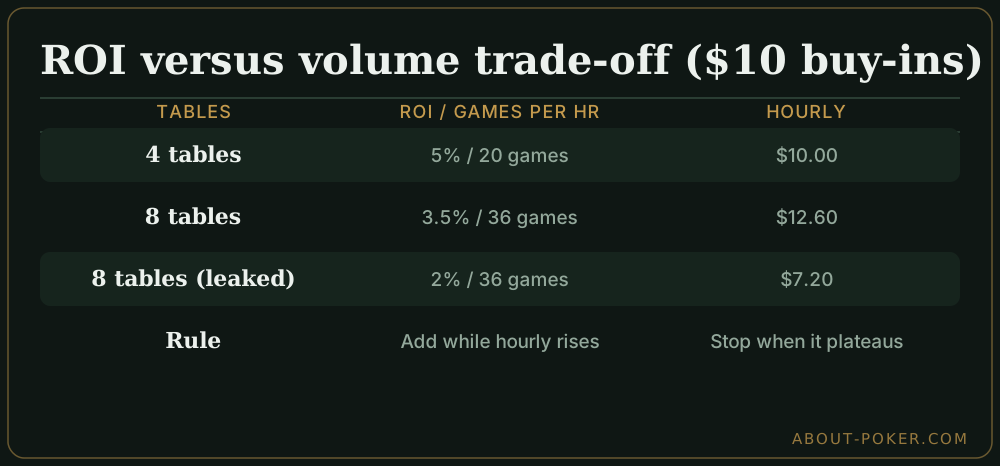
Here is the tension. As you add tables, your per-game ROI almost always falls a little because you make more rushed or default decisions. The question is whether the extra volume more than compensates.
Worked example. Suppose at 4 tables you run a 5% ROI and complete 20 games per hour. At 8 tables your ROI drops to 3.5% but you now complete 36 games per hour. Assume $10 buy-ins.
- 4 tables: 0.05 × $10 × 20 = $10.00 per hour
- 8 tables: 0.035 × $10 × 36 = $12.60 per hour
The 8-table setup wins despite the lower ROI, because volume more than offset the edge loss. But if ROI at 8 tables collapsed to 2%, your hourly would be 0.02 × $10 × 36 = $7.20 — worse than 4 tables. The lesson: add tables only while your total hourly keeps climbing. Track this against your overall SNG ROI and win rate so you know your real numbers rather than guessing.
Simplify your decisions
You cannot play deep, creative postflop poker on 10 tables at once. The winning multi-tabling style is disciplined and default-heavy:
- Lean on push/fold charts for short stacks so those decisions are instant and correct.
- Reduce marginal postflop spots — take the simpler line rather than the theoretically optimal one that requires 30 seconds of thought.
- Act on clear reads, not thin guesses. If you are unsure, default to the standard play and move on.
- Prioritize the table with the biggest decision when two demand attention at once; let a close spot at another table resolve on a default.
This is a deliberate trade: you sacrifice a sliver of per-table edge to keep every table’s decisions timely and sound.
Table layout and setup
Physical setup matters more than beginners expect. Use a tiled layout where no table overlaps another, so you always see the full action. Stacked or cascaded windows hide tables and cause timeouts, which are pure losses. Enable action highlighting or a “table needs attention” pop-up if your client offers it, and set up hotkeys for common bet sizes so you are not hunting for buttons.
Ramp up your table count gradually. Start a session at your comfortable number and only open more once you have settled in. Never open your maximum count cold.
Common multi-tabling mistakes
- Adding tables too fast. Jumping from 4 to 12 overnight tanks your ROI. Add one or two at a time and verify results.
- Timing out. A single timed-out fold in a spot you should have shoved can cost a cash. Layout discipline prevents this.
- Chasing volume over bankroll. More tables means more simultaneous buy-ins at risk. Keep your table count within your SNG bankroll management limits.
- Ignoring fatigue. Mental sharpness fades across a long multi-table session. Shorter, focused sessions often beat marathon grinds.
Scaling checklist
- Is my current table count producing a stable, positive ROI?
- Am I completing decisions without ever timing out?
- Is my hourly rate still rising as I add tables, or has it plateaued?
- Is my bankroll deep enough for this many simultaneous buy-ins?
- Am I defaulting cleanly on close spots instead of agonizing?
Answer yes to all five and you are ready to add another table. Answer no to any and you have already found your ceiling for now.
Frequently asked
How many sit & gos should I play at once?
Start with two or three and only add tables when your win rate holds steady at that count. Serious grinders run 6-12 or more, but volume is worthless if it degrades your decisions and cuts your ROI.
Does multi-tabling lower my ROI?
Usually yes, slightly, per game — but total profit is ROI times volume. If dropping from 4% ROI at 4 tables to 3% ROI at 8 tables doubles your games, you make more money overall. The trick is finding where added tables stop being worth it.
What table layout is best for multi-tabling SNGs?
Tiled (non-overlapping) layouts are best for many tables because you can see every table's action at once and never miss a decision. Cascaded or stacked layouts risk timing out. Use a layout tool if your client supports one.
How does strategy change when multi-tabling?
You simplify. Lean on push/fold charts, reduce marginal postflop spots, and act on strong reads rather than agonizing over close decisions. Consistency across many tables beats perfect play on one.