Sit & Go ICM Basics
ICM basics for sit & gos: why chips are worth less than money, tighter bubble calls, wider shoves, and a worked ICM fold example on the SNG bubble.
On this page · 6 sections
ICM is the single most important concept in sit & go strategy, and most losing players either ignore it or misunderstand it. It explains why you should shove wide but call tight near the bubble, why a chip lead is worth less than it looks, and why the “obvious” call is often a losing play. This page teaches the basics in plain terms. When you are ready to apply it to shoving decisions, our push/fold and ICM in SNGs guide carries it into concrete ranges.
What ICM actually is
ICM stands for the Independent Chip Model. It is a formula that converts your chip stack into its real-money value, given the remaining players’ stacks and the payout structure. The core insight is that chips in a tournament are not money — you can only realize value by finishing in a paid position, and payouts are flat relative to chip counts.
In a standard 9-player SNG, first pays 50%, second 30%, and third 20%. Notice that going from an average stack to the chip lead does not come close to doubling your equity, because second and third still pay well. ICM captures this precisely: each additional chip you win is worth less than the one before. For the full definition and math, see what is ICM in poker.
Why chips are worth less than their face value
Because you cannot cash out chips, doubling your stack never doubles your money. The chips you stand to lose are more valuable than the chips you stand to gain. This asymmetry is the heart of ICM.
Concrete illustration: imagine four players left in a game that pays three. Everyone has 2,500 chips. If you shove and lose, you finish fourth for zero — you forfeit a near-certain payday. If you shove and win, you gain 2,500 chips but your equity climbs far less than proportionally, because you were already almost guaranteed to cash. Losing costs you everything; winning gains you a little. That is why survival becomes so valuable near the money.
The golden rule: shove wide, call tight
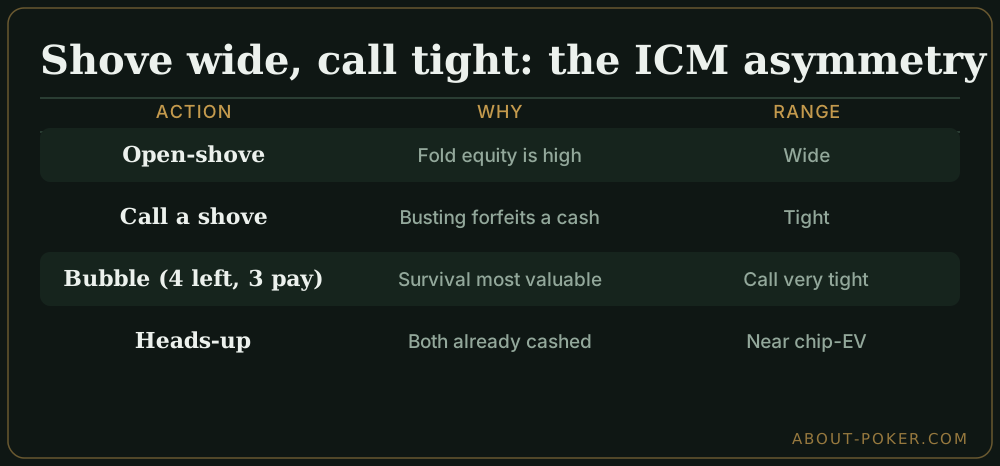
ICM creates a powerful asymmetry between shoving and calling:
- Shoving is cheap because fold equity is high. Opponents fear busting, so they fold often, letting you steal blinds and antes with a wide range.
- Calling is expensive because busting forfeits a near-certain cash. You need a much stronger hand to call an all-in than the raw pot odds suggest.
This is why the same hand can be a clear shove from your seat and a clear fold when facing a shove. The direction of the aggression flips the ICM math entirely. This is expanded in our ICM in sit and gos page.
A worked ICM fold example
Four players left, top three pay, blinds 100/200. You have 3,000 chips in the big blind with A-9 offsuit. The chip leader with 6,000 shoves from the button. The other two players have short stacks of about 1,500 each. Do you call?
In a pure chip-EV game, A-9 offsuit is a comfortable call against a wide button-shoving range. But under ICM, this is a fold. If you call and lose, you bust in fourth for zero, throwing away a cash you were likely to secure by simply folding and letting the two short stacks bust first. The two players sitting on 1,500 chips are far more likely to be eliminated before you, so folding preserves your near-lock on the money. The chips you would win do not compensate for the money you would risk. ICM turns a routine call into a clear fold — that is the concept in action.
Common ICM mistakes
- Calling too wide on the bubble. The classic leak. Players use chip-EV odds and call off with hands ICM says must fold.
- Not shoving wide enough. The flip side. Fearful players fold spots where their fold equity makes a shove hugely profitable.
- Ignoring the other stacks. ICM is relational. A call that is fine with two big stacks left is a disaster with two short stacks about to bust.
- Applying ICM heads-up. Once you reach heads-up in a standard SNG both players have cashed, so ICM pressure nearly vanishes and you play close to chip-EV.
ICM basics checklist
Before any big preflop decision near the money, run this:
- Am I the one applying pressure (shove wider) or facing it (call tighter)?
- Are there shorter stacks likely to bust before me, making survival more valuable?
- Does busting here forfeit a near-certain cash?
- Am I using ICM logic, not raw chip-EV pot odds?
- Has the bubble already burst, meaning I can loosen back toward chip-EV?
Internalize those five questions and you will make the folds and shoves that quietly separate winning SNG players from the field.
Frequently asked
What is ICM in a sit & go?
ICM, the Independent Chip Model, converts your chip stack into its real-money value based on the payout structure. Because SNG payouts are flat and top-heavy, chips are not worth their face value — the chips you can lose are worth more than the chips you can win.
Why do chips lose value in a sit & go?
You cannot cash out chips; you can only finish in a paid position. Since first place does not pay proportionally more than second or third, doubling your stack does not double your equity. That diminishing return is what makes chips worth less than their face value near the money.
How does ICM change my calling range on the bubble?
It tightens it dramatically. Calling an all-in on the bubble risks busting out of a near-certain cash, so ICM makes those calls much more expensive than the raw chip odds suggest. You call far tighter than you would in a chip-EV game.
Does ICM make me shove wider or tighter?
Wider as the aggressor. Because opponents must call so tightly to avoid busting, your fold equity goes up, so shoving into short and medium stacks near the bubble becomes very profitable even with weak hands.