Buying In at a Casino Poker Room
Learn exactly how to buy in at a casino poker room — from the podium waitlist to putting cash on the table — so your first live session starts smoothly.
On this page · 7 sections
Buying in at a casino poker room is a two-minute process once you know the steps, but it trips up almost every first-timer. You do not sit down and hand a dealer your bank card — poker is a cash game between players, and the room only takes a rake. This guide walks you from the front door to your first hand, and explains how much to bring so you are not the short stack getting pushed around.
Start at the podium
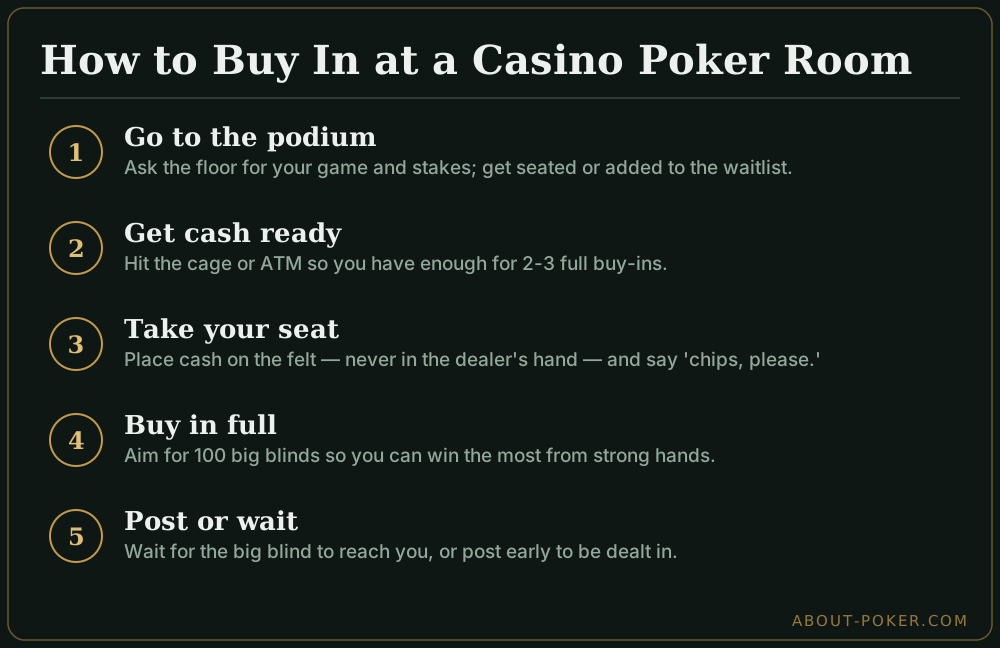
Every poker room has a podium or desk near the entrance, usually with a whiteboard or digital screen listing the games running. Walk up and tell the floor person what you want — for example, “$1/$2 No-Limit Hold’em.” If a seat is open you’ll be sent straight to a table. If not, they add your initials to the waitlist and call your name (often over a microphone) when a seat opens.
While you wait, this is a good moment to hit the cashier’s cage or an in-room ATM so you have cash ready. You can review the broader flow in our first-time live poker guide if this is your debut.
Getting your chips
There are two ways to turn cash into chips:
- Buy in at the table. This is the most common. Sit in your assigned seat, place your cash on the felt (do not hand it to the dealer directly — house rules require it go on the table so cameras can see it), and say “chips, please.” A chip runner or the dealer will bring your stack.
- Buy in at the cage. Some rooms have you buy chips at the cashier before sitting. You then carry your rack to the table.
Never buy chips from another player at the table — that is against the rules everywhere and can get you both warned.
How much to buy in for
The table has a posted minimum and maximum. As a rule, buy in for the maximum you can comfortably afford, and think in big blinds rather than dollars. A full stack is 100 big blinds.
At $1/$2 No-Limit Hold’em:
- Minimum is often $40-$100 (20-50 big blinds).
- Maximum is usually $200-$300 (100-150 big blinds), though many rooms are uncapped.
Buying in for the max matters because you can only win from an opponent what you have in front of you. If you sit with $60 and stack a player holding $300, you still only win $60. A deep stack also lets you apply pressure and play a wider, more skillful game postflop.
Worked example: the short stack trap
Say you sit at $1/$2 with only the $40 minimum — that is 20 big blinds. You wake up with pocket aces, raise to $8, and get one caller. The flop comes and you get it all in for your remaining $32. Best case, you double to $80. Now compare that to sitting with $300: the same aces, played across three streets against a stubborn opponent, can win you $150 or more. Same hand, same skill, but the deep stack captures nearly four times the value. Short-stacking throws away your edge on exactly the spots where you have one.
Rebuying and adding on
You can add chips to your stack between hands, up to the table maximum, whenever you want — this is called a top-up or rebuy. If you lose your stack, just put more cash on the felt and rebuild to a healthy amount. You can never remove chips from the table during a session and pocket them (that is “going south” or “ratholing”) and is strictly forbidden. When you leave, you rack your chips and cash them at the cage.
Etiquette during the buy-in
A few small habits mark you as someone who belongs:
- Place cash on the table, not in the dealer’s hand. Cameras must see the transaction.
- Wait for the big blind or post. In most rooms you either wait for the blind to reach you or “post” (pay a blind early) to be dealt in immediately. Ask the dealer if unsure.
- Do not tap the table or ask to play while chips are en route. Wait until you have your stack.
For the fuller list of table manners, see our poker etiquette rules and the mechanical details in live poker rules.
Quick pre-game checklist
Before you take your seat, run through this:
- Cash in hand (2-3 full buy-ins is a safe session bankroll).
- Registered on the waitlist or assigned a seat.
- Know the stakes and the min/max buy-in.
- Plan to buy in for a full 100 big blinds if you can.
- Ready to place cash on the felt and ask for chips.
Get these right and nobody at the table will guess it is your first time. The buy-in is the easiest part of live poker to master — after that, the game itself takes over.
Frequently asked
How much should I buy in for at a casino poker room?
Buy in for the maximum the table allows if you can afford it, or at least 100 big blinds. At $1/$2 No-Limit that means around $200-$300. Buying in short leaves you unable to punish opponents' mistakes and limits your winnings on your best hands.
Can I buy in with a credit card at a poker table?
No. Poker tables take cash only. You'll need to get chips from the cage or an ATM first, or buy in for cash at the table. Some rooms let you buy chips at the cage before sitting down.
What is the minimum buy-in for live poker?
The minimum is set by the room and posted at the table, usually 40 to 50 big blinds. For $1/$2 No-Limit that is often $40-$100. The maximum is typically 100-200 big blinds or, in deep-stack games, uncapped.