Managing a Big Live Session
How to manage a long live poker session: set stop points, guard focus and stamina, adjust as the table changes, and quit for the right reasons.
On this page · 7 sections
A big live session is a stamina event as much as a poker event. You might sit for eight, ten, even fourteen hours, and the difference between a winning trip and a losing one is often not the hands you were dealt but how well you managed your focus, your emotions, and your reasons for staying or leaving. Online you can quit in a click; live, you have committed a whole day, and that sunk cost quietly pushes you to play too long, too tired, and too loose.
Play the game, not the clock
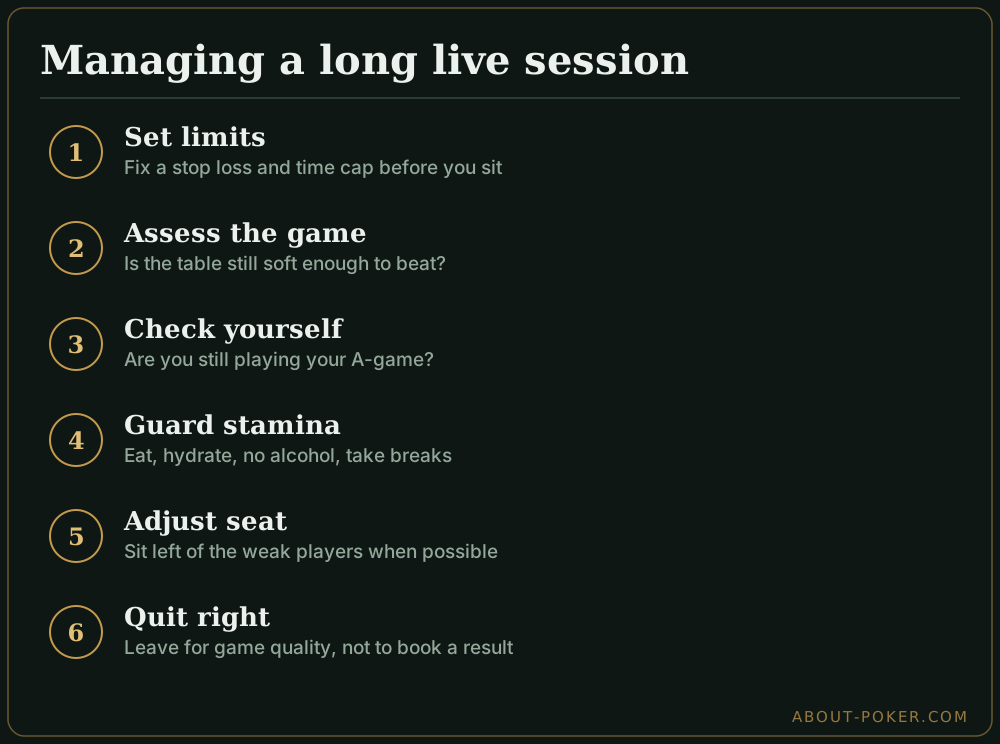
The single most important idea: your stopping point should be about the quality of the game and the quality of your own decisions, not a fixed number of hours. A soft table with three recreational players splashing chips is worth staying at even when you are a little tired. A grinder-heavy table where the fish already busted is worth leaving even if you have only been there two hours. Ask two questions on a loop: is this game still beatable, and am I still playing my A-game? When either answer turns to no, you have your exit.
For a broader picture of how live play differs from the click-speed of online, see our live poker tips guide — the slow pace is exactly why session management matters more live.
Set your stop points before you sit
Decide your limits while you are calm, not while you are stuck. Three numbers are worth writing down or fixing in your head:
- A stop loss in buy-ins — often two to three — after which you leave regardless of how good the game looks.
- A time cap for when you started, so a 2 a.m. start does not turn into a bleary 7 a.m. disaster.
- A focus check every orbit or two: if you cannot recall what the last aggressor has been doing, your reads have already degraded.
These are guardrails, not laws. The stop loss especially is about protecting you from tilt, not from variance — variance is fine, but a tilted stack refill at hour nine is where trips go to die.
Guard your stamina and your focus
Treat your body like equipment. Eat before you are hungry, drink water alongside anything else, and take a real five-minute walk once an hour or two — standing up resets both your posture and your attention. Alcohol is a straightforward negative-EV decision; even a couple of drinks measurably loosen your calling range. The players who last are the ones who look after boring things: sleep the night before, a light meal, and a hard rule about caffeine timing so they are not crashing at the exact moment the game gets juicy.
Adjust as the table evolves
A live table is a living thing over a long session. The maniac who was spewing at hour one may tighten up after losing three buy-ins. A tight regular may start tilting after a bad beat and become your best customer. Seats change: the fish to your right is worth far more than the same fish to your left, so consider a seat change or table change request when it opens value. Keep updating your reads — the tells and patterns you built early can go stale, which is why reading poker hands is a continuous process, not a one-time snapshot.
A worked example
You sit down at 6 p.m. with a $500 stack in a $2/$5 game and a stop loss of three buy-ins ($1,500) and a soft target to reassess at 2 a.m. By 11 p.m. you are up $1,200; the two big spenders who made the game great have busted and gone home, replaced by two tight regulars. Nothing dramatic has happened, but the game is now roughly break-even for you. This is the textbook quit-while-ahead spot: the edge is gone, so you rack up. Contrast the mirror case — you are down $900 at midnight but the table is still full of loose callers and you feel sharp. Here you stay, because the game is beatable and your decisions are still clean. Notice that in neither case did the win/loss number decide it; the game quality and your state did.
Quitting for the right reasons
The hardest skill is separating good reasons to quit from bad ones. Good reasons: the game got tough, you are tired, you have hit your stop loss, or you can feel tilt creeping in. Bad reasons: you just want to lock up a win, you got unlucky in one big pot and feel owed, or you are bored. Booking a win in a great game is a leak; chasing losses in a bad one is a bigger leak. If you catch yourself calculating how much you need to win to get even, that thought itself is the signal to leave.
Session checklist
- Have I defined a stop loss and a time cap before sitting?
- Is the game still soft enough to beat right now?
- Am I still playing my A-game, or have my reads gone fuzzy?
- Have I eaten, hydrated, and stayed off alcohol?
- Am I in the best available seat relative to the weak players?
- Am I about to quit for a game-quality reason, or just to book a result?
Manage those six things and the hands mostly take care of themselves. For newcomers to the live environment, pair this with our first-time live poker guide so the logistics never distract you from the decisions that matter.
Frequently asked
How long should a live poker session last?
Play as long as the game is good and you are still sharp, not for a fixed number of hours. Most players start leaking edge after 6 to 8 hours because focus and discipline fade. If you can no longer describe why your last three big decisions were correct, it is time to go home.
Should I set a stop loss for live cash?
A stop loss protects you from tilt more than from variance. A common rule is two to three buy-ins, but the real trigger is emotional: if you notice yourself playing to get even rather than to make good decisions, stop regardless of the number. Winning players quit bad states, not just bad results.
Is it correct to quit while ahead?
Only if the game has gotten tougher, the good players busted the fish, or you are tired. Booking a win for its own sake is a leak. If the table is still soft and you are still focused, staying is the profitable choice even after a big score.