Playing Your First Live Tournament
A beginner's guide to playing your first live poker tournament — what to expect at registration, how blind levels work, and how to protect your stack early.
On this page · 6 sections
Your first live tournament is a different experience from cash games or online play — there is a fixed buy-in, a rising blind structure, and the pressure of a shrinking field. Knowing the mechanics in advance lets you focus on decisions instead of logistics. This guide walks you through what to expect and how to play your first live tournament without beating yourself.
Before you sit down: registration and the structure sheet
Get to the room 30 to 45 minutes early. You will pay your buy-in at the cashier or registration desk, receive a seat card with a table and seat number, and find your spot. Chips are usually already stacked at the seat or handed to you on arrival. If anything is unclear, ask a floor person — that is exactly what they are there for, as covered in live poker rules.
Before play starts, find the structure sheet. It lists the starting stack, the blind levels, how long each level lasts, and whether re-entry or rebuys are allowed. Two numbers matter most: your starting stack in big blinds, and how fast the blinds climb. A deep, slow structure rewards patience; a fast “turbo” structure forces action sooner. Knowing which one you are in shapes your whole approach.
How blind levels change the game
Unlike a cash game, tournament blinds rise on a timer. As they climb, your stack shrinks in big-blind terms even if you win no pots. Your effective stack — measured in big blinds, not chips — is the single most important number to track. With 60 big blinds you can play a full postflop game; at 15 big blinds or fewer you are in shove-or-fold territory and the math changes completely.
This is why chip preservation early is not the same as playing scared. You are protecting an asset that gains leverage as the field thins and short stacks are forced to gamble. For a fuller breakdown of the format, see live poker tournament basics.
A worked example: early-stage discipline
You start with 20,000 chips at blinds of 100/200 — a 100 big blind stack. In the first level you are dealt Ah Jc on the button. A tight early-position player raises to 600, and a middle-position player calls. You have a decent hand, but AJ offsuit is easily dominated by the AK, AQ, and pairs that make up a tight player’s opening range, and you would be out of position to the raiser postflop in a three-way pot.
Because the blinds are tiny relative to your stack, there is almost nothing to win here and real money to lose if you flop top pair and get stacked by a better ace. Folding is completely fine. This is the essence of early-tournament play: with 100 big blinds and small blinds, you do not need to fight marginal battles. Wait for spots where you have a clear edge.
Live-specific things that surprise first-timers
Live play is slower — you will see far fewer hands per hour than online, so patience is mandatory. You must also act in turn, protect your cards, and handle your chips clearly; fumbling these can cost you or slow the game. The first-time live poker guide covers the etiquette in detail, but the essentials are: do not act out of turn, keep your cards on the table with a chip on top, and announce your action verbally when raising.
Table breaks are another surprise. As players bust, tables are consolidated and you may be moved to a new seat mid-tournament. Bring your chips and your seat card, and adjust — you will have no reads on your new table, so tighten up briefly until you gather information.
Common first-tournament mistakes
The biggest is playing too many hands early, treating the tournament like a cash game where you can reload. In a freezeout you cannot; your tournament life is finite. The second is ignoring effective stack depth and playing a 15-big-blind stack as if it were 50 — at short stacks, limping and calling raises are traps, and a clean shove is usually better.
A third mistake is tilting after a bad beat and firing away your remaining chips. Variance is brutal in tournaments; even great players bust most events. Detach from any single result. The fourth is not reading the structure — showing up without knowing whether you can re-enter, or how fast blinds rise, leaves you playing blind to the format.
A quick pre-tournament checklist
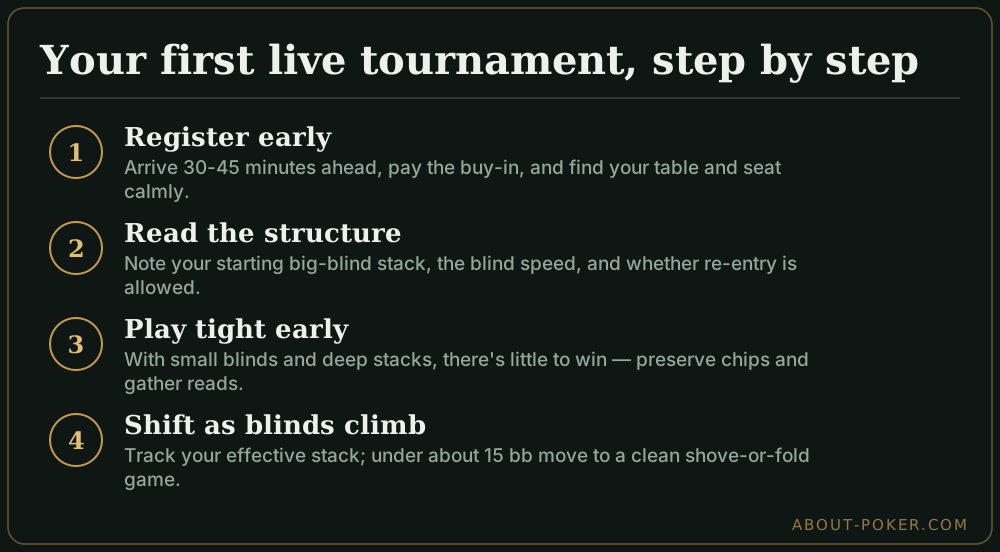
Arrive early and register calmly. Read the structure sheet and note your starting big-blind stack and the blind speed. Confirm whether re-entry or rebuys are available so a bust-out does not surprise you. Plan to play tight and patient in the early levels while you gather reads.
Track your effective stack in big blinds every level, and shift toward shove-or-fold as you drop under about 15. Above all, accept that busting is normal and does not mean you played badly. Your first live tournament is as much about learning the rhythm of the room as it is about the cards — treat it as practice, and the results will follow.
Frequently asked
How early should I arrive for my first live tournament?
Arrive at least 30 to 45 minutes before the start. You will need to register, pay the buy-in, get your table and seat assignment, and find your seat. Arriving early also lets you settle in, watch the room, and avoid the stress of being late while blinds are already running.
What happens if I run out of chips in a tournament?
In a freezeout tournament, busting means you are out. Many events offer re-entry or rebuys during early levels, letting you buy in again for the same amount. Check the structure sheet before you play so you know whether a bust-out ends your day or lets you fire again.
Should I play tight or loose early in a tournament?
Play relatively tight and patient early. Blinds are small relative to stacks, so there is little to win and no reason to risk your tournament life in marginal spots. Preserve chips, gather reads, and let looser players make the early mistakes.