Single Table vs Multi-Table
Single-tabling vs multi-tabling online poker: how playing more tables trades edge for volume, how many tables to run, and how to add tables without leaking money.
On this page · 5 sections
Single-tabling means playing one poker table at a time; multi-tabling means playing several at once, something only possible online. The choice is fundamentally a trade between edge and volume. One table lets you make your best possible decision on every hand. Many tables let you play far more hands per hour, so even a smaller edge on each one can add up to more total profit. Neither is universally “better” — the right answer depends on your skill, your goals, and how well you handle the cognitive load.
The core trade-off: edge vs volume
Your long-run profit is roughly your win rate multiplied by your volume. Win rate online is measured in big blinds per 100 hands (bb/100). A focused single-tabler might win, say, 6 bb/100 because they catch every timing tell, note every tendency, and never rush a decision. Add tables and that number almost always drops — to maybe 4 bb/100 at four tables — because your attention is split and your decisions get faster and more mechanical.
But volume more than compensates in the early stages. One table might deal you 70 hands an hour; four tables deal you close to 280. Even at the lower win rate, four tables at 4 bb/100 across 280 hands produces far more profit per hour than one table at 6 bb/100 across 70. The catch is that the win-rate drop is not linear forever — push too far and each new table costs you more edge than it buys you in volume.
A worked example
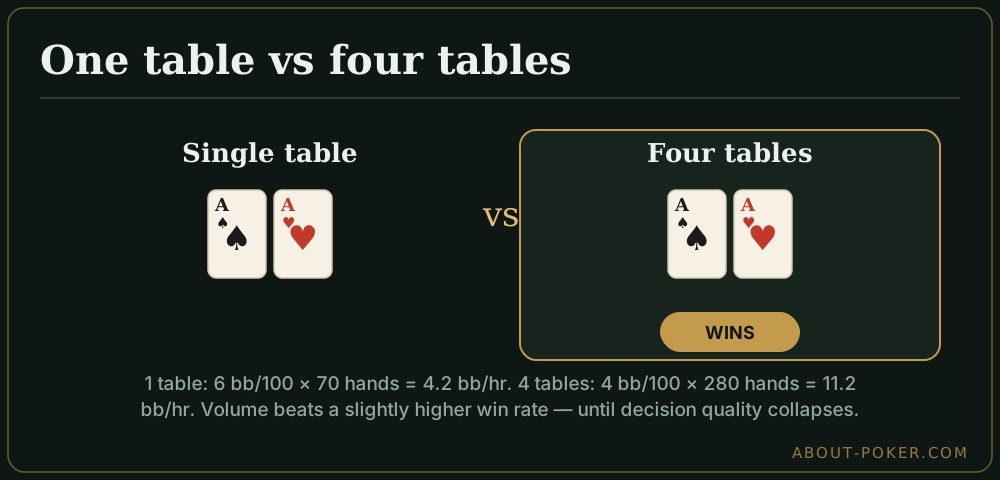
Compare the two setups directly using round numbers.
- One table: 6 bb/100 win rate × 70 hands/hour = 4.2 bb/hour of profit.
- Four tables: 4 bb/100 win rate × 280 hands/hour = 11.2 bb/hour of profit.
Four tables wins here, and it is not close — more than double the hourly rate. Now push to twelve tables, where your win rate collapses to 1 bb/100 because you are barely reading anything and clicking on autopilot: 1 bb/100 × 840 hands/hour = 8.4 bb/hour. You are playing three times the volume of the four-table setup but making less money, because the edge you gave up outweighed the hands you gained. This is the shape of the whole decision: adding tables helps until the per-hand skill loss overtakes the volume gain, and then it hurts.
What you sacrifice by adding tables
Every table beyond the first costs you attention, and attention is where your edge lives. The specific things that erode:
- Reads and notes. You can’t watch showdowns or track betting patterns across eight tables the way you can on one.
- Decision depth. Close spots that deserve thirty seconds of thought get five, so you default to a “standard” line that is sometimes wrong.
- Timing tells. You stop noticing how long opponents take, a real source of information in fast games.
- Table selection. Managing more tables makes it harder to leave a bad seat or a table full of tough regulars.
- Misclicks and fatigue. More tables means more chances to fat-finger a bet size or shove when you meant to fold, and mental fatigue sets in faster.
If you notice these mistakes creeping in, that is the game telling you to drop a table. Ignoring the warning signs is one of the common mistakes that turns a winning grinder into a break-even one.
How to add tables the right way
The path is simple: get good at one table first, then scale carefully. Do not open six tables on day one hoping volume will hide a leaky game — it just multiplies your leaks. Build a stable, winning single-table game, confirm it over a real sample, and only then add a second table.
A practical progression:
- Master one table until you are a confident, tracked winner.
- Add one table at a time, and play that number for several sessions before adding another.
- Watch your win rate, not just your hourly. If bb/100 falls off a cliff when you add a table, drop back down.
- Tighten up slightly as you add tables — fewer marginal spots means fewer decisions to rush.
- Fix your table layout so no table is ever hidden; tiled beats stacked for most players.
Fast-fold formats like Zoom change this math a little: because you are moved to a new hand the instant you fold, a single Zoom table already feels like multiple regular tables in terms of hands per hour, so you usually run fewer of them. For the broader picture of grinding online — software, formats, and setup — start with our guide to playing Texas Hold’em online.
The bottom line
Single-tabling is a skill-maximizing choice; multi-tabling is a profit-and-volume choice. If your goal is to learn and improve, play one table and study every decision. If you are already a proven winner and want to build your bankroll, add tables gradually until your win rate tells you to stop. The winning grinder finds the specific table count where their total hourly profit peaks — and then resists the temptation to add “just one more.”
Frequently asked
Is it better to play one table or multiple tables?
It depends on your goal. One table maximizes your win rate per hand because you can focus fully on reads and decisions. Multiple tables maximize total profit and volume at the cost of some per-hand edge. Beginners should master one table first, then add tables gradually.
How many tables should I play online?
Start with one table until you are a confident winner. Then add tables one at a time, watching your win rate. Most solid regulars run four to eight tables; only experienced grinders play more, and past a certain point the drop in decision quality outweighs the extra volume.
Does multi-tabling lower your win rate?
Usually, yes, on a per-hand basis. Splitting your attention across tables means fewer reads, faster and more mechanical decisions, and more misclicks. But because you play many more hands per hour, your total hourly profit can still rise even as your win rate per 100 hands falls.