Sit & Go vs MTT
Sit & Go vs MTT compared: field size, payout shape, session length, and the ICM and strategy differences that decide which format suits you.
On this page · 7 sections
Sit & Gos and multi-table tournaments (MTTs) are both tournaments, but the size of the field changes almost everything: how often you cash, how long you play, how much you can win, and how the money-bubble decisions work.
| Feature | Sit & Go | MTT |
|---|---|---|
| Field size | 1 table (or small) | Hundreds to thousands |
| Start | When seats fill | Scheduled time |
| Payouts | Top 2–3, flat | Top ~15%, top-heavy |
| Session length | 20–60 min | Several hours |
| Variance | Lower | Very high |
How the formats differ
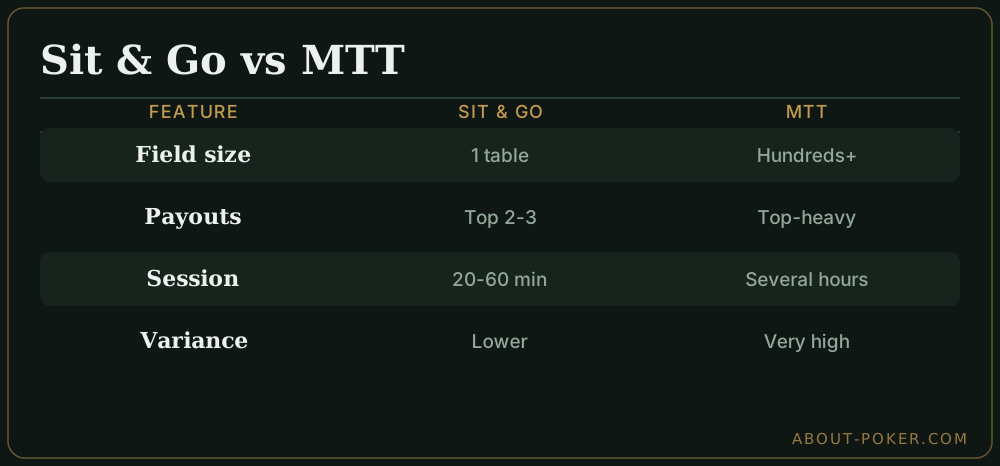
A Sit & Go launches the moment the required players register — no clock to watch. The classic version is a single nine- or six-handed table paying the top three finishers. Fields are tiny and fixed, sessions are short, and you cash often. A multi-table tournament has a scheduled start, a huge field, and a top-heavy payout that funnels most of the prize money to the final table.
That payout shape is the heart of the difference. In an SNG, reaching the final three is the whole game, and each of those spots is worth a solid chunk. In an MTT, min-cashing is barely above breakeven; your profit lives in the rare deep runs where the prizes explode.
ICM and the money bubble
Because SNG payouts are flat and the bubble arrives fast, the Independent Chip Model — ICM — dominates single-table strategy. Near the bubble, survival is worth more than raw chips, so you tighten up, especially with a medium stack, and let short stacks bust first. The big stack, meanwhile, applies maximum pressure precisely because everyone else is playing to survive.
MTTs also involve ICM, but with thousands of players and a distant final table, chip accumulation matters far more for most of the event. You take marginal spots to build a stack that can reach the top-heavy prizes. Understanding when survival trumps chips is the key skill split between the two; the tournament strategy guide breaks these bubble dynamics down further.
A worked example
You are on the SNG bubble — four players left, three get paid — with a medium stack of 15 big blinds. The big stack open-shoves from the button and you look down at A9 offsuit in the big blind. Against a wide button jamming range, A9o is often ahead in raw equity. But calling risks your entire tournament life on the bubble, where busting means zero and folding into the money is guaranteed value. ICM says fold many hands you would happily call in an MTT deep run. If a short stack were about to bust regardless, folding A9 here is standard. In an MTT far from the money, that same A9o call is routine because a bust costs you far less relative to the upside.
Session length and volume
SNGs suit players with limited time: you know roughly when the game ends, and you can fit one into a lunch break. MTTs are an open-ended commitment — a deep run can last five or six hours, and you cannot leave a good stack without torching equity. If you want predictable sessions, SNGs win. If you want the shot at a life-changing score and can block out an evening, MTTs deliver.
Common mistakes
The biggest SNG leak is ignoring ICM and calling off on the bubble like it is a cash game. The biggest MTT leak is the opposite — playing too tight and “protecting” a min-cash instead of building the stack that reaches real money. Skills like short-handed play and positional awareness matter in both, but the way you value survival flips between them.
Which should you play?
Choose SNGs for lower variance, frequent cashes, and predictable, short sessions — ideal for building steady confidence and studying bubble play. Choose MTTs for top-heavy prizes, deep-run excitement, and bigger scores, if you can handle long sessions and long dry spells. Many players use SNGs to sharpen endgame skills that pay off at MTT final tables.
Quick checklist
- SNGs start when seats fill; MTTs run on a schedule with huge fields.
- SNG payouts are flat and top-3; MTT payouts are top-heavy at the final table.
- ICM and survival dominate SNG bubbles; chip accumulation dominates most of an MTT.
- SNGs have short, predictable sessions; MTTs can run many hours.
- Do not call off on an SNG bubble the way you would deep in an MTT.
Frequently asked
What is a Sit & Go?
A Sit & Go, or SNG, is a tournament that starts as soon as enough players register — there is no scheduled start time. The most common form is a single-table nine or six-max event, but multi-table SNGs exist too. They have small, fixed fields and short, predictable sessions.
Is an SNG or MTT easier to win?
SNGs are easier to cash because a single table often pays the top three, so you finish in the money far more often. MTTs are harder to cash but pay dramatically more at the top, since you are beating hundreds or thousands of players for one big prize.
Which format has lower variance?
Single-table SNGs have much lower variance because the field is small and you cash frequently. MTTs are extremely high variance — you can play well for hours and min-cash or bust, and most of your long-term profit comes from rare deep runs and final tables.