Building a Poker Study Plan
How to build a poker study plan that actually improves your win rate: set goals, pick sources, schedule blocks, and measure progress with a repeatable loop.
On this page · 7 sections
Most players “study” reactively — whatever caught their eye that day. A study plan replaces that scatter with a system: a goal, a prioritized target list, matched activities, a schedule, and a feedback loop. The plan is what turns effort into a rising win rate instead of spinning wheels. Here’s how to build one you’ll actually follow.
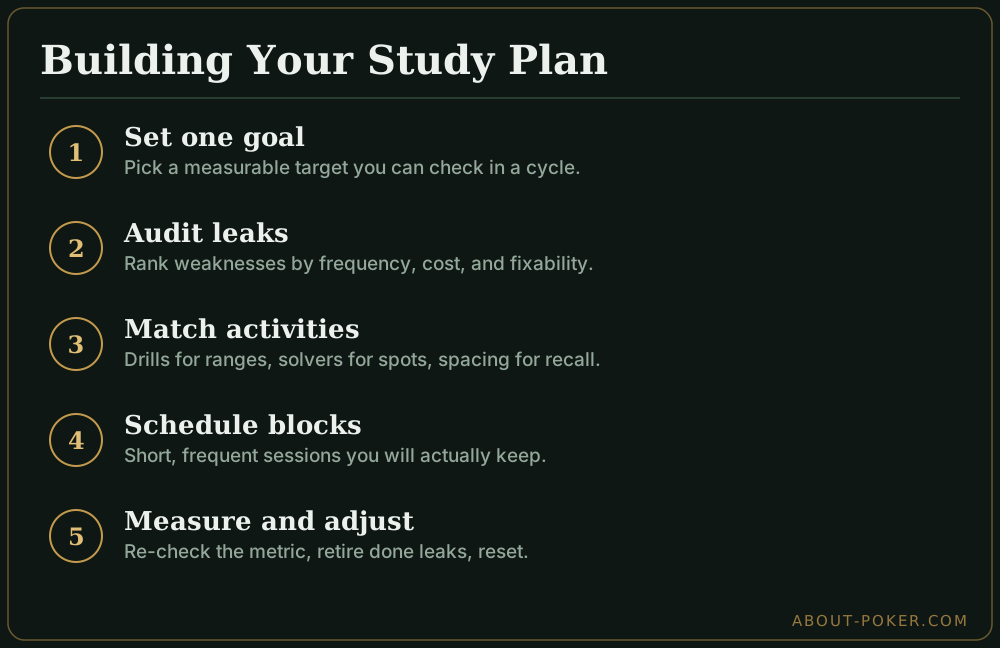
Step 1: Set one measurable goal
Vague goals (“get better”) produce vague effort. Pick something you can measure over a cycle: “cut my 3-bet-pot fold rate on the turn,” “add a value bet on the river in spots I’m checking back,” or “raise my win rate from break-even to a clear profit over 20k hands.” A concrete goal tells you exactly what to study and how you’ll know it worked.
Step 2: Audit your leaks and prioritize
Your plan should attack your biggest, most frequent, and most fixable weaknesses first — not the ones that are most fun to study. The best source is your own play. Reviewing hand histories or running your database through tracking software gives you evidence rather than guesses; finding leaks in your poker database turns thousands of hands into a ranked list. Prioritize by three factors: how often the spot comes up, how much it costs when you get it wrong, and how quickly it can be fixed. A frequent, expensive, easy leak is your first target every time.
Step 3: Match an activity to each leak
Different leaks need different tools. Don’t watch a random video and hope. Map the fix to the problem:
- Preflop range errors → drilling with a trainer and flashcards.
- A specific postflop spot → solver study to extract the principle, then targeted review.
- Recall failures at the table → spaced-repetition review of the relevant charts.
- Fuzzy fundamentals → structured reading, then self-testing.
For memorization-heavy material, spaced repetition for poker study is the most efficient method there is — it schedules reviews right before you’d forget, so ranges become automatic in minutes a day rather than hours.
Step 4: Schedule it realistically
A plan you can’t sustain is worthless. Be honest about your available time and build blocks that fit it. Short, frequent, focused sessions beat rare marathons — thirty minutes four times a week outperforms one three-hour cram, because active learning fades when you’re tired and spacing helps memory. Put the blocks on your calendar like any appointment. If your general approach to off-table work is shaky, the fundamentals in how to study poker pair naturally with this scheduling layer.
Step 5: Measure and adjust
At the end of each two-to-four-week cycle, check the metric you set in Step 1. Did the leak shrink? Do the spots feel more automatic? If yes, retire that target and re-audit for the next one. If not, ask whether the activity was wrong for the leak, or whether you simply didn’t put in the reps. Then rebuild the plan for the next cycle. This audit-fix-remeasure loop is the whole engine.
A worked weekly plan
Suppose your audit shows your biggest leak is over-folding the turn in single-raised pots, and a secondary leak is shaky button opening ranges. A one-week plan might look like this:
- Monday (30 min): Button open-range drill + add missed hands to flashcards.
- Tuesday (40 min): Review five recent turn-fold hands; for each, write the opponent’s range and whether the fold was justified.
- Wednesday (30 min): Load the two worst of those into a solver; note the turn-defense principle you were missing.
- Thursday (20 min): Flashcards only — clear due cards, drill the new turn principle.
- Friday (40 min): Play a short session applying the turn lesson; flag any spot it came up.
- Weekend: One review pass; note whether the turn leak felt smaller and set next week’s target.
That’s roughly two and a half focused hours, every block tied to a named leak, with a built-in measurement at the end. Multiply that over a few cycles and the improvement compounds.
Keep it lightweight
The best study plan is the one you keep. Don’t over-engineer it into a chore. A single note with your current goal, your top three leaks, your weekly blocks, and last cycle’s result is enough. Revisit it, prune what’s done, and always keep the loop closed: audit, fix, measure, repeat.
Frequently asked
What should a poker study plan include?
A good plan has a clear goal, a prioritized list of leaks to fix, specific study activities matched to each leak, a weekly schedule, and a way to measure progress. The structure matters less than that every study block ties back to a concrete weakness in your own game.
How long should a poker study plan run before I change it?
Review your plan roughly every two to four weeks. That's long enough to make real progress on a leak and gather feedback, but short enough that you're not grinding a stale focus after it's already fixed. Re-audit your leaks each cycle and re-prioritize.
How much study versus play?
A common healthy ratio is one hour of study for every three to five hours of play, though beginners often benefit from more study early on. Quality beats quantity — a focused hour tied to a real leak beats an unfocused afternoon.
Do I need paid tools to study effectively?
No. You can build a strong plan with free trainers, your own hand histories, and a spreadsheet. Paid solvers and tracking software speed things up, but a disciplined, well-structured free plan beats an expensive tool used aimlessly.