How Many Hands to Judge a Win Rate
How big a sample do you need before your poker win rate means anything? The real numbers, why variance fools you, and how to read your results honestly.
On this page · 6 sections
Nearly every online player has stared at their tracker after a bad week and wondered whether they are actually any good. The honest answer is almost always the same: you do not have enough hands to know yet. Understanding how many hands it takes to judge a win rate is one of the most important pieces of poker literacy, because it protects you from two disasters, quitting a winning game during a downswing and staying in a losing game during a heater.
Once you understand the sample-size problem, tools like poker variance calculators turn from curiosities into essential reality checks.
Why win rate is so noisy
Win rate in cash games is usually measured in big blinds won per 100 hands (bb/100). A solid online winner might have a true win rate of 3-5 bb/100. That sounds stable, but the standard deviation of results in no-limit hold’em is enormous, typically around 80-100 bb/100. Your signal (the edge) is tiny compared to the noise (the swing) on any single stretch.
This is the whole problem. When the thing you are measuring is small and the random fluctuation around it is large, you need a huge number of observations before the average settles down. That is not a poker quirk; it is basic statistics applied to a low-edge, high-variance game.
The actual numbers
Here is roughly what to expect at each milestone for a cash-game player, assuming typical variance:
- 10,000 hands: essentially meaningless. Your observed win rate could be double your true rate or deeply negative. Do not draw conclusions.
- 25,000 hands: still very rough. The confidence interval spans many big blinds in each direction.
- 100,000 hands: now you can start to believe you are winning or losing, though the interval is still a few bb/100 wide.
- 500,000+ hands: your observed win rate is a reasonably trustworthy estimate of your true rate.
The uncomfortable takeaway: the number where most players start feeling confident (a few tens of thousands of hands) is nowhere near the number where confidence is justified.
A worked example
Say you play 30,000 hands and show a win rate of 6 bb/100. Great, you are crushing, right? Run the math. With a standard deviation near 90 bb/100, the standard error of your win rate over 30,000 hands is roughly 90 divided by the square root of 300 (since 30,000 hands is 300 units of 100), which is about 5.2 bb/100.
A rough 95% confidence interval is your observed rate plus or minus two standard errors, so about 6 minus 10.4 up to 6 plus 10.4, or roughly negative 4 to positive 16 bb/100. Your true win rate could genuinely be negative. That single calculation should permanently change how you read short samples.
How to read your results honestly
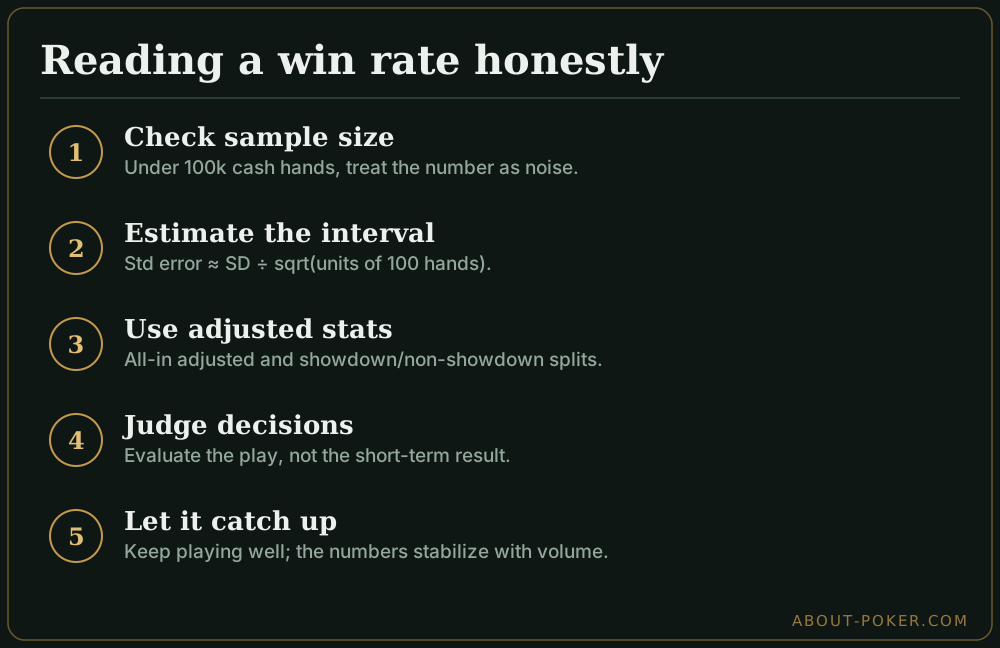
Because raw profit is so noisy, use the extra tools your tracker gives you. All-in adjusted winnings smooth out the luck of coolers by replacing actual all-in results with their expected value. Separating showdown from non-showdown winnings shows whether your profit comes from value hands or from betting opponents off pots. These views are described in poker tracker database explained, and they let you see your edge more clearly than the profit line alone.
The key mental shift is to judge decisions, not outcomes, until your sample is genuinely large. A well-reasoned bluff that gets called is still a good bluff if the math supported it. Outcome-based thinking over small samples is how good players talk themselves into bad changes.
Tournaments are even worse
If cash-game samples are demanding, tournaments are brutal. Most tournament profit comes from a handful of deep runs and wins, which are rare events. That concentration means ROI (return on investment) can stay negative across hundreds of tournaments for a real winner. Expect to need many hundreds, often a few thousand, tournaments before your ROI means much. The feedback loop is simply slower, which is why tournament players lean even harder on process over results.
Common mistakes
The most common error is treating a downswing as proof you have a leak. Sometimes it is variance; sometimes it genuinely is a leak. The way to tell them apart is not to stare at the profit graph but to study your actual decisions in your database. If you want to find real problems rather than blame variance, finding leaks in your poker database shows how to isolate genuine mistakes from noise.
The second mistake is moving up in stakes off a small winning sample, then getting crushed and blaming the tougher competition when the real culprit was an unearned confidence built on 15,000 lucky hands.
The disciplined player internalizes one rule: small samples describe your luck, large samples describe your skill. Until the sample is large, keep playing well and let the numbers catch up.
Frequently asked
How many hands until my win rate is reliable?
For cash games, expect meaningful reliability only after roughly 100,000+ hands, and even then the confidence interval is wide. At 20,000 hands your win rate can easily be off by several big blinds per 100 in either direction. Short samples tell you almost nothing about true skill.
Can I be a winning player and still lose over 50,000 hands?
Yes. With normal cash-game variance, a genuine winner can run below break-even across a 50,000-hand stretch. This is why downswings feel so unfair and why you should judge decisions, not short-term profit, until the sample is very large.
Does tournament sample size work the same way?
No, tournaments are far higher variance because most of your profit comes from rare deep runs. You typically need many hundreds to a few thousand tournaments before ROI stabilizes, which is a much slower feedback loop than cash-game hands.