Reviewing Your Poker Hands
A repeatable method for reviewing your poker hands: which spots to pick, how to reason street by street, and how to turn each review into a real improvement.
On this page · 7 sections
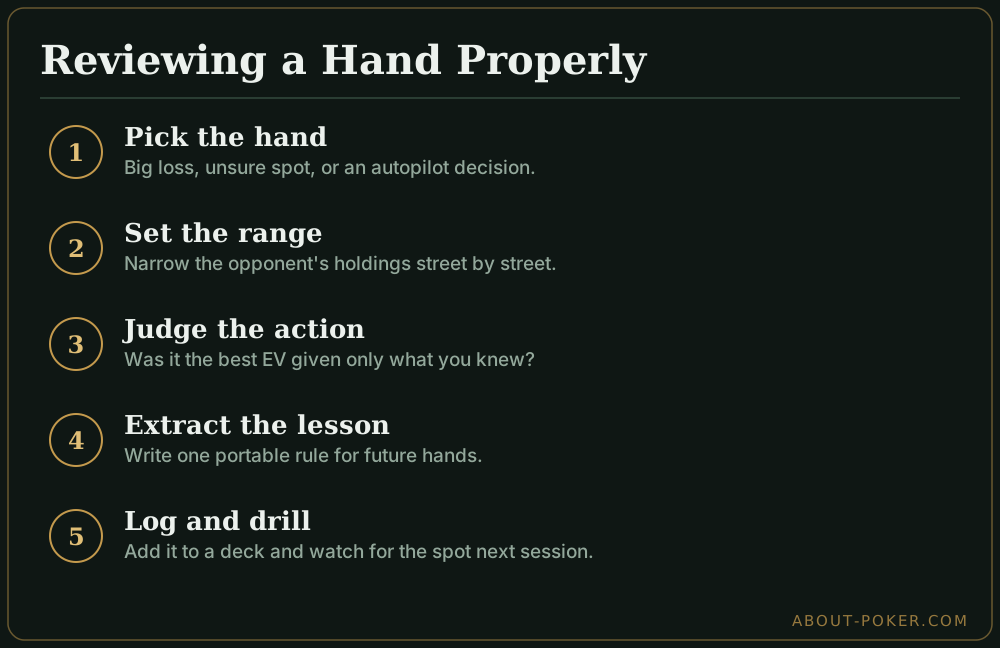
Reviewing your own hands is the highest-leverage study you can do, because it targets exactly the mistakes you’re actually making rather than generic theory. But most reviews are shallow — a quick “should I have called there?” with no real reasoning. This is a method for doing it properly: which hands to pick, how to reason, and how to convert each review into an improvement that shows up next session.
Pick the right hands
You can’t review everything, so choose well. Three categories deserve your attention:
- Big pots you lost. These cost the most, so errors here are expensive.
- Spots where you felt unsure. Confusion is a flag that you lack a clear plan — exactly what study fixes.
- Autopilot decisions. Hands you played on reflex often hide leaks precisely because you never questioned them.
Crucially, don’t only review losses. A hand you won with a loose call or a spewy bluff is a mistake that got lucky — review it too, or it’ll cost you later. If you use tracking software, finding leaks in your poker database can surface the recurring spots worth reviewing rather than leaving it to memory.
Judge decisions, not results
The most important mindset in review: separate the decision from the outcome. Poker is high-variance, so a correct play loses plenty of the time and a bad play wins plenty of the time. If you evaluate hands by whether they worked, you’ll “fix” good plays and reinforce bad ones. Ask instead: given only what I knew at the time, did this action have the highest expected value? That’s the only question that improves your game.
Reason street by street
Work through the hand one decision at a time, and at each point do two things: define your opponent’s range, and pick the best action against that range.
Start preflop — what hands would this opponent take this line with? Narrow it on the flop based on their action, narrow it again on the turn, and again on the river. By the river you should have a tight picture of what they’re representing. Only then judge your action against that range. A structured hand history review workflow keeps this disciplined so you don’t skip straight to “was I ahead?” without doing the range work that actually teaches you.
A worked review
You have Ah Kd in the cutoff, open, and the big blind calls. Flop is Kc 8s 4d — top pair top kicker. Big blind checks, you bet, they call. Turn is the 2h; they check, you bet again, they call. River is the Qc; they lead into you for pot. You call and they show Jc Tc for a rivered straight.
Reviewing decisions, not the result: preflop and flop are standard. On the turn, betting for value is fine — you beat most of their calling range. The river is the real spot. What does a pot-sized lead from a passive caller represent here? Their range is heavy with two pair, sets, and the Q-J and J-T straight combos that just got there; pure bluffs are rare from this player type. Against a range that value-heavy, top pair is a bluff-catcher that’s beaten far more often than the roughly 33% a pot-sized call needs. The correct read is a fold — and you’d reach that conclusion whether or not they happened to show the straight. The lesson to bank: passive players who suddenly lead the river for pot are rarely bluffing.
Turn each review into a lesson
A review that ends at “I misplayed the river” is wasted. Extract a portable, one-sentence rule you can apply to future hands — like the passive-lead lesson above. Write it down. Then feed those lessons into your broader study routine; the loop of play, review, extract, and drill is the core of how to study poker. Add the lesson to a flashcard deck if it’s memorizable, and flag the spot type to watch for next session.
Keep reviews short and frequent
You don’t need marathon sessions. Five focused minutes after most sessions on one or two hands, plus a deeper weekly pass on the toughest spots, beats a rare three-hour slog. The consistency is what builds the pattern-recognition that eventually makes these reads automatic at the table.
A review checklist
- Pick big losses, unsure spots, and autopilot hands — including some you won.
- Judge the decision’s expected value, never the result.
- Define the opponent’s range on every street before judging your action.
- Reason to your own answer first, then check a solver or peer.
- Extract one portable lesson per hand and log it for later drilling.
Frequently asked
How do I review a poker hand properly?
Reconstruct the hand street by street, and at each decision point ask what your opponent's range was and what your best action against that range was. Reason to your own conclusion first, then check a solver or peer if available. The goal is a general lesson, not just a verdict on that one hand.
Which hands should I review?
Prioritize spots where you lost a big pot, felt genuinely unsure, or made a decision on autopilot. Don't just review hands you lost — a hand you won with a bad play is a leak waiting to cost you later. Aim for a handful of high-quality reviews over many shallow ones.
Should I review results or decisions?
Decisions, always. Poker has short-term variance, so a correct play can lose and a mistake can win. Judge whether your action had the best expected value given what you knew at the time, not whether the hand happened to go your way.
How often should I review hands?
A short review after most sessions works well — even five focused minutes on one or two spots. Then do a deeper weekly pass on the toughest hands. Consistency matters more than marathon sessions.