What Is 3-Bet Percentage in Poker?
3-bet percentage measures how often a player re-raises preflop. Learn what it means, what a good number looks like, and how to adjust your play against it.
On this page · 6 sections
3-bet percentage is the HUD stat that tells you how often a player makes the first re-raise before the flop. If someone opens the pot for a raise and the next player re-raises, that re-raise is a 3-bet. The stat counts how often a given player takes that action out of all the times they could have. It is one of the fastest ways to gauge how aggressive an opponent is preflop, and it directly shapes how you should open and defend against them.
What the number actually measures
The math is simple: 3-bet percentage equals the number of first re-raises a player made, divided by the number of chances they had to re-raise, multiplied by 100. Note the word “chances.” The denominator is opportunities, not total hands. If a player folds to an open or just calls, that is a missed opportunity, not a data point that vanishes. So a 7 percent 3-bet means that out of every 100 times this player faced a raise and could re-raise, they did so seven times.
This distinction matters because it makes the stat comparable across players who see wildly different numbers of hands. It is closely related to the broader family of preflop numbers you can read about in our poker HUD stats explained guide.
What a good 3-bet percentage looks like
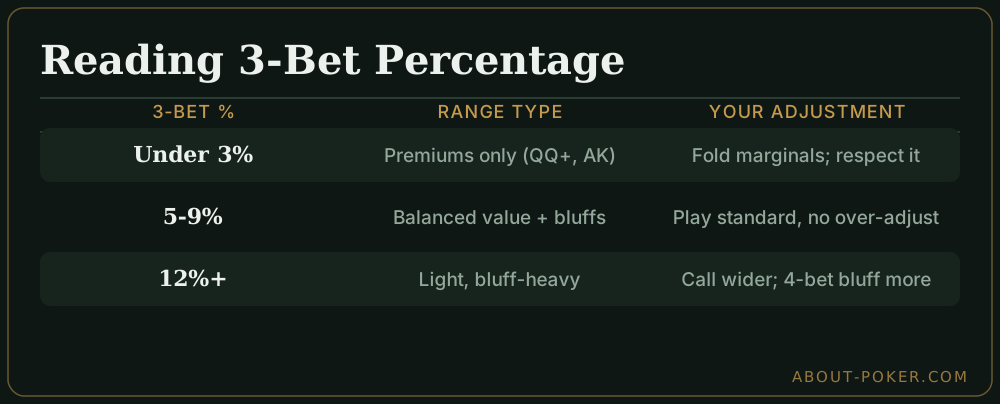
For a solid tight-aggressive six-max cash player, a 3-bet around 5 to 9 percent is normal and balanced. That range blends value hands like QQ+ and AK with a measured number of bluffs such as suited connectors and suited aces used as blockers.
- Under 3 percent: the player only re-raises premiums. When they 3-bet, fold your marginal hands and continue only with strong holdings.
- 5 to 9 percent: balanced. Play a standard 4-bet-or-fold-or-call strategy and do not over-adjust.
- 12 percent and up: a light, aggressive 3-bettor. You can flat wider in position, 4-bet bluff more, and stop folding hands like AJ and KQ that beat a big chunk of their re-raising range.
A worked example
You open KQo from the cutoff. The button, whose HUD shows a 4 percent 3-bet over 800 hands, makes it three bets. That 4 percent screams a value-heavy range: think QQ+, AK, maybe AQ. Against that, KQo is a clear fold. It is dominated by AQ and AK and behind every pair. Calling to “see a flop” just donates.
Now swap the button for a player showing a 14 percent 3-bet. Fourteen percent cannot be all premiums, so it is stuffed with bluffs and thin value. Against that player, calling KQo in position or even 4-bet bluffing becomes reasonable, because your hand crushes the bottom of their range and blocks some of their AK and AQ combos.
How position changes the read
3-bet percentage should be read against the position the player is 3-betting from, because HUDs let you split the stat by seat. A 6 percent overall 3-bet might hide a 3 percent number from early position and a 10 percent number from the blinds. Blind 3-bets are wider by design because the blinds face steal attempts and re-raise to avoid playing out of position. So a blind 3-bet is less scary than the same frequency from under the gun. Sample size matters here too. A positional 3-bet split needs a few thousand hands before you trust it; over 200 hands, treat the number as a loose hint. Our guide on how to read and use a poker HUD covers sample-size discipline in more detail.
Common mistakes reading the stat
The biggest error is reacting to a single 3-bet as if it defines the player. One re-raise is noise. Wait for the stat to stabilize. The second mistake is folding too much to high 3-bettors: if someone shows 14 percent, folding everything but premiums means you surrender pot after pot to a range full of air. The third is confusing 3-bet with 4-bet or with squeeze percentage, which measures re-raising after a raise and one or more callers. They are separate numbers with different strategic meaning.
Quick checklist for using 3-bet percentage
- Confirm the sample is at least a few hundred hands before trusting the number.
- Split by position when you can; blind 3-bets are wider than early-position ones.
- Under 3 percent means value-only; tighten up and respect it.
- Over 12 percent means light; widen your calls and 4-bet bluffs.
- Cross-reference with fold-to-3-bet to know whether your own 3-bets will get through.
Used well, 3-bet percentage lets you profile an opponent’s preflop aggression in seconds and pick the counter-strategy that exploits it. Pair it with the rest of your poker HUD layout and it becomes one of the highest-value reads on the table.
Frequently asked
What is a good 3-bet percentage in poker?
For a balanced six-max cash regular, 5 to 9 percent is standard. Below 3 percent means a player only re-raises premiums, so respect those 3-bets. Above 12 percent signals a light, aggressive 3-bettor you can call or 4-bet wider against.
How is 3-bet percentage calculated?
It is the number of times a player made the first re-raise preflop divided by the number of times they had the opportunity to do so, times 100. Facing an open raise and re-raising counts; calling or folding does not.
Is a higher 3-bet percentage better?
Not automatically. A high 3-bet is profitable only if it applies pressure to hands that fold and is backed by a sound 4-bet-facing plan. Blindly cranking it up against calling stations who never fold just bloats pots with a marginal edge.