What Is Aggression Frequency in Poker?
Aggression frequency measures how often a player bets or raises versus all their postflop actions. Learn what it means and how it differs from aggression factor.
On this page · 7 sections
Aggression frequency is the HUD stat that measures how often a player takes an aggressive action, betting or raising, out of all the times they took a non-checking action after the flop. Expressed as a percentage, it captures a player’s postflop style on an intuitive scale from zero to one hundred. It answers a simple, powerful question: when this player does something other than check, how likely is that something to be a bet or a raise rather than a call?
What the stat measures
Aggression frequency is calculated as bets plus raises, divided by bets plus raises plus calls, times 100. Checks and folds are excluded from the denominator, which is the whole point: the stat isolates a player’s disposition once they are actively in a betting decision. If a player made 30 aggressive actions and 20 calls over a stretch, their aggression frequency is 30 divided by 50, or 60 percent.
The stat sits in the postflop group alongside aggression factor and check-raise, all covered in our poker HUD stats explained reference. Many players prefer aggression frequency to aggression factor precisely because its capped percentage scale is easier to interpret at a glance.
Aggression frequency versus aggression factor
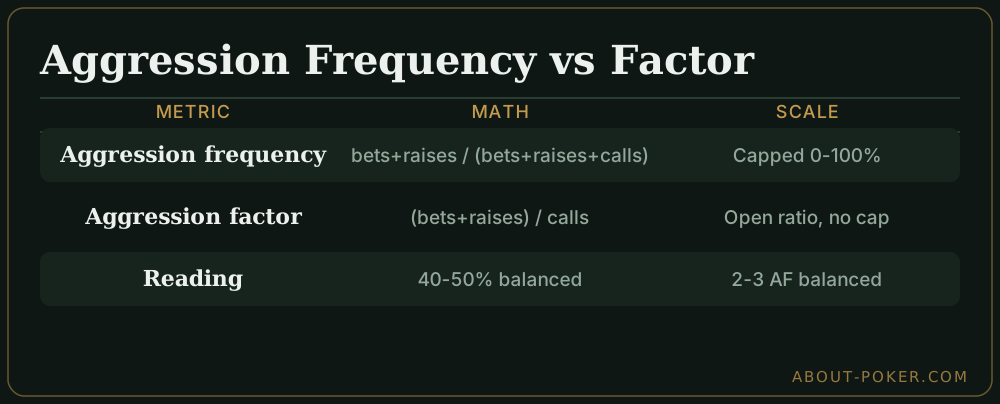
Both stats describe postflop aggression, but the math differs. Aggression factor is a raw ratio of bets and raises to calls, so a player who bets 30 times and calls only 3 times has an aggression factor of 10, a big and slightly abstract number. Aggression frequency converts the same behavior into a bounded percentage that never exceeds 100. That makes it easier to compare players and easier to reason about. A 50 percent aggression frequency simply means half of this player’s active decisions are aggressive. You can read more about the ratio version and the rest of the core set in poker HUD stats explained.
What a good number looks like
- Under 30 percent: passive. Most of this player’s active decisions are calls, so their bets and raises carry real strength.
- 40 to 50 percent: balanced. A healthy mix of value bets, bluffs, and calls.
- Over 60 percent: very aggressive, often over-bluffing. When they bet, a large chunk of the range is air, so you can call and raise lighter.
A worked example
You hold second pair on a J-8-3 board. The turn is an offsuit 2, and your opponent, whose aggression frequency reads 63 percent over a solid sample, fires a big bet. That 63 percent tells you this player bets far more than they call, which mathematically forces bluffs into their betting range; there simply are not enough value hands to justify betting that often. So your second pair, which beats their missed draws and floats, becomes a reasonable call rather than an easy fold.
Now swap in an opponent showing 26 percent aggression frequency. That player mostly calls and rarely bets, so a big turn bet from them is heavily weighted toward value. Against them, the same second pair drifts toward a fold, because their aggression is honest.
How to read it in context
Aggression frequency is most useful combined with a few other numbers. Pair it with VPIP and PFR to know whether the player is loose or tight overall, and with fold-to-c-bet to understand both sides of their game. A player can have a high aggression frequency but a narrow overall range, which means their aggression is concentrated on strong hands. Context, not the single number, drives the decision. The layout principles in how to read and use a poker HUD explain how to combine stats without overloading yourself.
Common mistakes
The first mistake is treating aggression frequency and aggression factor as interchangeable; they use different math and different scales, and quoting one as the other leads to bad reads. The second is trusting the stat on a thin sample. Postflop actions accumulate more slowly than preflop ones, so give it a few hundred hands. The third is over-folding to high-frequency bettors; the reason the stat is high is that they bet too much, which means you should call more, not less.
Quick checklist
- Confirm a real postflop sample before trusting the number.
- Under 30 percent means passive; give their bets credit.
- Over 60 percent means bluff-heavy; call and raise lighter.
- Do not confuse frequency (a capped percentage) with factor (an open ratio).
- Combine with VPIP, PFR, and fold-to-c-bet for the full picture.
Read as part of a complete poker HUD layout, aggression frequency gives you a clean, intuitive gauge of how much of an opponent’s betting is real, and how much you should be willing to call down.
Frequently asked
What is a good aggression frequency in poker?
A balanced postflop player shows an aggression frequency around 40 to 50 percent, meaning nearly half of their non-checking actions are bets or raises rather than calls. Below 30 percent is passive, and above 60 percent signals a very aggressive, often over-bluffing player.
What is the difference between aggression frequency and aggression factor?
Aggression frequency is a percentage of aggressive actions out of aggressive plus passive actions, so it is capped at 100 percent. Aggression factor is a ratio of bets and raises to calls, which can climb without limit. Frequency is often easier to read because the scale is intuitive.
How do I use aggression frequency at the table?
Use it to gauge how much of an opponent's betting is bluff versus value. A high aggression frequency means you can call and check-raise lighter because they bet too much. A low one means their bets are usually real, so give them more credit.