What Is Check-Raise Percentage in Poker?
Check-raise percentage measures how often a player check-raises the flop. Learn what the stat reveals about aggression and how to respond to frequent check-raisers.
On this page · 6 sections
Check-raise percentage is the HUD stat that measures how often a player checks and then raises after their opponent bets. It is most commonly tracked on the flop, where check-raising is a core weapon for the out-of-position player who wants to fight back against continuation bets. The stat reveals a player’s postflop aggression from the check-first line and directly shapes how comfortably you can bet when the action checks to you.
What the stat measures
Check-raise percentage is calculated as the number of times a player checked and then raised after facing a bet, divided by the number of times they checked and faced a bet, times 100. The two conditions are that the player checked first and then, after an opponent bet, raised rather than called or folded. A check-call or a check-fold does not count. Trackers usually default this stat to the flop, but you can find separate turn and river versions in more detailed layouts.
This is a postflop aggression stat, so it lives alongside aggression factor and fold-to-c-bet in the family covered by our advanced HUD stats: steal and postflop guide.
What a good check-raise percentage looks like
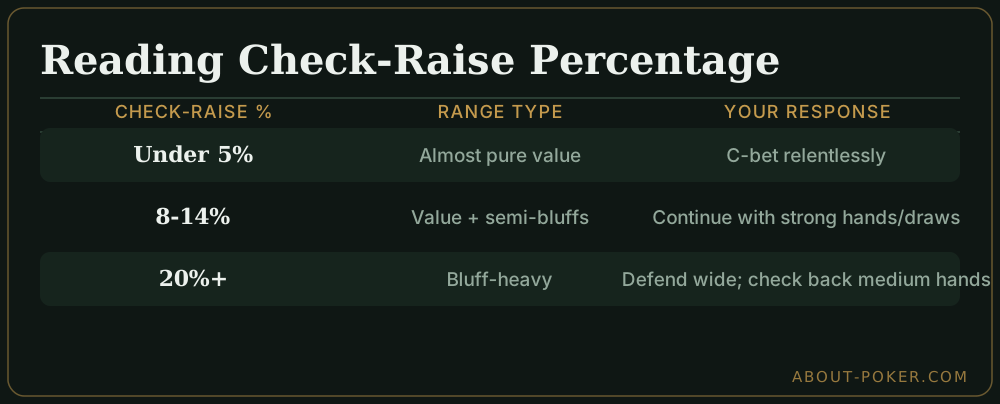
- Under 5 percent: too passive. This player almost never fights back, so you can continuation bet relentlessly and expect it to work.
- 8 to 14 percent: balanced. The check-raise range blends value hands like sets and two pair with semi-bluffs like flush and straight draws.
- Over 20 percent: aggressive, often too light. When the range gets this wide it is stuffed with bluffs and weak draws, so you should defend more against the raise.
A worked example
You raise pre-flop with A-Q and get one caller in the big blind. The flop comes Q-8-4 with two hearts, giving you top pair top kicker. You continuation bet, and the big blind check-raises. Their HUD shows a 24 percent flop check-raise over a good sample. Twenty-four percent is far too high to be all value, so their range here is heavy on flush draws, straight draws, and lighter pairs, with only a small slice of sets and two pair.
Against that read, folding top pair top kicker would be a serious error. A-Q is ahead of most of their range, blocks some of their Qx value, and holds up against the many draws. The correct play is usually to call and reevaluate on the turn, or in some spots re-raise for value and protection. If instead the player’s check-raise were 5 percent, that tiny number would be almost pure value, and you would tread far more carefully with one pair.
How texture and position shift the read
Check-raise frequency should be interpreted against board texture. On dry, static boards, a check-raise is more polarized toward value because there are fewer draws to bluff with, so it deserves more respect. On wet, dynamic boards full of draws, a check-raise is more often a semi-bluff and you can continue wider. Position matters too: this stat is by definition an out-of-position action, and a player who check-raises a lot is trying to seize initiative they gave up preflop. Cross-referencing with fold-to-c-bet, part of the poker HUD stats explained core set, tells you whether their whole defensive game is passive folding or active raising.
Common mistakes
The biggest mistake is folding good hands to a high check-raiser. When the frequency climbs past 20 percent, the range is bluff-heavy and over-folding hands your opponent to a large pot. The second mistake is continuation betting mechanically into a big check-raiser; against them you should check back more medium hands to avoid getting blown off equity. The third is ignoring sample size. Flop check-raises are a specific sequence that accumulates slowly, so a number over a couple hundred faced spots is far more reliable than one over thirty.
Quick checklist
- Confirm a real sample before trusting an extreme number.
- Under 5 percent means passive; c-bet freely and often.
- Over 20 percent means light; defend wider and check back medium hands.
- Weight check-raises on dry boards as value, wet boards as semi-bluffs.
- Cross-reference fold-to-c-bet to profile their full defensive style.
Read together with the rest of your display as described in how to read and use a poker HUD, check-raise percentage tells you exactly how much resistance to expect when you fire into an out-of-position opponent, and lets you size your aggression to match.
Frequently asked
What is a good check-raise percentage on the flop?
A balanced out-of-position player check-raises the flop somewhere around 8 to 14 percent of the time they face a continuation bet. Under 5 percent is too passive and lets opponents c-bet freely; over 20 percent usually means the player check-raises too light.
How is check-raise percentage calculated?
It is the number of times a player checked and then raised after facing a bet, divided by the number of times they checked and faced a bet, times 100. It is normally measured on the flop but can be tracked for later streets too.
How do I play against a high check-raiser?
Against someone who check-raises over 20 percent, tighten your continuation betting on boards that favor their range, check back more of your medium hands, and be willing to continue against their raise with strong draws and top pair because their range is bluff-heavy.