What Is River Bet Percentage in Poker?
River bet percentage is a HUD stat showing how often a player bets on the final street. Learn what it means, typical values, and how to exploit it.
On this page · 7 sections
River bet percentage is a heads-up display (HUD) stat that measures how often a player bets on the final street when given the chance. Of all the postflop betting stats, this one is arguably the most revealing, because the river is where balance breaks down. There are no more cards to come, ranges are fully defined, and the biggest bets go in. A player’s river betting behavior exposes whether they understand value, bluffing, and pressure — or whether they are leaving money on the table every hand.
What river bet percentage measures
The stat counts how often a player makes a bet on the river out of the times they had the opportunity to. Good tracking software breaks it down by line: river bet after betting the turn (a triple-barrel frequency), river bet after the turn checked through, and river bet as the preflop raiser versus caller. Each line means something different, so read the specific breakout your HUD shows rather than a single blended number.
Because river spots are relatively rare compared to preflop actions — many hands end before the river — this stat needs a sizable sample to be reliable. A river bet percentage over a couple hundred hands can swing wildly; give it a few thousand hands before you lean on it heavily.
Typical river bet percentage values
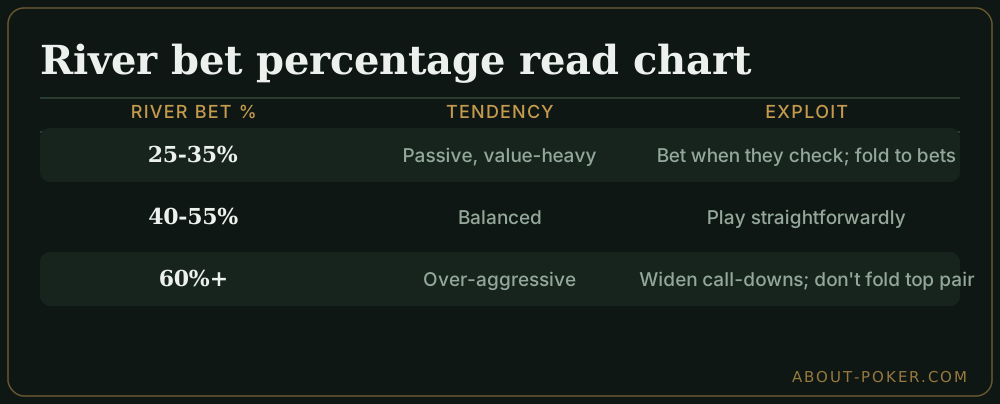
For the common line of betting the river after having bet the turn:
- 25 to 35 percent: Passive on the river. This player gives up with most missed draws and only bets when they have it. Their bets are value-heavy.
- 40 to 55 percent: A balanced, competent regular mixing value bets and bluffs at a reasonable rate.
- 60 percent and up: Over-aggressive. They are either bluffing too much or barreling thin value into a range that can call. You can call down lighter against them.
Why the river reveals skill
On the river, the math is unforgiving. To bluff profitably you need your opponent to fold often enough, and to value bet thin you need worse hands to call often enough. A skilled player balances these so opponents cannot exploit them. Weaker players fall into two camps: the passive player who checks back every busted draw, and the maniac who fires the river with any hand that missed. River bet percentage sorts opponents into these camps at a glance, which is why it is a cornerstone of the advanced postflop stats panel.
A worked example
You hold Kh Kd on a board of Qs 8c 4d 2h. You raised preflop and bet the flop and turn; your opponent called both. The river is the 7s. Your opponent’s HUD shows a river bet-after-turn-check-through of only 22 percent, meaning when checked to on the river they rarely bet without a strong hand.
You have an overpair but a marginal one on this runout. If you check, a passive player will check behind most of their range and only bet their strong made hands. So you can check-call comfortably: their river bets are so value-heavy that folding to a bet loses little, and checking lets you capture value from the many missed draws that would fold to your bet anyway. Against a player with a 60 percent river bet in the same spot, you would instead bet for thin value yourself, because their range is wide enough to call with worse. The stat flips your entire decision. This is precisely how you turn HUD numbers into money at the tables.
How to exploit river bet tendencies
- Against low river bettors: Their checks mean weakness, so bet into them when they check to steal the pot. When they do bet, over-fold marginal hands — their betting range is almost all value.
- Against high river bettors: Their bets are full of bluffs and thin value. Widen your calling range and let them barrel into your bluff-catchers. Do not fold top pair to a river shove from a known over-bettor.
- Against balanced river bettors: Play straightforwardly and look for other, more exploitable stats instead.
Common mistakes
The first mistake is reading a blended river bet percentage without the line breakdown; betting the river after three streets of aggression means something completely different from stabbing at a checked-down pot. The second is trusting a tiny sample — river spots are scarce, so demand thousands of hands. The third is ignoring board texture: a player’s overall river bet number is an average across all textures, and their actual frequency shifts on wet versus dry runouts. Always combine river bet percentage with fold-to-river-bet and the rest of the core HUD stats to see both sides of their river game.
Quick checklist
- River bet percentage measures how often a player bets the final street.
- Read the specific line breakdown, not a blended number.
- 40 to 55 percent (after betting the turn) is roughly balanced.
- Low bettors check weakness — bet into them and fold to their bets.
- High bettors over-bluff — call them down wider.
- Demand a large sample before trusting the stat.
Frequently asked
What is a good river bet percentage in poker?
It depends heavily on the exact line, but for a player betting the river after betting the turn, something in the 40 to 55 percent range is typical for a balanced regular. A very low river bet percentage signals a player who gives up with bluffs; a very high one means they over-bluff or thin value bet too much.
Why is the river the most important street for betting stats?
The river is where the money goes in and where balance is hardest to maintain. Ranges are defined, no more cards come, and it is the easiest street to make large, exploitable errors. A player who cannot bet the river correctly leaks value or bluffs into calls, so this stat exposes real skill.
How do I exploit a low river bettor?
If a player rarely bets the river, they are checking back too many missed bluffs and giving up. Bet into them more when they check, because their checking range is weak, and fold marginal hands when they do bet, because their betting range is heavily weighted toward value.